

Gaia overview
Status: Post-operations
Objective
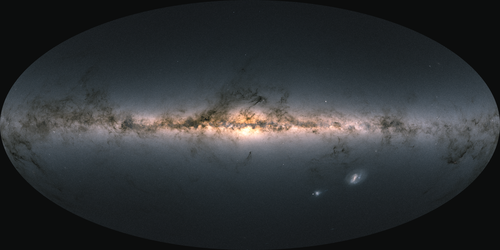
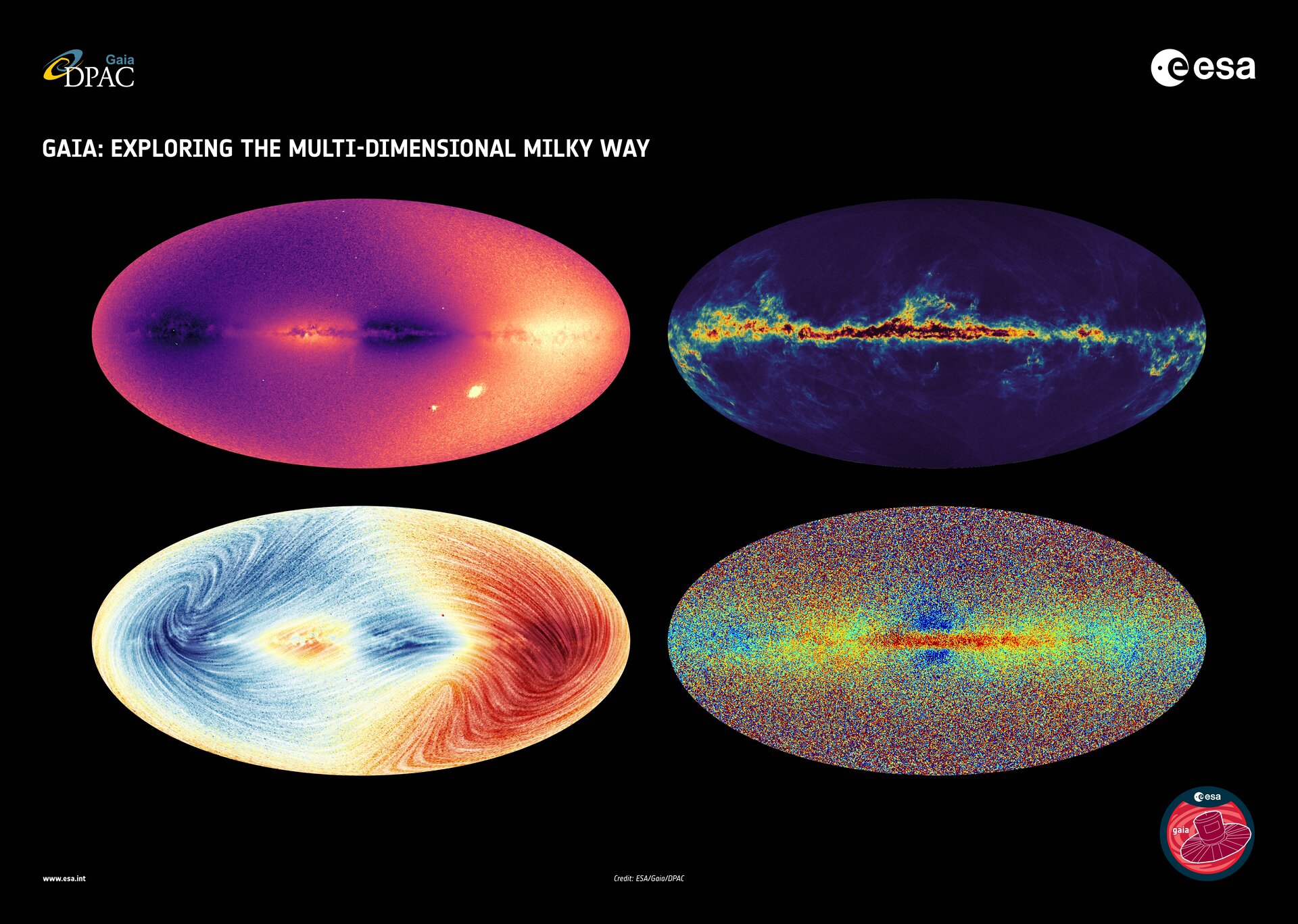
A global space astrometry mission, Gaia built the largest, most precise three-dimensional map of our Galaxy by surveying nearly two billion objects.
Mission
Throughout the course of its mission, Gaia monitored each of its target stars about 14 times per year. It precisely charted their positions, distances, movements, and changes in brightness. It is expected to discover hundreds of thousands of new celestial objects, such as extra-solar planets and brown dwarfs, and observe hundreds of thousands of asteroids within our own Solar System. Gaia also studied more than 1 million distant quasars and provided stringent new tests of Albert Einstein’s General Theory of Relativity.
What's special?
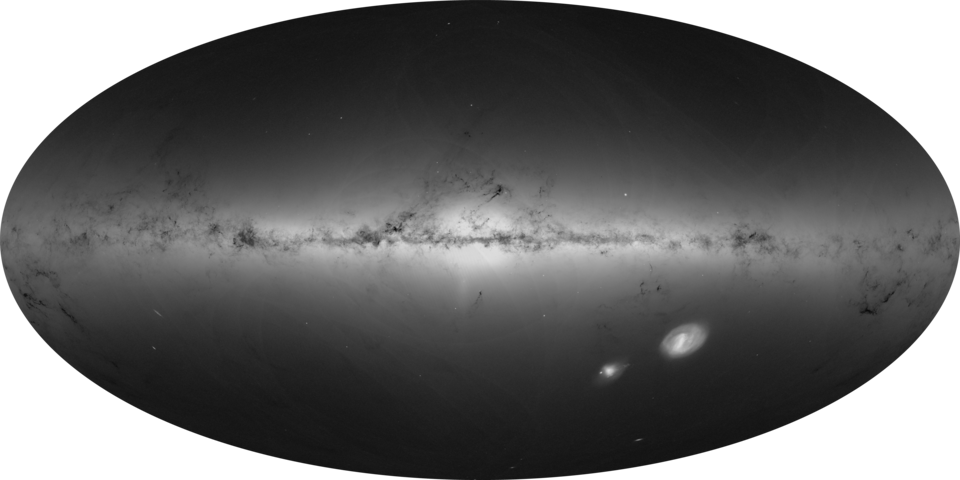
From 27 July 2014 to 15 January 2025, Gaia has made more than three trillion observations of two billion stars and other objects throughout our Milky Way galaxy and beyond, mapping their motions, luminosity, temperature and composition. Gaia's extraordinarily precise three-dimensional map will provide the data needed to tackle an enormous range of important questions related to the origin, structure and evolutionary history of our galaxy.
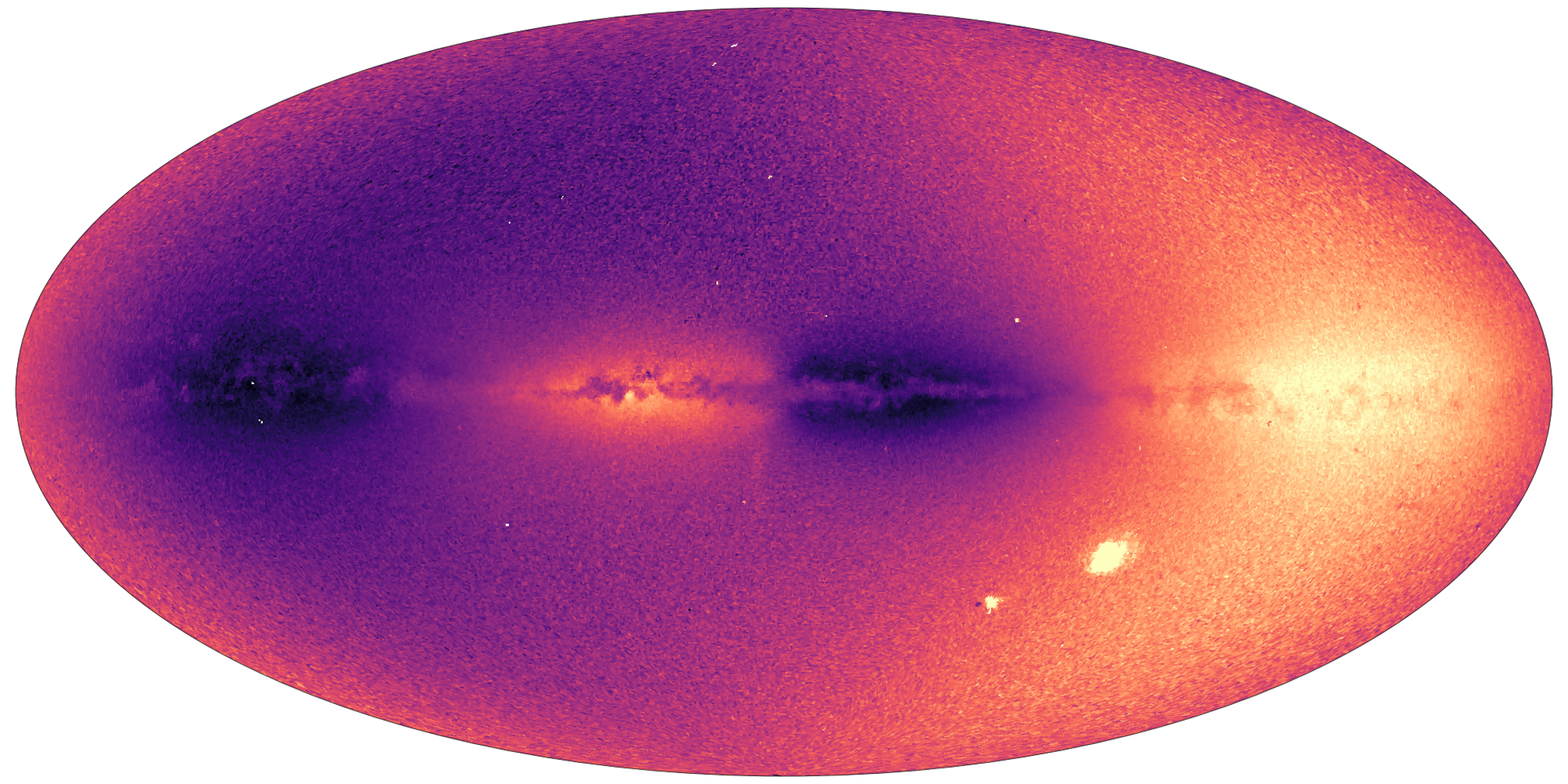
For example, Gaia is identifying which stars are relics from smaller galaxies long ago ‘swallowed’ by the Milky Way. By watching for the large-scale motion of stars in our Galaxy, it is also probing the distribution of dark matter, the invisible substance thought to hold our Galaxy together.
Gaia achieved its goals by repeatedly measuring the positions of all objects down to magnitude 20 (about 400 000 times fainter than can be seen with the naked eye).
For all objects brighter than magnitude 15 (4000 times fainter than the naked eye limit), Gaia measured their positions to an accuracy of 24 microarcseconds. This is comparable to measuring the diameter of a human hair at a distance of 1000 km.
This allowed the nearest stars to have their distances measured to the extraordinary accuracy of 0.001%. Even stars near the Galactic centre, some 30 000 light-years away, will have had their distances measured to within an accuracy of 20%.
The vast catalogue of celestial objects created from Gaia’s scientific haul is not only benefiting studies of our own Solar System and Galaxy, but also the fundamental physics that underpins our entire Universe.
Spacecraft

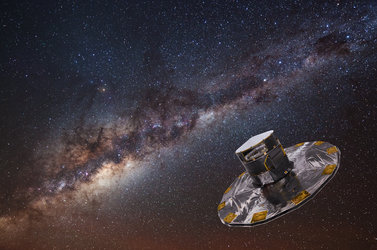
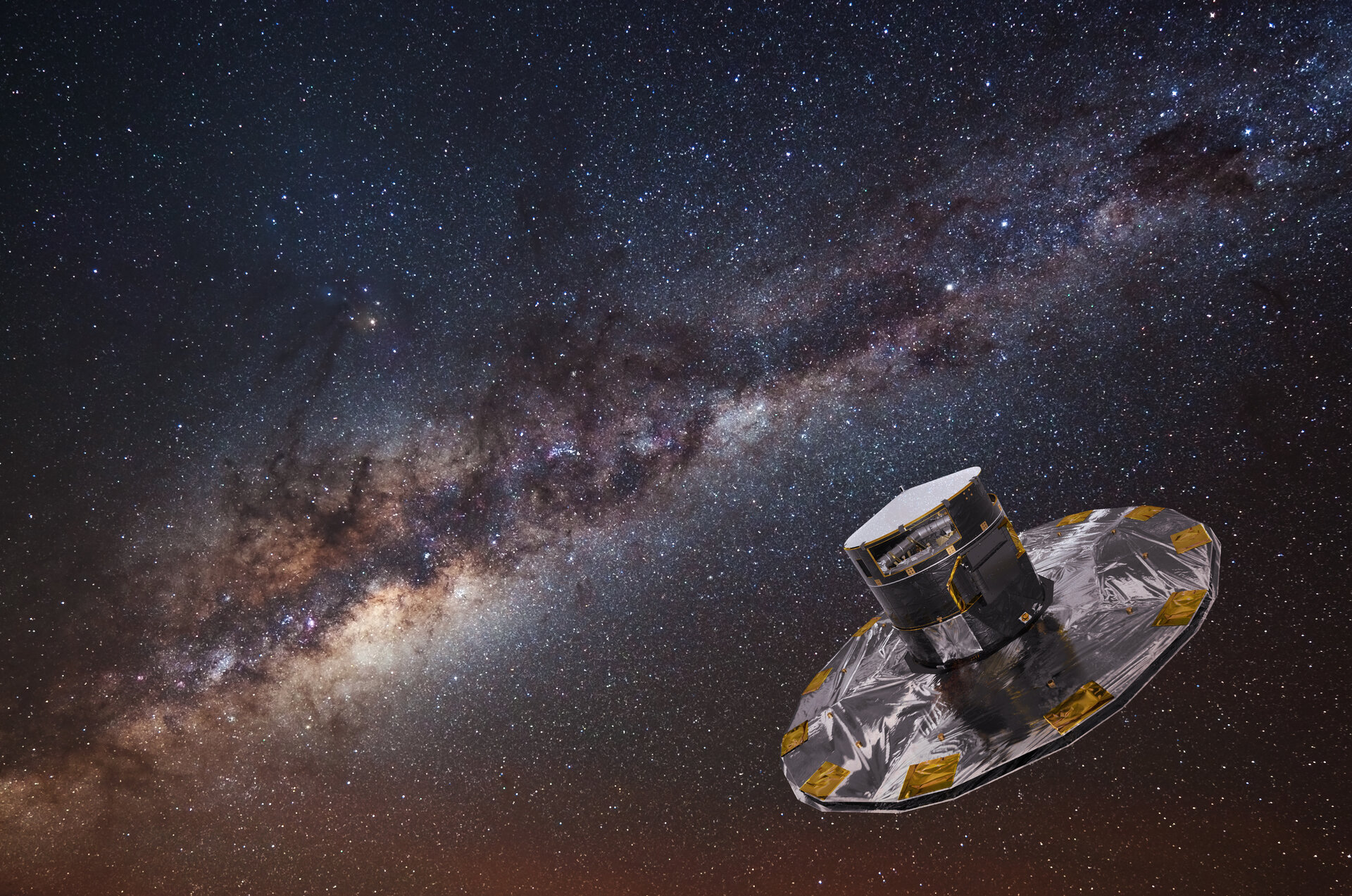
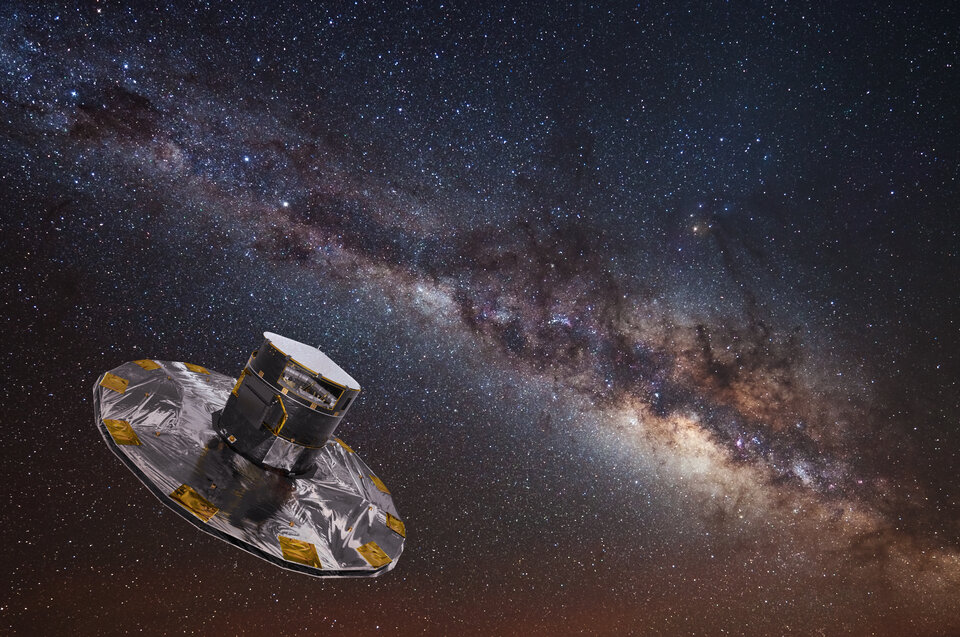
At its heart, Gaia contained two optical telescopes that worked with three science instruments to precisely determine the location of stars and their velocities, and to split their light into a spectrum for analysis.
During its mission, the spacecraft was spinning slowly, sweeping the two telescopes across the entire celestial sphere. As the detectors repeatedly measured the position of each celestial object, they were detecting the object's motion through space as well as changes therein.
Journey

Gaia launched on a Soyuz-STB/Fregat-MT launch vehicle from the European Spaceport in Kourou, French Guiana.
After launch, Gaia unfolded a ‘skirt’ just over 10 m in diameter. This acted as both a sunshade to permanently shade the telescopes and allow their temperatures to drop to below –100°C, and as a power generator for the spacecraft. The underside of the shield was partially covered with solar panels and always faced the Sun, generating electricity to operate the spacecraft and its instruments.
Gaia mapped the stars from an orbit around the Sun, at a distance of 1.5 million km beyond Earth’s orbit. This special location, known as the L2 Lagrangian point, keeps pace with Earth as we orbit the Sun. It offers a clearer view of the cosmos than an orbit around Earth, which would result in the spacecraft passing in and out of Earth's shadow and causing it to heat up and cool down, distorting its view. Free from this restriction and far away from the heat radiated by Earth, L2 provides a much more stable viewpoint.
On 27 March 2025, Gaia’s control team at ESA’s European Space Operations Centre carefully switched off the spacecraft’s subsystems and sent it into a ‘retirement orbit’ around the Sun.
Though the spacecraft’s operations are now over, the scientific exploitation of Gaia’s data has just begun.
History
Gaia has its roots in ESA’s Hipparcos mission (1989-1993), which catalogued more than 100 000 stars to high precision, and more than a million to lesser precision. Gaia catalogues nearly two thousand million stars, measuring each star's position and motion 200 times more accurately than Hipparcos, and produces data for 20 000 times more stars than its predecessor.
The Gaia mission was approved in 2000 as an ESA Cornerstone mission.
The name ‘GAIA’ was originally derived as an acronym for Global Astrometric Interferometer for Astrophysics. This reflected the optical technique of interferometry that was originally planned for use on the spacecraft. However, the working method has now changed, and although the acronym is no longer applicable, the name Gaia remains to provide continuity with the project.
Partnerships

Gaia is a fully European mission.
The spacecraft is controlled from the European Space Operations Centre (ESOC, Darmstadt, Germany) using the three ground stations Cebreros (Spain), Malargüe (Argentina) and New Norcia (Australia). Science operations were conducted from the European Space Astronomy Centre (ESAC, Villafranca, Spain).
The Gaia Data Processing and Analysis Consortium (DPAC) processes the raw data that are published in one of the largest stellar catalogues ever made.