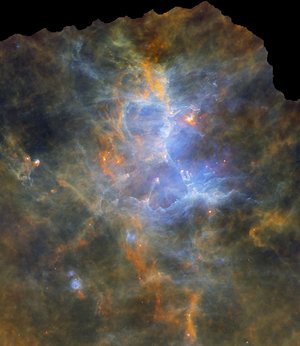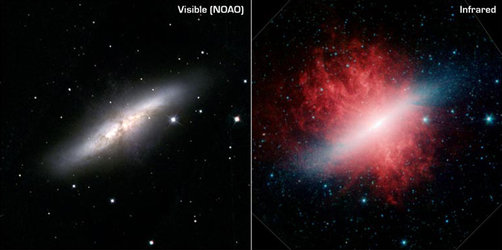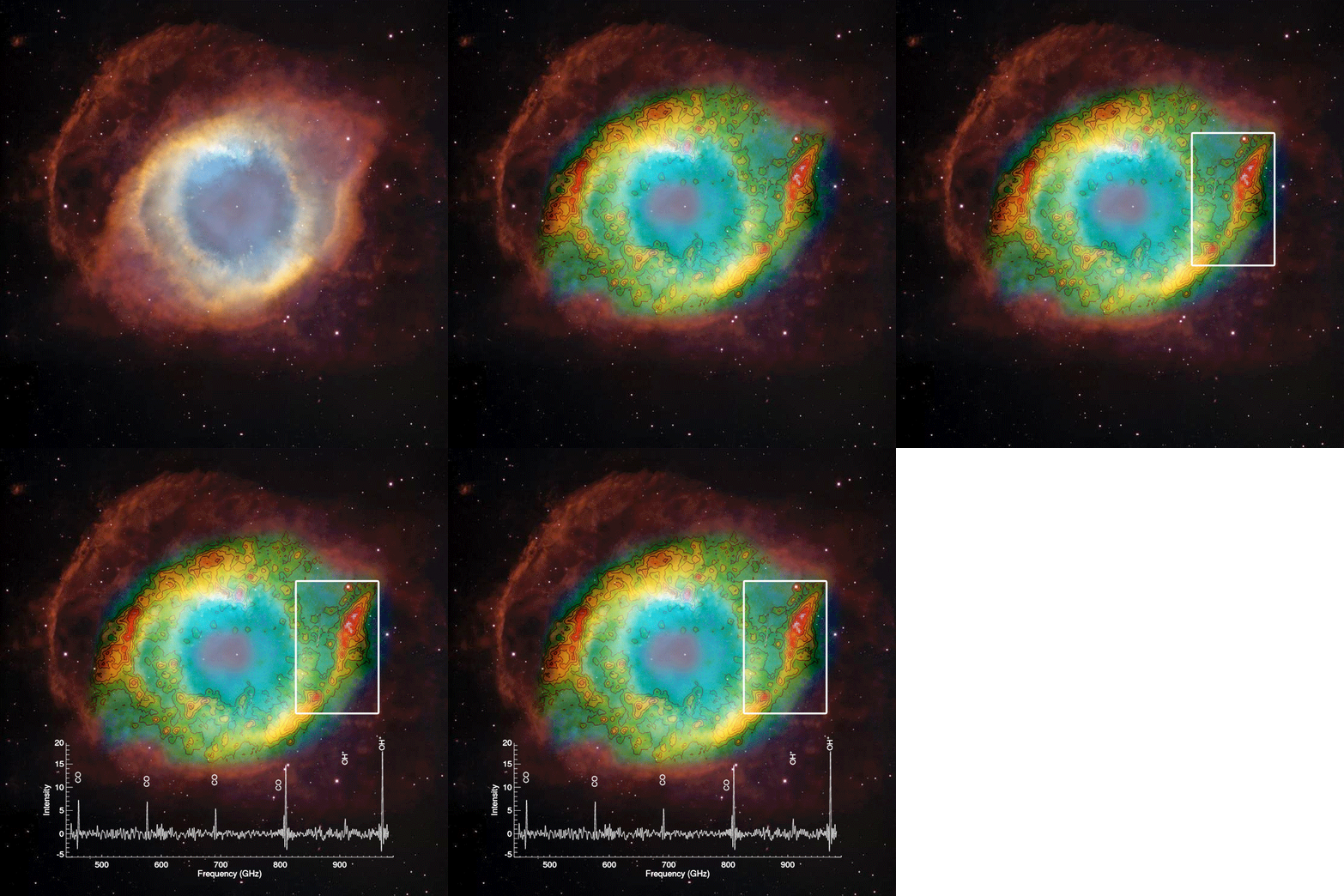
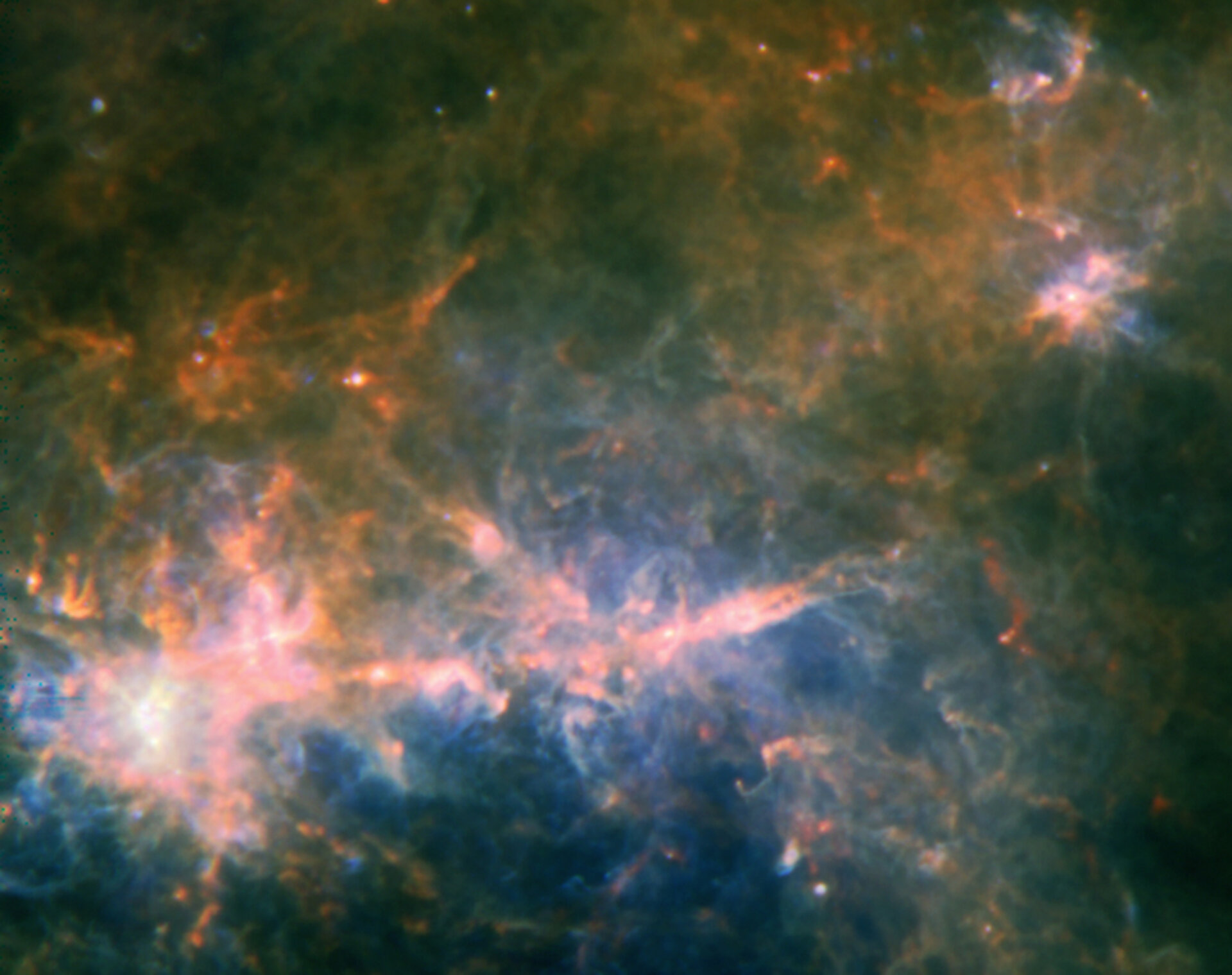


Herschel overview

Name: Hershel
Status: Completed (2013)
Objective: To study cool objects across the Universe and in our Solar System, in particular the formation and evolution of stars and galaxies and their interaction with the interstellar medium.
Mission: Carrying the largest telescope ever flown in space with a main mirror 3.5 m across, Herschel studied the cool Universe at infrared to submillimetre wavelengths. It probed the formation of stars and galaxies across the history of the Universe, and investigated their interaction with the interstellar medium – the dilute matter between stars from which new stars are forming.
Herschel also examined the physical state and chemical composition of asteroids and comets in our own Solar System, seeking out planet formation, and tracing the signature of water from the interstellar matter from which they form all through to the discs around newly forming stars in other stellar systems.
What's special?
The Herschel Space Observatory had the largest telescope ever flown in space with a main mirror 3.5 m across, more than four times larger than any previous infrared space telescope and almost one and a half times larger than that of the Hubble Space Telescope. It was also the first space observatory to extend the observations from the far-infrared into submillimetre wavelengths and bridge the two, exploring further into the far-infrared than any previous mission had done. By tapping these unexploited wavelengths, Herschel could see phenomena beyond the reach of other observatories, and study others at a level of detail that has not been captured before.
Herschel was sensitive to the heat from the small fraction of cold dust mixed in with the clouds of gas in space where stars and planets form, and to signatures from particular substances like water. By imaging such regions, Herschel could point astronomers to dense gas where new stars were forming, and study the action in detail.
The spacecraft carried three advanced science instruments: two cameras and a very high-resolution spectrometer. The detectors in these instruments were cooled to temperatures close to absolute zero by a sophisticated cryogenic system.
Spacecraft
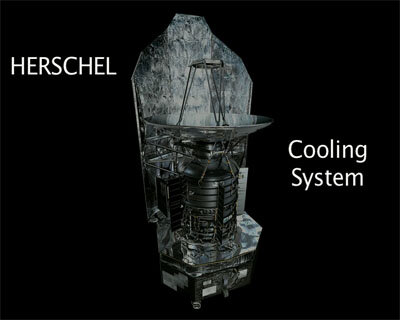
The Herschel Space Observatory was approximately 7.5 m high and 4 m wide, with a launch mass of 3400 kg. The primary mirror was 3.5 m in diameter and accompanied by three science instruments: two cameras and imaging spectrometers – PACS (Photoconductor Array Camera and Spectrometer) and SPIRE (Spectral and Photometric Imaging REceiver) – and a very high-resolution spectrometer, HIFI (Heterodyne Instrument for the Far Infrared). Together, these instruments cover approximately 55–671 microns. The detectors in these instruments were cooled to temperatures close to absolute zero by a sophisticated cryogenic system. Herschel operated autonomously, receiving commands and returning acquired data to Earth in a three-hour communications period every day.
Journey
Herschel was launched on 14 May 2009 on an Ariane 5 from ESA’s Spaceport in Kourou, French Guiana. It had a launch mass of about 3.4 tonne and measured 7.5 m high by 4 m wide.
Herschel was launched along with Planck, ESA’s microwave observatory, which studied the Cosmic Microwave Background. Herschel separated from the Ariane 5 upper stage about 26 minutes after launch; Planck followed a few minutes later. From this point, the two spacecraft operated independently.
Herschel reached its operational orbit about a hundred days after launch. It operated from a largo halo orbit around the second Lagrangian point of the Sun–Earth system (L2), a virtual point located 1.5 million km from Earth in the direction opposite to the Sun. The satellite’s average distance from L2 was 800 000 km.
Hershel's primary ground station was ESA’s deep space antenna in New Norcia, Australia. Herschel operated autonomously, sending acquired data to Earth over a three-hour period every day.
The mission operated until the cryostat ran out of helium, about four years after launch.
History

Herschel was built on the heritage of previous ESA successes in infrared astronomy, starting with the pioneering Infrared Astronomical Satellite (IRAS) in 1983, a joint venture between the Netherlands, United Kingdom and USA that produced the first maps of the entire sky at four infrared wavelengths. This success paved the way for ESA's Infrared Space Observatory (ISO), which operated from 1995-1998. The Japanese-led Akari mission mapped more than 94% of the sky at infrared wavelengths in greater detail than IRAS during 2006-2007. NASA’s infrared mission the Spitzer Space Telescope is also currently in orbit.
Herschel took a giant leap forward in infrared technology while bridging the gap between the wavelengths seen by previous infrared satellites and those studied by radio telescopes on ground.
The telescope was named after the German–British astronomer William Herschel.
Partnerships
Most of Herschel’s observing time was available to the worldwide scientific community through a standard competitive proposal-based time allocation process. A fraction of 32% of the observing time was allotted to the guaranteed time holders, mainly the instrument consortia.