![]() |
| ESA Home |
| Science News Release | |
| SNR 13-2003 | |
| ESA sees stardust storms heading for Solar System 18 August 2003 Until ten years ago, most astronomers did not believe stardust could enter our Solar System. Then ESA's Ulysses spaceprobe discovered minute stardust particles leaking through the Sun's magnetic shield, into the realm of Earth and the other planets. Now, the same spaceprobe has shown that a flood of dusty particles is heading our way.
What is surprising in this new Ulysses discovery is that the amount of stardust has continued to increase even after the solar activity calmed down and the magnetic field resumed its ordered shape in 2001.
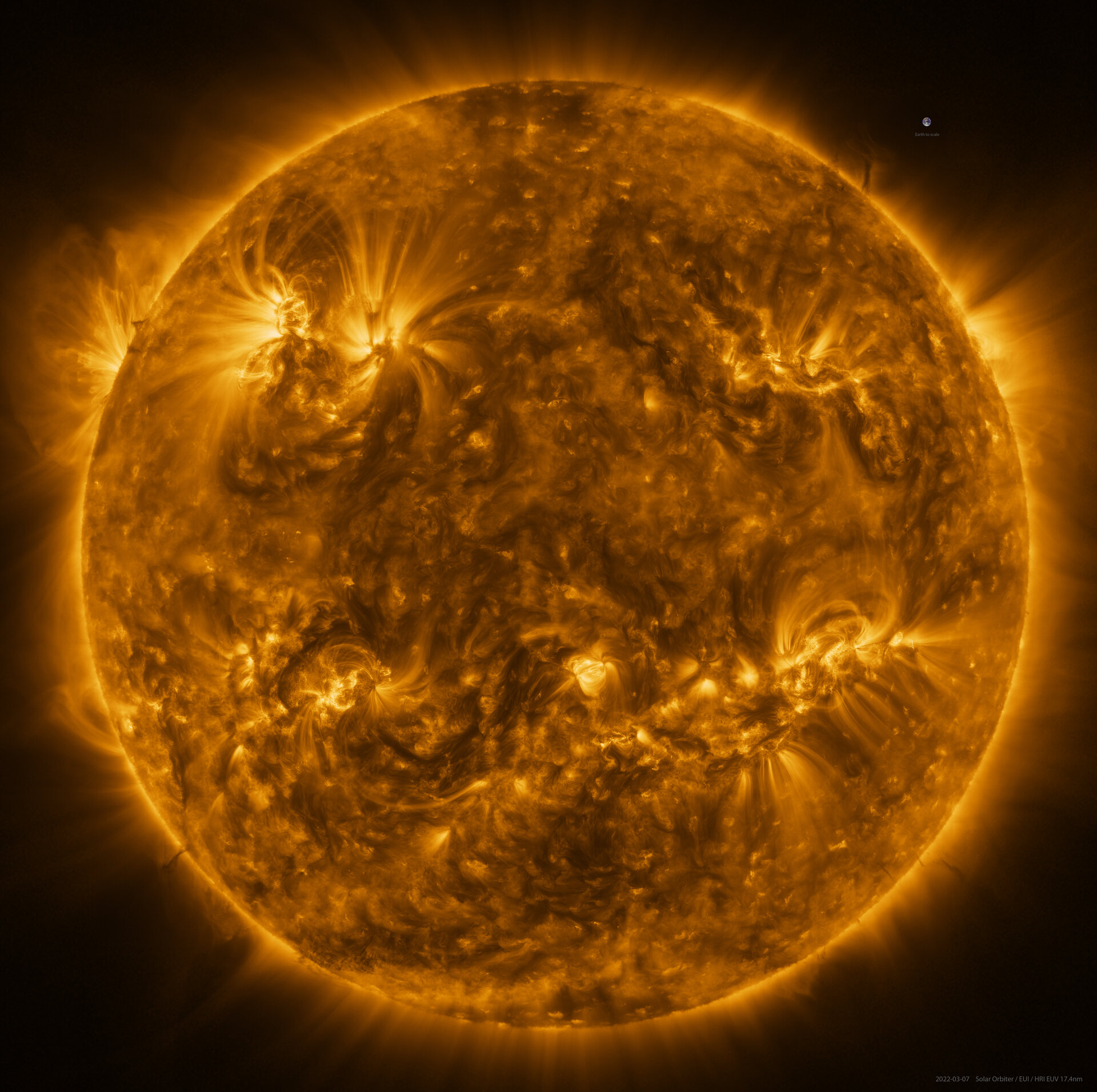
Scientists believe that this is due to the way in which the polarity changed during solar maximum. Instead of reversing completely, flipping north to south, the Sun's magnetic poles have only rotated at halfway and are now more or less lying sideways along the Sun's equator. This weaker configuration of the magnetic shield is letting in two to three times more stardust than at the end of the 1990s. Moreover, this influx could increase by as much as ten times until the end of the current solar cycle in 2012.
On the other hand, this astronomical occurrence could offer a powerful new way to look at the icy comets in the Kuiper Belt region of the outer Solar System. Stardust colliding with them will chip off fragments that can be studied collectively with ESA's forthcoming infrared space telescope, Herschel. This might provide vital insight into a poorly understood region of the Solar System, where the debris from the formation of the planets has accumulated. Back down on Earth, everyone may notice an increase in the number of sporadic meteors that fall from the sky every night. These meteors, however, will be rather faint. Astronomers still do not know whether the current stardust influx, apart from being favoured by the particular configuration of the Sun's magnetic field, is also enhanced by the thickness of the interstellar clouds into which the Solar System is moving. Currently located at the edge of what astronomers call the local interstellar cloud, our Sun is about to join our closest stellar neighbour Alpha Centauri in its cloud, which is less hot but denser.
ESA's Ulysses data make it finally possible to study how stardust is distributed along the path of the Solar System through the local galactic environment. However, as it takes over 70 thousand years to traverse a typical galactic cloud, no abrupt changes are expected in the short term. Ulysses is the first mission to study the environment of space above and below the Sun's poles. It is a joint mission with NASA and has been in space since 1990, after a mission extension agreed in 2000. Launched from the Space Shuttle Discovery in October 1990, Ulysses has now completed two orbits, passing both the Sun's north and south pole on each occasion. Its data gave scientists their first look at the variable effect that the Sun has on the space that surrounds it. The Ulysses DUST experiment provides direct observations of dust grains weighing less than a millionth of a gram in interplanetary space as Ulysses moves along an orbit that takes it periodically away from the Sun and from the plane of the planets - a disc known as the ecliptic. DUST measures the mass, speed, flight direction, and electric charge of individual dust particles.
Astronomers wanted to know what portion of dust is provided by comets and asteroids and what, instead, comes directly from interstellar space. By taking measurements when Ulysses was farthest from the Sun and high above the ecliptic, in regions where cometary dust can hardly reach, scientists were able to detect and isolate particles of stardust entering the Solar System from the outer space. To confirm that these dust grains are indeed of interstellar origin, Landgraf and his collaborators verified that the dust had the same flight direction and speed as the atoms of helium which are known to come exclusively from interstellar space.
ESA Science Programme Communication Service
ESA Media Relations Service | ||||||||||||||||||||||||