Space Science About Space ScienceESA's 'Cosmic Vision'Science & Technology in-depthMultimedia Science imagesScience videosAnimationsDownloadsSounds from spaceMedia centre Press ReleasesPress kitsESA TelevisionResources Reference sectionGlossaryFAQs Science missions Services HelpLegal disclaimerCommentsSubscribeFollow us RSS feeds ESA Sci on Twitter
|  |  |  |  | | | The Ulysses legacy, multimedia 12 June 2008
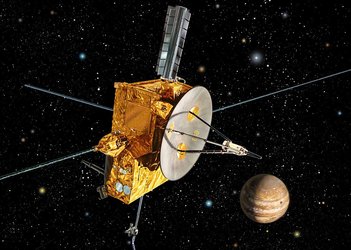
| | | | | | | | | | | | | | | | | | | |  | Over more than 17 years of observations above and below the poles of the Sun, the ESA/NASA Ulysses mission has made fundamental contributions to our understanding of the Sun itself, its sphere of influence (the heliosphere), and our local interstellar neighbourhood. The mission provided the first-ever map of the heliosphere in the four dimensions of space and time.
Ulysses was launched by Space Shuttle Discovery in October 1990. It headed out to Jupiter, arriving in February 1992 for the gravity-assist manoeuvre that swung the craft into its unique solar orbit. It orbited the Sun three times and performed six polar passes. The mission will be declared to have concluded on 1 July 2008 because of the declining capacity of the spacecraft to keep the onboard temperature optimal for functioning.
The design of the Ulysses spacecraft was dictated by the large distances from Earth and the Sun (up to 950 million km from Earth, 810 million km from the Sun).
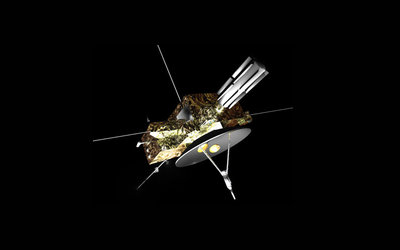
At such distances, solar power could not provide enough electricity so a Radioisotope Thermoelectric Generator (RTG) was provided. A large antenna (1.65-m diameter) was necessary to communicate with Earth from large distances. The thermal design had to accommodate the widely-varying temperatures during the mission. The electronics were hardened to withstand the strong radiation in the vicinity of Jupiter during the close fly-by in 1992.
ESA provided the spacecraft, built by Astrium GmbH, Friedrichshafen, Germany (formerly Dornier Systems). NASA provided the Space Shuttle for launch, the inertial upper stage and the payload assist module to put Ulysses into its correct orbit. NASA also provided the RTG to power the craft and its payload.
ESA’s European Space Research and Technology Centre (ESTEC) and European Space Operations Centre (ESOC) have been managing the mission in coordination with NASA’s Jet Propulsion Laboratory (JPL). Ulysses has been tracked by NASA’s Deep Space Network. A joint ESA/NASA team at JPL has overseen spacecraft operations and data management. Teams from universities and research institutes in Europe and the United States provided the 10 instruments on board.
Credits: ESA (animation by C.Carreau) |  |  |  |  |
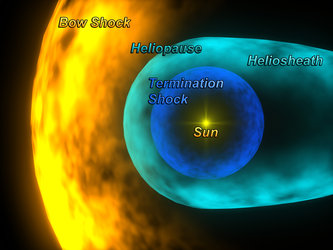
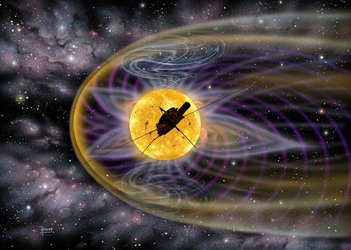
| | | |  | The orbit of Ulysses was chosen so as to chart the heliosphere – the sphere of influence of the Sun carved out by the solar wind that extends beyond the outer fringes of the Solar System - at all solar latitudes.
Ulysses’s orbit is an ellipse with the Sun at one focus (heliocentric), and is inclined 80° with respect to the Sun’s equator (polar). The orbital period is 6.2 years. Maximum distance from the Sun (aphelion) is reached at about 810 million km (or 5.4 AU; one AU or Astronomical Unit equals the average distance between Earth and the Sun, or about 150 million km) and minimum distance (perihelion) is at about 200 million km (or 1.3 AU).
Ulysses was launched on 6 October 1990. It then headed out to Jupiter, arriving on 8 February 1992 for the gravity-assist manoeuvre that swung the craft into its unique solar orbit.
Over more than 17 years of operation, Ulysses orbited the Sun three times and performed six polar passes, during which the spacecraft was above 70° heliospheric latitude in either hemisphere (South pole: June–November 1994, September 2000 – January 2001, November 2006 – April 2007. North pole: June–September 1995, August–December 2001, November 2007 – March 2008).
During its mission, Ulysses has travelled 8.6 thousand million km (or 57.65 AU) at an average speed of 56 000 km/hr.
Credits: ESA (animation by C.Carreau) |  |  |  |  |
| | | |  | The Sun’s magnetic field is known to completely reverse in polarity every 11 years. The ESA/NASA Ulysses mission has discovered that this actually happens much more simply than originally thought: the magnetic dipole, similar to a bar-magnet, simply rotates by 180° to accomplish the reversal, as shown in this animation.
Credits: ESA (eclipse images by Wendy Carlos & Fred Espenak) |  |  |  |  |
| |
|  | Listen to the press conference audioMore about... Ulysses overviewUlysses factsheetUlysses operationsRelated videos The Ulysses legacy (QT player) The Ulysses legacy (WM player)Articles in this release The Ulysses legacySun to set on Ulysses solar mission on 1 JulyUlysses: the science legacyUlysses: the engineering challengeMultimedia The Ulysses legacy, in picturesFor the media Joint ESA and NASA statement (pdf)Ulysses factsheet (pdf)PresentationsRelated articles Joint ESA/NASA team wins international awardUlysses mission coming to a natural endIn depth Ulysses in-depthRelated links NASA's Ulysses web site
|