ESAHome
   
Space Science
About Space ScienceESA's 'Cosmic Vision'Science & Technology in-depth
Multimedia
Science imagesScience videosAnimationsDownloadsSounds from space
Media centre
Press ReleasesPress kitsESA Television
Resources
Reference sectionGlossaryFAQs
Science missions
Services
HelpLegal disclaimerCommentsSubscribe
Follow us
RSS feedsESA Sci on Twitter


Bookmark and Share


Article Images
Mars: how low can you go?
 
8 October 2010

Download:
 HI-RES JPEG (Size: 1205 kb)  HI-RES TIFF (Size: 54 216 kb)
To the left of the image is Melas Chasma, a part of the huge Valles Marineris rift valley, which stretches for more than 4000 km across the face of Mars. Melas Chasma itself sinks 9 km below the surrounding plains, on the right of the image, making it one of the lowest depressions on Mars. This image covers 200 x 100 km and covers an area of roughly 20 000 sq km, which is about the size of Slovenia.

Credits: ESA/DLR/FU Berlin (G. Neukum)
 
 
Download:
 HI-RES JPEG (Size: 584 kb)  HI-RES TIFF (Size: 2859 kb)
On 1 July 2006, the High-Resolution Stereo Camera on ESA’s Mars Express spacecraft obtained images of Melas Chasma at approximately 10°S/290°E. The data were acquired during orbit 3195 and the resolution of the image is approximately 23 m per pixel.

Credits: NASA MGS MOLA Science Team
 
 
Download:
 HI-RES JPEG (Size: 969 kb)  HI-RES TIFF (Size: 48 504 kb)
Melas Chasma is part of the huge Valles Marineris rift valley, which stretches for more than 4000 km across the face of Mars. Melas Chasma itself sinks 9 km below the surrounding surface, making it one of the lowest depressions on Mars. This image was created using a Digital Terrain Model (DTM) obtained from the High Resolution Stereo Camera on ESA’s Mars Express spacecraft. Elevation data from the DTM are colour-coded: purple indicates the lowest-lying regions, and beige the highest elevations. The scale is in metres.

Credits: ESA/DLR/FU Berlin (G. Neukum)
 
 
Download:
 HI-RES JPEG (Size: 1342 kb)  HI-RES TIFF (Size: 20 583 kb)
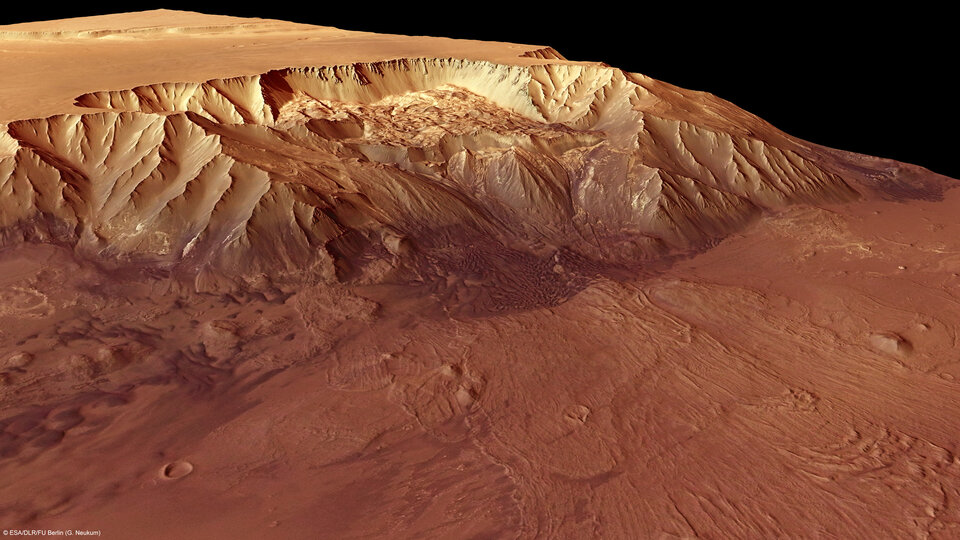
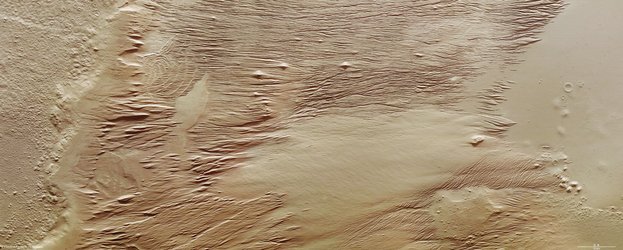
Melas Chasma is part of the huge Valles Marineris rift valley on Mars. Melas Chasma itself sinks 9 km below the surrounding surface, making it one of the lowest depressions on the planet. Landslides have created huge fans of rubble at the base of the cliff.

Credits: ESA/DLR/FU Berlin (G. Neukum)
 
 
Download:
 HI-RES JPEG (Size: 1312 kb)  HI-RES TIFF (Size: 20 915 kb)
Melas Chasma is part of the huge Valles Marineris rift valley on Mars. Melas Chasma itself sinks 9 km below the surrounding surface, making it one of the lowest depressions on the planet. The flow patterns in the canyon floor show that it must once have been covered by liquid water or water ice.

Credits: ESA/DLR/FU Berlin (G. Neukum)
 
 
Download:
 HI-RES JPEG (Size: 757 kb)  HI-RES TIFF (Size: 14 278 kb)
Melas Chasma shows evidence of multiple large-scale landslides that have created vast fan shapes of material (box 1). The smoother surface seen further into the basin display flow textures indicating that they were once deposited by liquid water, water ice or mud (box 2). Levees of sediment can also been seen here. On the high plateau at the top of the cliff, a few ancient valleys have been preserved (box 3). The orientation of the largest one is parallel to the edge of the cliff, which may indicate that the valley originally followed an old fault line. Light-coloured deposits are present in the basin and at elevated locations on the flank (box 4). These are sulphates, which could have formed in an ancient lake.

Credits: ESA/DLR/FU Berlin (G. Neukum)
 
 
Download:
 HI-RES JPEG (Size: 748 kb)  HI-RES TIFF (Size: 14 327 kb)
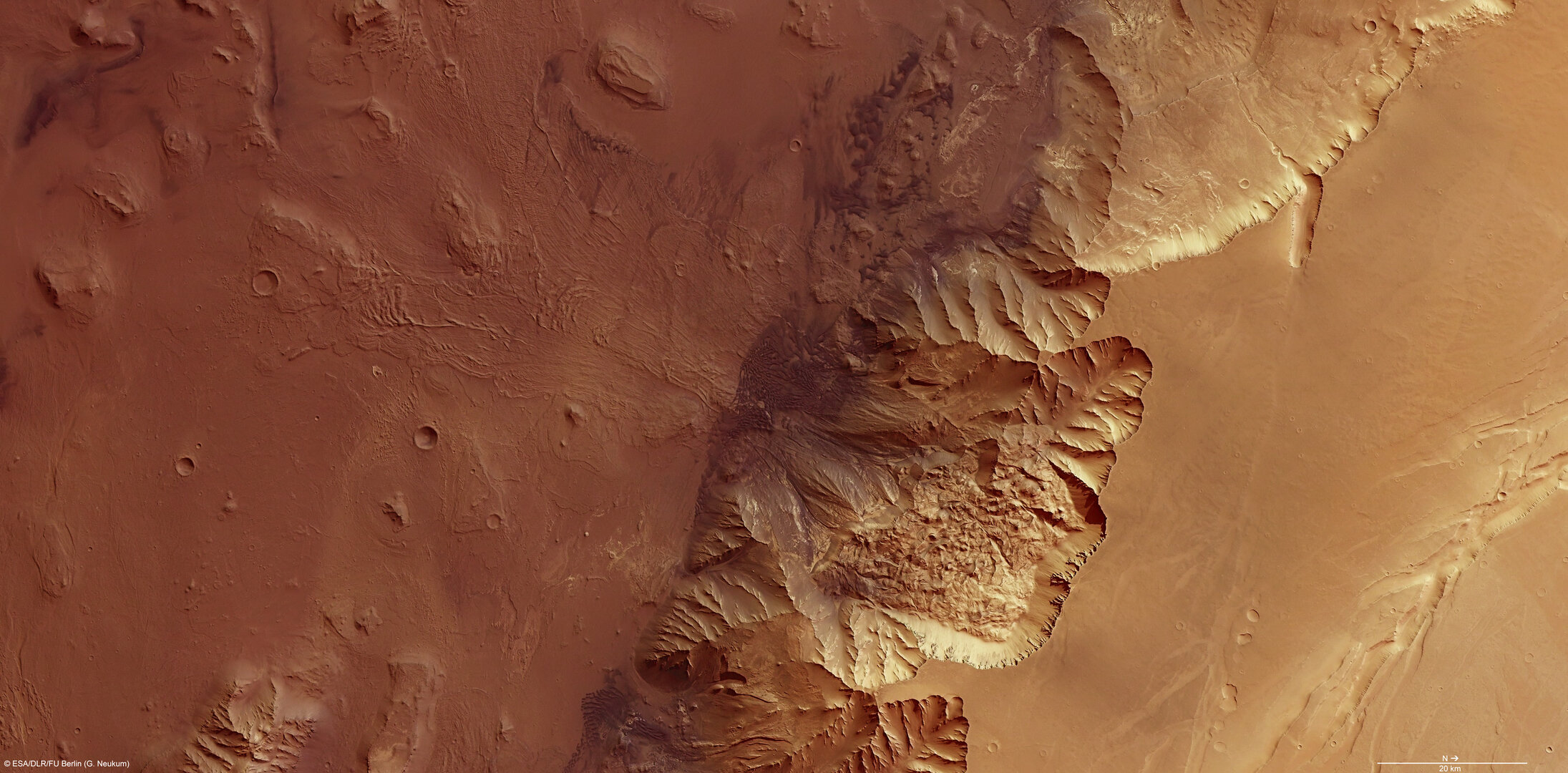
Melas Chasma is part of the huge Valles Marineris rift valley on Mars. Melas Chasma itself sinks 9 km below the surrounding surface, making it one of the lowest depressions on the planet. On 1 July 2006, the High-Resolution Stereo Camera on ESA’s Mars Express spacecraft obtained images of Melas Chasma at approximately 10°S/290°E. The data were acquired during orbit 3195 and this image was derived from the HRSC nadir channel, which provides the highest detail of all the channels.

Credits: ESA/DLR/FU Berlin (G. Neukum)
 
 
Download:
 HI-RES JPEG (Size: 1143 kb)  HI-RES TIFF (Size: 42 781 kb)
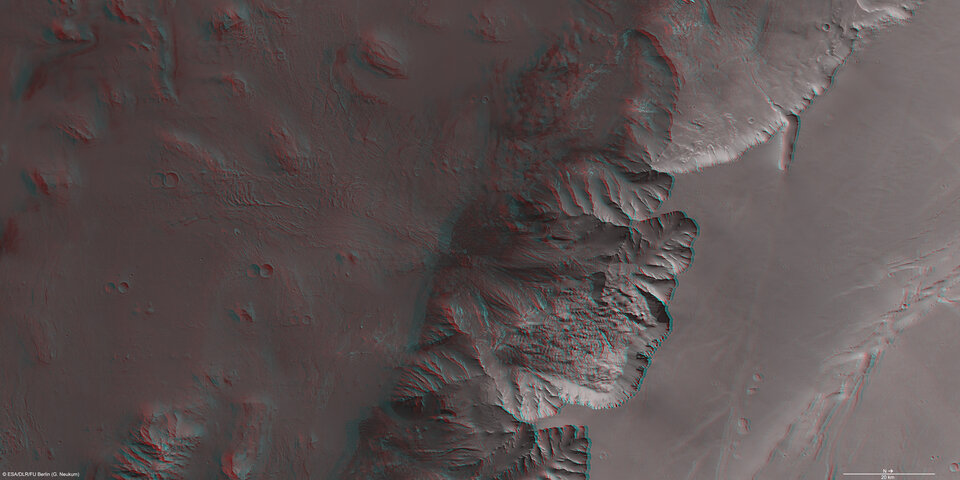
Melas Chasma is part of the huge Valles Marineris rift valley on Mars. Melas Chasma itself sinks 9 km below the surrounding surface, making it one of the lowest depressions on the planet. On 1 July 2006, the High Resolution Stereo Camera on ESA’s Mars Express spacecraft obtained images of Melas Chasma at approximately 10°S/290°E. The data were acquired during orbit 3195 and the resolution of the image is approximately 23 m per pixel. Combining data from the nadir channel and one stereo channel of HRSC produced this 3D image. Stereoscopic glasses are required to see the 3D effect. This image covers 200 x 100 km and covers an area of roughly 20 000 sq km, which is about the size of Slovenia.

Credits: ESA/DLR/FU Berlin (G. Neukum)
 
 
Mars Express image browser
Mars Express on YouTube
Traces of Martian life
Related articles
Mars Express close flybys of martian moon PhobosWind and water have shaped Schiaparelli on MarsLight and dark in the Phoenix LakeMars’s mysterious elongated craterRocky mounds and a plateau on MarsWet era on early Mars was globalVolcanic ash in Meridiani PlanumCraters young and old in Sirenum FossaeCraters, lava flows and tectonic features near Ma'adim VallisCraters and channels in Hephaestus FossaeChaotic terrain in Ariadnes CollesIce-covered martian North PoleThe Euminedes Dorsum mountains on MarsLava deposits in Mangala Fossae
Related links
High Resolution Stereo CameraBehind the lens...Frequently asked questions
For specialists
ESA Planetary Science archive (PSA)NASA Planetary Data SystemHRSC data viewer


   Copyright 2000 - 2012 © European Space Agency. All rights reserved.