![]() |
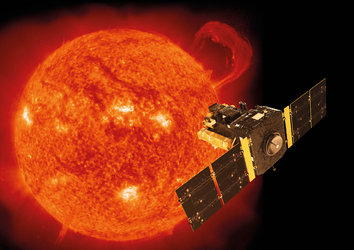
SOHO factsheet Staring at the Sun Name SOHO stands for SOlar Heliospheric Observatory. Description SOHO, the Solar and Heliospheric Observatory, is a project of international cooperation between ESA and NASA to study the Sun, from its deep core to the outer corona, and the solar wind. Together with ESA’s Cluster mission, SOHO is studying the Sun-Earth interaction from different perspectives. SOHO’s easily accessible, spectacular data and basic science results have captured the imagination of the space science community and the general public alike.
SOHO is a joint ESA-NASA project.
Objectives SOHO was designed to answer the following three fundamental scientific questions about the Sun:
Science highlights to date SOHO has provided an unprecedented breadth and depth of information about the Sun, from its interior, through the hot and dynamic atmosphere, to the solar wind and its interaction with the interstellar medium. These findings have been documented in an impressive, still growing body of scientific and popular literature. Some of the key results include:
Cost About a thousand million Euros. These costs have been spread between ESA and its member states, and NASA. Launch SOHO was launched by NASA on an Atlas II-AS rocket (AC-121) from the Cape Canaveral Air Station (Florida, United States) on 2 December 1995.
Orbit
SOHO moves around the Sun in step with the Earth, by slowly orbiting around the First Lagrangian Point (L1), where the combined gravity of the Earth and Sun keep SOHO in an orbit locked to the Earth-Sun line. The L1 point is approximately 1.5 million kilometres away from Earth (about four times the distance of the Moon), in the direction of the Sun. There, SOHO enjoys an uninterrupted view of our daylight star.
Mission lifetime SOHO was designed for a nominal mission lifetime of two years. Because of its spectacular successes, the mission was extended five times (in 1997, 2002, 2006, 2008, and 2010). This allowed SOHO to cover an entire 11-year solar cycle (#23) and the rise of the new cycle 24. SOHO is currently approved through the end of 2012.
Control of the spacecraft was lost in June 1998, and only restored three months later through efforts of the SOHO recovery team. All 12 instruments were still us-able, most with no ill effects. Two of the three on-board gyroscopes failed immediately and a third in December 1998. After that, new on-board software that no longer relies on gyroscopes was installed in February 1999. It allowed the spacecraft to return to full scientific operations, while providing an even greater margin of safety for spacecraft operations. This made SOHO the first three-axis stabilised spacecraft operated without gyroscopes, breaking new ground for future spacecraft designs.
Spacecraft Design SOHO is a three-axis stabilised spacecraft that constantly faces the Sun. Its design is based on a modular concept with two main elements: the payload module, housing the 12 instrument packages, and the service module, providing essentials such as thrusters, power and communications. Dimensions Approximately 4.3 × 2.7 × 3.7 metres (9.5 metres with solar arrays deployed). Mass 1850 kilograms at launch. Industrial involvement SOHO was built for ESA by industrial companies in 14 European countries, led by Prime Contractor Matra Marconi (now Astrium). The service module with solar panels, thrusters, attitude control systems, communications and housekeeping functions, was prepared in Toulouse, France. The payload module carrying the scientific instruments was assembled in Portsmouth, United Kingdom, and mated with the service module in Toulouse. During the building and assembly of the spacecraft, several hundred engineers were employed by the project. What's on board? The scientific payload of SOHO comprises 12 complementary instruments, developed and furnished by 12 international consortia involving 29 institutes from 15 countries. Nine consortia are led by European scientists, the remaining three by US scientists. More than 1500 scientists in countries all around the world are either directly involved in SOHO's instruments or have used SOHO data in their research programmes.
Coronal Diagnostic Spectrometer - CDS
Charge, Element, and Isotope Analysis System - CELIAS
Comprehensive Suprathermal and Energetic Particle Analyzer - COSTEP
Extreme ultraviolet Imaging Telescope - EIT
Energetic and Relativistic Nuclei and Electron experiment- ERNE
Global Oscillations at Low Frequencies - GOLF
Large Angle and Spectrometric Coronograph - LASCO
Michelson Doppler Imager/Solar Oscillations Investigation - MDI/SOI
Solar Ultraviolet Measurements of Emitted Radiation - SUMER
Solar Wind Anisotropies - SWAN
UltraViolet Coronograph Spectrometer - UVCS
Variability of Solar Irradiance and Gravity Oscillations - VIRGO
Operations Ground Control and Science Operations: SOHO is operated from NASA’s Goddard Space Flight Center (GSFC) near Washington. There an integrated team of scientists and engineers from NASA, partner industries, research laboratories and universities works under the overall responsibility of ESA. Ground control is provided via NASA’s Deep Space Network antennae, located at Goldstone (California), Canberra (Australia), and Madrid (Spain).
ESA Project Scientist: Bernhard Fleck
Last update: 10 February 2011
| ||||||||||||||||||||||||||||||||||||||||||||||||||||||||