ESAHomeUnderstanding Our PlanetSecuring Our EnvironmentBenefiting Our Economy
   
ESA's Earth observing missions
Services
CalendarSubscribe


Bookmark and Share


Mission Images
ERS overview


MARISS service
Download:
 HI-RES GIF (Size: 131 Kb)
The white dots in the animation are all of the vessels detected by the SAR instrument aboard ERS-2. Green dots represent vessels equipped with a transponder and identified by the Automatic Identification System (AIS). (Green circles represent the vessel location, while green lines represent the track of the vessel). Red dots are unidentified, potentially suspect vessels.

Credits: Telespazio Spa
 
 
3D visualisation of InSAR derived elevation data on Baffin Islan
Download:
 HI-RES JPG (Size: 306 kb)
3D visualisation of InSAR derived elevation data on Baffin Island, Canada. InSAR is a technique of combining two or more Synthetic Aperture Radar (SAR) images of the same site acquired from close to the same position in order to obtain extremely precise information on topography as well as any surface changes occurring between acquisitions.

Credits: Vexcel Canada
 
 
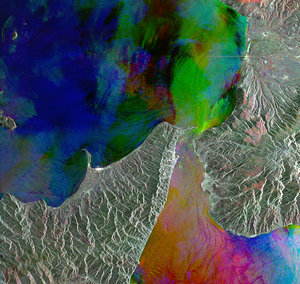
The Strait of Messina, Italy
Download:
 HI-RES JPEG (Size: 7715 kb)  HI-RES TIFF (Size: 34 189 kb)
This multi-colour ERS-2 image shows the Strait of Messina, the narrow section of water separating the Italian Peninsula (seen on the right) from Sicily. It is a composite of three ERS-2 radar images acquired on different dates with different colours assigned to each date: red for 13 February 2002; green for 11 August 2004; blue for 5 May 1999.

Credits: ESA
 
 
ERS-2 composite highlighting tsunami damage
Download:
 HI-RES JPEG (Size: 980 kb)
This view of Little Nicobar Island is part of a multitemporal composite of an ERS-1 SAR radar image acquired 21 December 1992 and ERS-2 image acquired 12 January 2005. The image is used to highlight the massive damage done to the west coasts of the Nicobar Islands during the December 2004 tsunami disaster, seen here in red.

Credits: ESA
 
 
Greenland
Download:
 HI-RES GIF (Size: 751 kb)
This animation of the Greenland results shows the boundaries (thick line) of the ice sheet and major ice divides (thin lines). The colours indicate ice sheet elevation change rate in centimetres per year (see colour scale). These values are derived from 11 years of ERS-1/ERS-2 satellite altimeter data, 1992–2003, excluding some ice-sheet marginal areas (white). The spatially averaged rate is +5.4 cm/year, or ~5 cm/year when corrected for bedrock uplift. The white areas between the colour-coded pixels and the thick line delimiting the ice sheet indicate no observations. Latitude in °N, longitude in °W.
O. M. Johannessen, K. S. Khvorostovsky, M. W. Miles and L. P. Bobylev (2005): Recent ice sheet growth in the interior of Greenland. Science (In Press, and October 20, 2005 issue of Science Express).

Credits: O. M. Johannessen, K. S. Khvorostovsky, M. W. Miles and L. P. Bobylev (2005): Recent ice sheet growth in the interior of Greenland. Science (In Press, and October 20, 2005 issue of Science Express).
 
 
Viewing results from a decade of ERS-2:

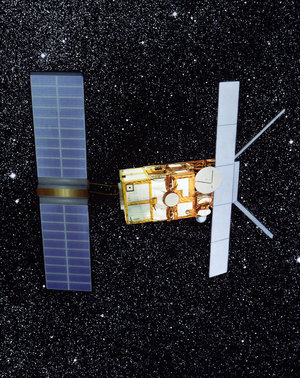
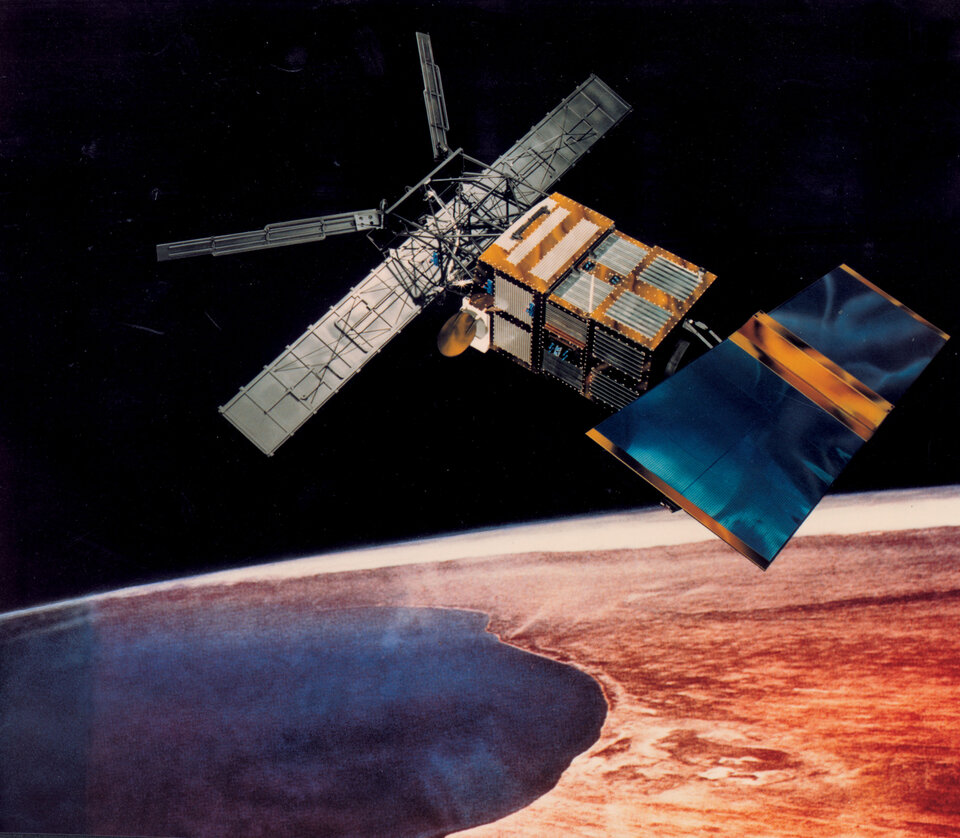
The spacecraft: ERS-2 was launched from French Guiana on an Ariane 4 during 21 April 1995. A successor to ERS-1, it carried one new instrument, the Global Ozone Monitoring Experiment (GOME).

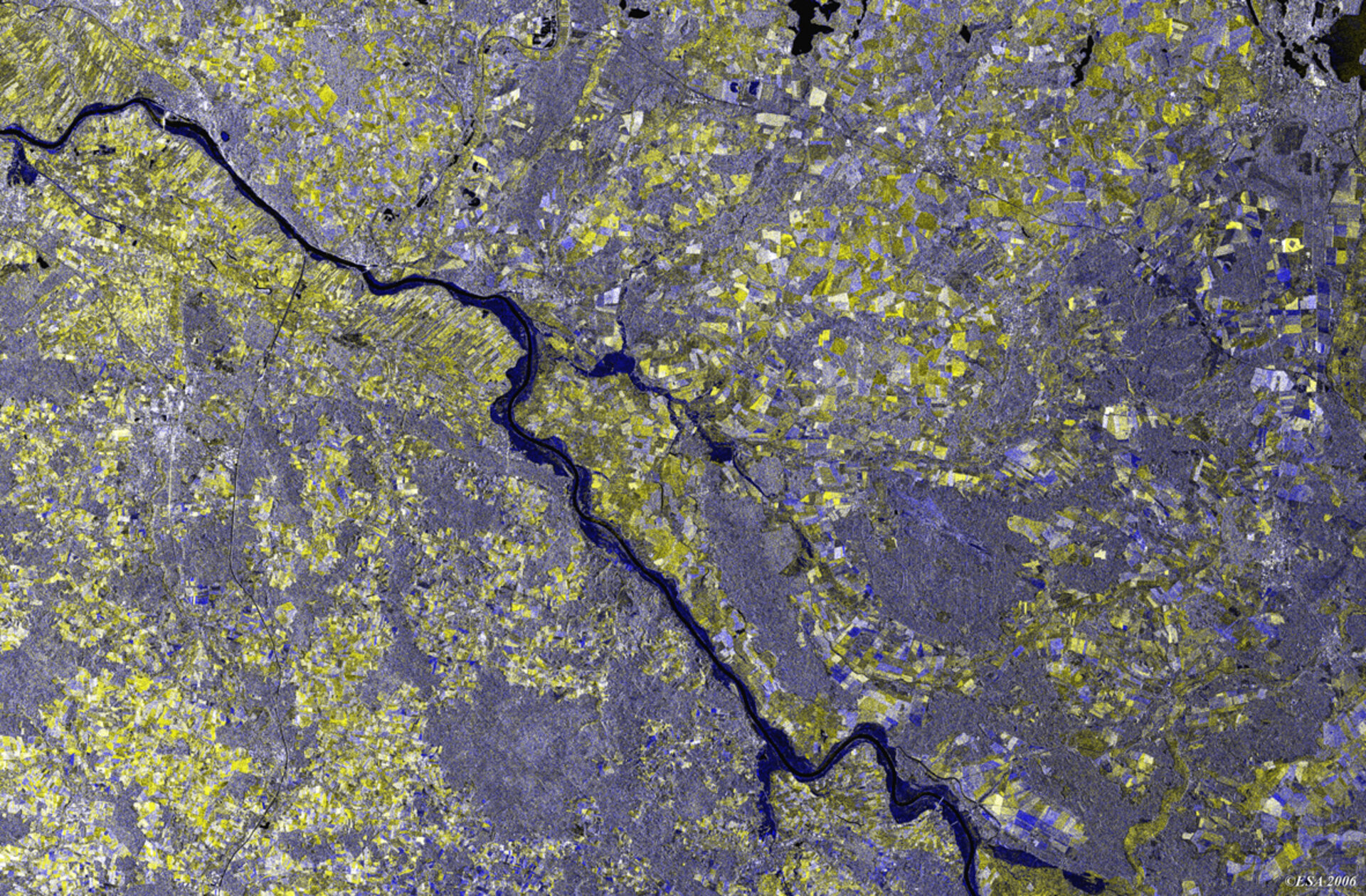
Flood: ERS-2 has often been used in the context of the International Charter on Space and Major Disasters. This ERS-2 SAR image shows the confluence of Elbe and Vltava rivers in the Czech republic, north of Prague. It is a multitemporal composite view combining an ERS-2 image acquired before flooding (07 August 1998) and an ERS-2 image acquired during flooding (16 August 2002).

Scatterometer: ERS-2 carries a C-band scatterometer, capable of measuring ocean surface wind fields even in the fiercest of weathers. On 23 April 2004, around midnight to the west of Ireland, a complex low was developing. The red arrows show near-real time ERS-2 scatterometer wind speeds up to 15 m/s and a cyclonic wind direction. There is a significant improvement on the three-hour forecast (blue arrows) which shows only one cyclonic centre and no shear line.

Rainforest deforestation: Deforestation areas in Rondonia, Brazil, appear in light-coloured linear features of relatively high temperatures, in this thermal image from ERS-2's Along Track Scanning Radiometer (ATSR). Courtesy Leicester University.

Ground stations involved in ERS-2 data acquisition: Since the failure of the satellite's Low Bit Rate onboard recorder in 2003, a growing global network of ground stations has been voluntarily receiving and distributing its data in near-real time.

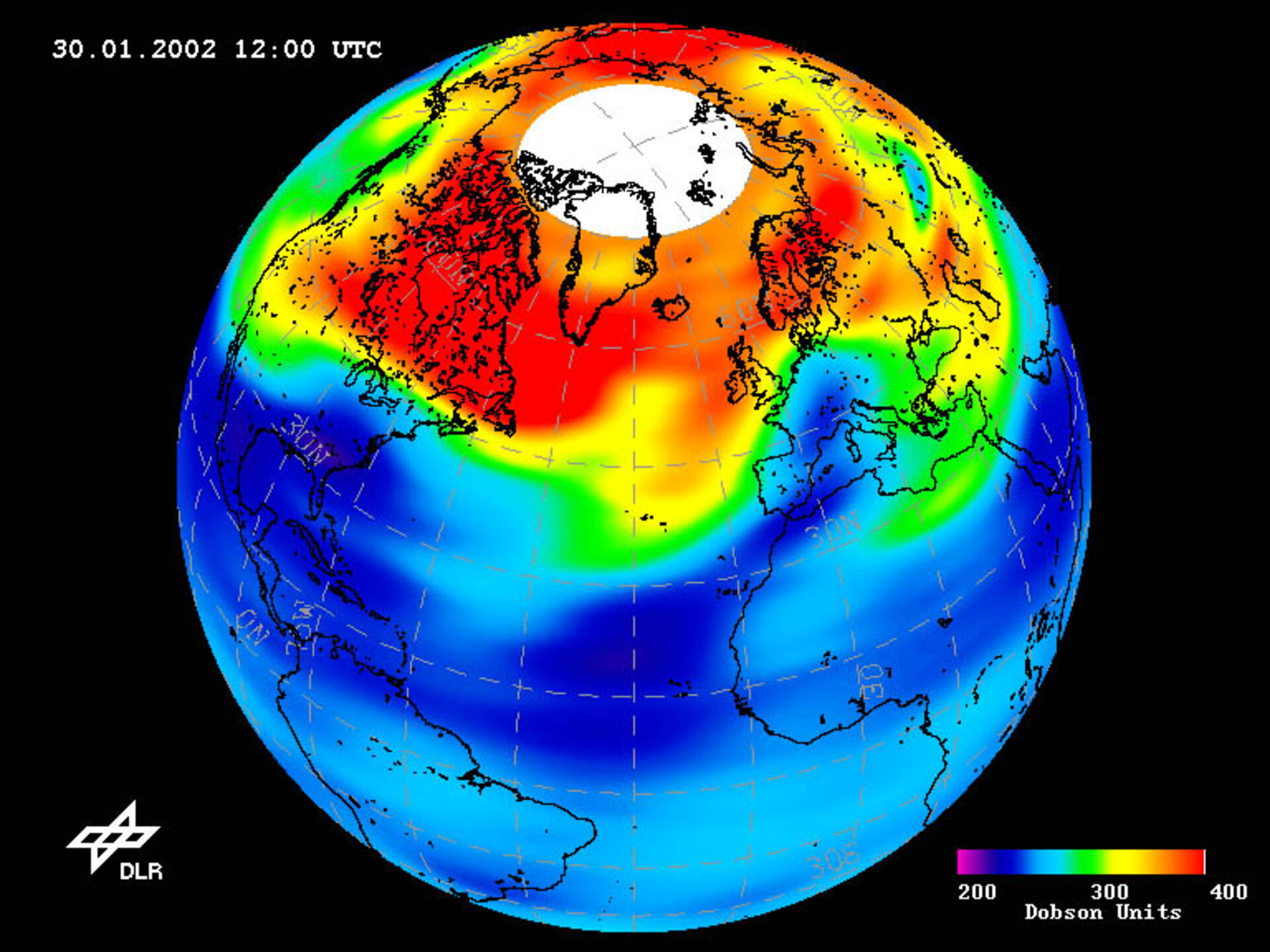
Ozone Monitoring: The GOME instrument on ERS-2 provided the first European trace gas measurements from space, enabling observations of high latitude 'ozone holes' at both latitudes. Because the data are available on a near-real time basis, they can be used to monitor events when low levels of ozone lead to an increase in the risk from the Sun's ultraviolet radiation.

Sea Surface Temperature: ERS-2 Along Track Scanning Radiometer (ATSR) image of the Gulf Stream off the US East Coast. Warmer waters are red, with colder northern waters shown in blue and green.

Ocean Wave Height: ERS-2's SAR sensor in Wave Mode can be used to derive average ocean wave height. In addition raw 'imagettes' are now being used by researchers to detect individual high 'monster' waves.

Land Cover Changes world map: Seasonal variation of vegetation response to ERS-2's scatterometer instrument, supporting climate change studies.

El Nino: The combination of ERS-2's ATSR and Radar Altimeter mapped temperature and height abnormalities arising from the 1997 El Nino event in the Pacific.

Credits: ESA

 
  Last update: 17 August 2011 
 
In depth
ERS technical site


   Copyright 2000 - 2011 © European Space Agency. All rights reserved.