Orion spacecraft orientation
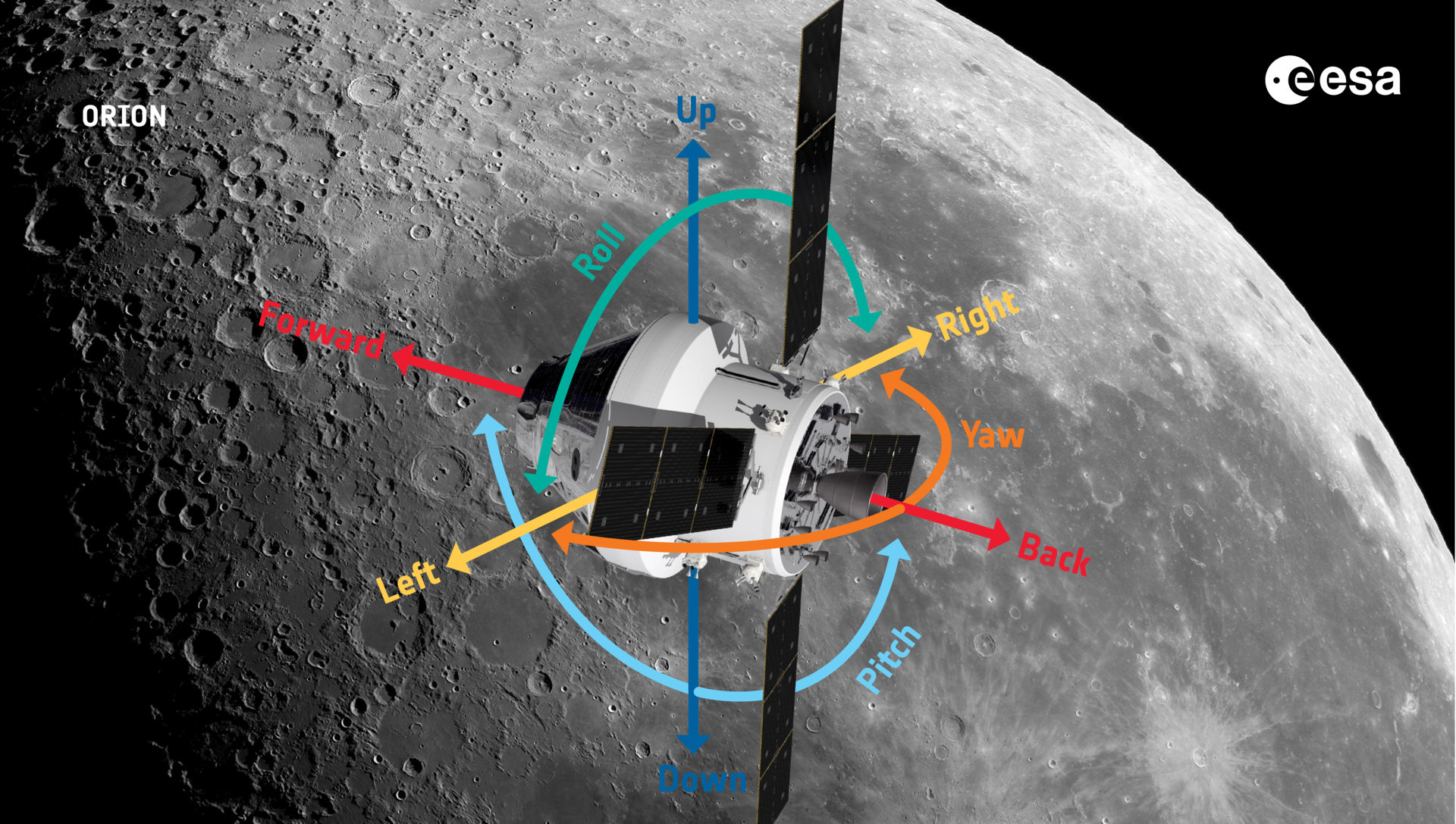
Spacecraft orientation explained on an artist's impression of NASA's Orion spacecraft for Artemis, with the European Service Module. In space you can fly in all dimensions; this illustration shows the terminology used in spacecraft control.
Artemis is a series of missions to propel humankind forward to the Moon and beyond. The Artemis programme aims to establish permanent stations and outposts in orbit around our natural satellite. During the Artemis I test flight, the Orion spacecraft flew without astronauts. NASA provided the rocket and crew capsule, and ESA provided the European Service Module – Orion's 'powerhouse’. For Artemis II, ESA is again providing the European Service Module to power and propel Orion and its crew of four astronauts around the Moon and safely back home.
Orion can fly in a three-degree of freedom attitude control mode, as opposed to the six-degree of freedom mode it typically flies in. Flying in six-degree of freedom mode entails that whenever Orion changes its angle of roll, pitch and yaw, the net result does not change its course through space, only the angle of flight of the spacecraft. In this mode the reaction control system thrusters compensate for any drift that might occur from changing attitude by pushing back and keeping Orion on a steady heading. Mission control tested flying in just three dimensions during the Artemis I mission – so only controlling the roll, pitch and yaw – which uses less fuel and requires less complex calculations. The disadvantage of three dimension of freedom mode is that Orion will inevitably start to drift off its original course, and this will need to be corrected in future burns.