Enabling & Support
Where and why we whizz around Earth
Our understanding of orbits, first established by Johannes Kepler in the 17th century, remains foundational even after 400 years. Today, Europe continues this legacy with a family of rockets launched from Europe’s Spaceport into a wide range of orbits around Earth, the Moon, the Sun and other planetary bodies.
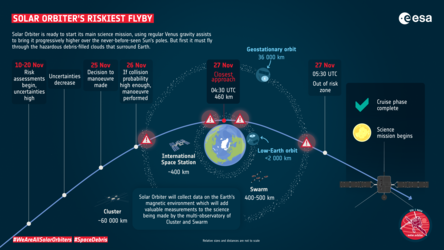
The most commonly used Earth orbits are represented in this infographic. In these space highways, humankind has put its most advanced ears and eyes, travelling thousands of kilometres per second and looking back at Earth, out to the Sun, the Solar System and across deep space.
| Name | Altitude | Benefits | Example |
| Low Earth orbit (LEO) | Below 2000 km | Close-up, high-resolution Earth views – good for Earth observation, weather, climate and telecoms | International Space Station |
| Polar orbit (PO) | 200–1000 km | Polar orbits allow for full coverage of Earth as it rotates beneath, good for Earth observation, positioning satellites | Cryosat |
| Sun synchronous orbit (SSO) | 600–800 km | Fixed position with respect to the Sun, meaning light and shadow are consistent – good for Earth observation and monitoring long-term changes | Copernicus Sentinel constellation |
| Medium Earth orbit (MEO)
|
2000–35786 km | Optimal balance of distance and number of satellites needed for full Earth coverage | Galileo constellation |
| Geostationary transfer orbit (GTO)
|
35 786 km (apogee) | Used to place a satellite into geostationary transfer orbit | Temporary |
| Geostationary orbit (GEO)
|
35 786 km | Satellites follow the same point on Earth – good for changing weather patterns, disaster and climate tracking as well as telecommunications | European Data Relay Service |
| Highly eccentric orbit (HEO)
|
Can extend far from Earth, including comets originating in the Oort cloud | Mostly far from Earth’s radiation and shadow – good for astronomy, telecoms | XMM-Newton |