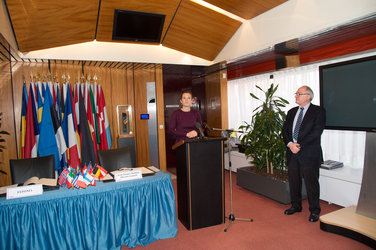
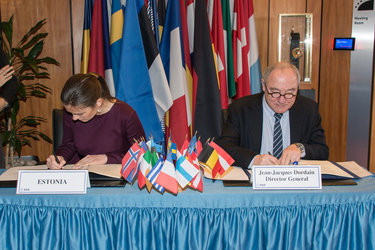
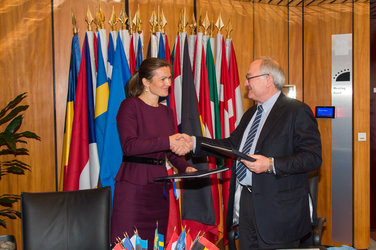
Space Cyber Range contract signing in Tallinn, Estonia
ESA and the Estonian Space Office have set out to develop Europe's newest space cyber range that aims to make space technology more secure and accessible for companies across Europe. Last year, Estonian industry was invited to submit proposals for concepts, and today the contract has been signed with a consortium led by Spaceit to begin development. The contract was signed on 23 January in Tallinn by Laurent Jaffart, ESA’s Director of Connectivity and Secure Communications and Silver Lodi, Management Board Member of Spaceit.
The space cyber range offers a safe and cost-effective way for space companies to test, validate and develop secure satellite technologies and solutions and perform cyber exercises and trainings. A space cyber range is a virtual environment that can be supported with a physical site to promote collaboration and provide necessary data centres, servers and equipment. You can picture it as a sophisticated simulator where companies can create virtual copies of their satellites and systems to check for security weaknesses and practice responding to cyberattacks – all before launching real hardware into orbit.
Building on Estonia's digital leadership
Estonia, already home to NATO's cyber defence centre and recognised as one of the world's most digitally advanced nations, will now extend its expertise to the space sector. The new space cyber range will be established at Foundation CR14, Estonia's national cyber range facility. The project brings together some of Estonia's leading tech companies, with Spaceit leading a consortium that includes CybExer Technologies, CGI Eesti, and the University of Tartu. Unlike existing facilities, this new space cyber range is specifically designed to support NewSpace small and medium-sized enterprises (SMEs).
The two-year project is supported by ESA's Advanced Research in Telecommunications Systems (ARTES) strategic programme line, Space Systems for Safety and Security (4S), with an investment of more than €2.5 million, highlighting the agency's commitment to securing Europe's digital future.
Development will begin immediately, with several organisations having already expressed interest in using the range, including satellite manufacturers and operators, telecom providers, and research institutions from Hungary, Estonia, Italy, Czech Republic and Switzerland.