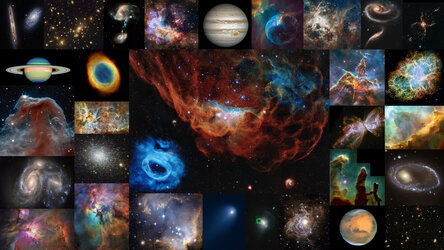
Hubble celebrates 35 years
In celebration of the NASA/ESA Hubble Space Telescope’s 35 years in Earth orbit, an assortment of compelling images have been released today that were recently taken by Hubble. This stretches from the planet Mars (top left) to dramatic images of stellar birth (bottom left) and death (top right), to a magnificent neighbouring galaxy (bottom right). After over three decades of perusing the restless universe, Hubble remains a household word as the most well-recognized telescope in scientific history.
Upper left: The planet Mars as seen in late December 2024. Thin water-ice clouds, revealed by Hubble’s unique ultraviolet capability, give the Red Planet a frosty appearance.
Upper right: Planetary nebula NGC 2899. This moth-like nebula is sculpted by the outflow of radiation and stellar winds from a dying star – a white dwarf – at the center.
Lower left: The Rosette Nebula. This is a small portion of the huge star-forming region. Dark clouds of hydrogen gas laced with dust are silhouetted across the image.
Lower right: The galaxy NGC 5335, which is a flocculent spiral galaxy with patchy streamers of star formation across its disc. A notable bar structure slices across the center of the galaxy.
[Image description: Composite shows four Hubble images in quarters. At top left is a crisp view of Mars in shades of orange, blues, and browns. At top right is planetary nebula NGC 2899, which is shaped like a single macaroni noodle, with its central torus appearing semi-transparent and blue/green, and top and bottom edges in orange. At bottom left is a tiny portion of the Rosette Nebula. Very dark gray material shaped like a V takes up the center. At bottom right is barred spiral galaxy NGC 5335 with a milky yellow center that forms a bar surrounded by multiple blue star-filled spiral that wrap up counterclockwise.]
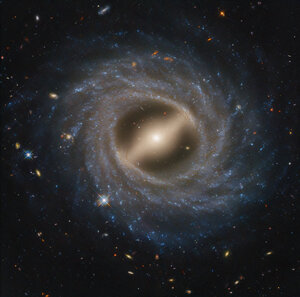
Barred Spiral Galaxy NGC 5335

Hubble's 28th birthday picture: The Lagoon Nebula

Full Trifid Nebula (Rubin Image with Hubble Close-up)

Thirty years of Hubble Space Telescope