

A crumbling crater seen by ESA’s Mars Express
The feature-rich Deuteronilus Cavus depression allows us to explore a range of geological processes across Mars’s complex history.
From channels that once contained flowing water, and glacial-driven activity around its crater walls, to eroded blocks and wind-blown volcanic dust, click the labels to explore the features in more detail.
The image comprises data acquired by Mars Express’s High Resolution Stereo Camera (HRSC) on 25 October 2024 (orbit 26275). The ground resolution is approximately 18 m/pixel and the image is centred at about 36°N/14°E. It was created using data from the nadir channel, the field of view which is aligned perpendicular to the surface of Mars, and the colour channels of HRSC.
[Image description: An irregularly shaped depression takes centre stage in this birds-eye view of a portion of the martian landscape. Evidence of glacial activity is apparent around much of the inner crater walls as rock-covered ice has flowed downslope. At the nine o’clock position a channel with several branches breaches the crater wall; it likely once contained flowing water. At the three o’clock position a rectangular chunk is missing from the crater wall – likely related to water erosion initiating collapse, and later glacial erosion widening it out. The crater floor has various scattered blocks that have resisted erosion. The floor also has a patch of dark material which is likely volcanic dust. Outside of the depression other smaller craters are seen, with wrinkle ridges formed from cooling lava snaking through them in some places.]
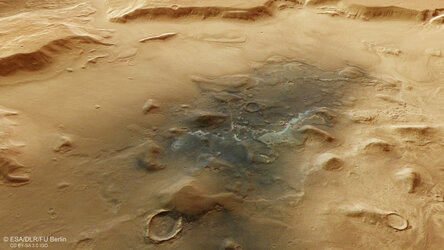
Jumbled blocks and dust on the floor of Deuteronilus Cavus
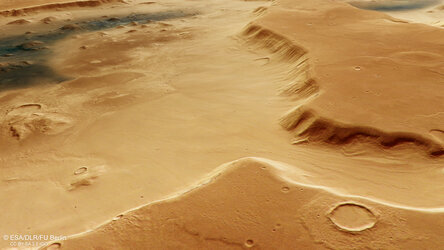
Glacial flow into Deuteronilus Cavus on Mars

Branched channel at Deuteronilus Cavus on Mars
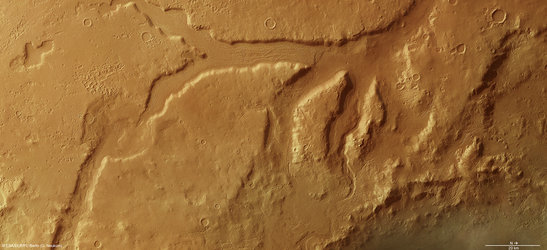
Ismeniae Fossae
