


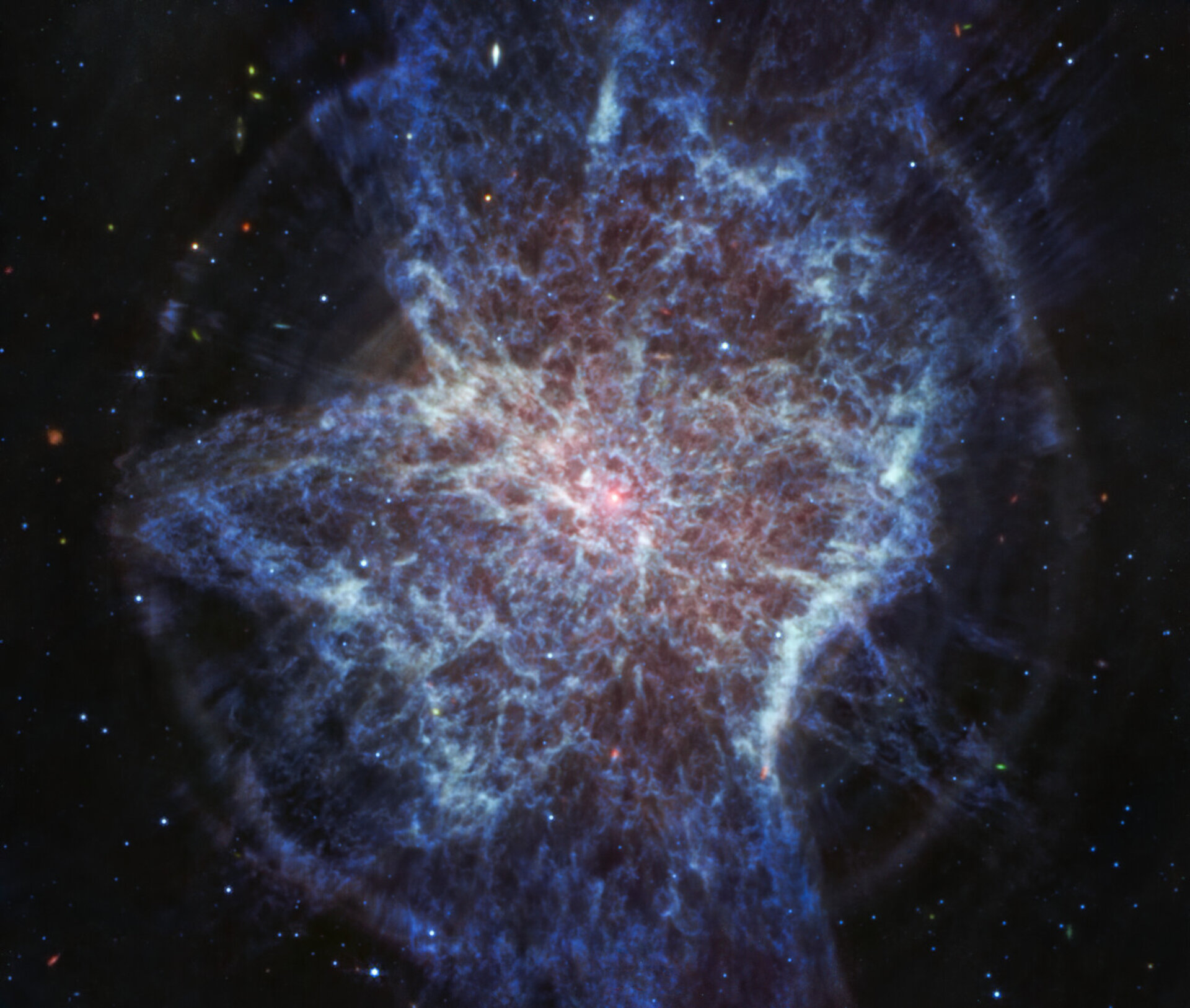
Slider: NGC 6072 (NIRCam & MIRI)
This slider shows a comparison of the planetary nebula NGC 6072 as viewed by the NASA/ESA/CSA James Webb Space Telescope through two different instruments: NIRCam (Near-Infrared Camera) and MIRI (Mid-Infrared Instrument).
NIRCam image:
The near-infrared view of NGC 6072 reveals a complex scene of multiple outflows expanding in various directions from a dying star at the centre. These outflows push gas toward the equatorial plane, forming a disc. Astronomers suspect that another star is interacting with the material cast off by the central star, which may explain the nebula’s unusual appearance. The red areas in the image represent cool molecular gas, like molecular hydrogen.
MIRI image:
The mid-infrared view of NGC 6072 reveals expanding circular shells around the outflows from the central dying star. This star, likely the pinkish-white dot at the centre, is thought to be the source of the outflows. The MIRI captures longer wavelengths, highlighting the dust ejected by the star. In this image, blue areas represent cool molecular gas, which appeared red in the NIRCam image due to colour mapping.


