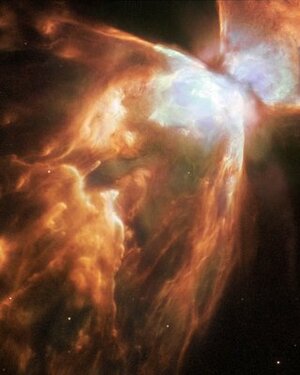
Butterfly Nebula NGC 6302 (Optical Hubble image)
This view of the Butterfly Nebula, NGC 6302, comes from the NASA/ESA Hubble Space Telescope. In the optical wavelengths shown here, the ‘wings’ of the Butterfly Nebula appear clumpy and nearly opaque, blocking most of the background stars from view. The orange colour that suffuses the ‘wings’ comes from ionised nitrogen and hydrogen, while the red accents come from ionised sulphur. Blue comes from hydrogen atoms.
This Hubble image highlights the Butterfly Nebula’s bipolar shape, showing how its two lobes spread in opposite directions, forming the ‘wings’ of the butterfly. A dark band of dusty gas poses as the butterfly’s ‘body’. This band is actually a doughnut-shaped torus that we see from the side, hiding the nebula’s central star – the ancient core of a Sun-like star that energises the nebula and causes it to glow. The dusty doughnut may be responsible for the nebula’s insectoid shape by preventing gas from flowing outward from the star equally in all directions.
[Image description: A planetary nebula called NGC 6302 or the Butterfly Nebula. A dark dust lane runs through the centre of the nebula and two broad clouds emerge from either side of the dust lane like the outstretched wings of a butterfly. The nebula appears clumpy and nearly opaque, with a few background stars showing through the cloudy material. The nebula appears in different shades of cream, yellow and orange, with the lightest colours appearing closest to the centre. The background of space is black with a handful of stars that are tinged pink.]

Slider: Butterfly Nebula NGC 6302 (Hubble Optical &…

Butterfly Nebula NGC 6302 (Near-infrared Hubble image)

Butterfly Nebula NGC 6302 (Hubble, Webb & ALMA images)

Butterfly Nebula NGC 6302 (Webb & ALMA image)