Slider: Butterfly Nebula NGC 6302 (Hubble Optical & Near-infrared images)
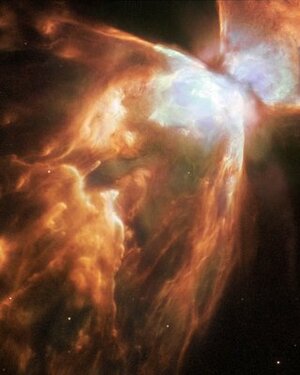
This slider shows two different views of the Butterfly Nebula (NGC 6302) captured by the NASA/ESA Hubble Space Telescope. Each image reveals distinct features of the nebula depending on the wavelength of light used, offering unique insights into its complex structure.
Left: Optical (Visible Light) View
In optical wavelengths, the Butterfly Nebula appears clumpy and opaque, with its ‘wings’ blocking most background stars. The orange hues arise from ionised nitrogen and hydrogen, red accents from ionised sulphur, and blue from hydrogen atoms. This image also highlights the nebula’s striking bipolar structure, with a central dusty band forming the ‘body’ and two lobes expanding outward like wings. The doughnut-shaped torus of dust around the hidden central star may be responsible for this insect-like shape, as it channels the star’s outflow into opposite directions.
Right: Near-Infrared View
This view of the Butterfly Nebula comes from Hubble using near-infrared wavelengths. Compared to its appearance in visible light, the nebula looks more gauzy and ethereal. The dominant red tones represent light from hydrogen, while green and blue shades highlight ionised iron. These wavelengths pierce through some of the obscuring dust, offering a deeper glimpse into the nebula’s structure. The image clearly showcases the nebula’s bipolar shape, with two expansive lobes forming the ‘wings’ of the butterfly. The central dark band, posing as the butterfly’s ‘body’, is actually a doughnut-shaped torus of dusty gas that we see edge-on. This torus obscures the nebula’s central star – the hot, dying core of a Sun-like star that powers the glowing cloud around it.

Butterfly Nebula NGC 6302 (Near-infrared Hubble image)

Butterfly Nebula NGC 6302 (Hubble, Webb & ALMA images)

Butterfly Nebula NGC 6302 (Optical Hubble image)

Butterfly Nebula NGC 6302 (Webb & ALMA image)