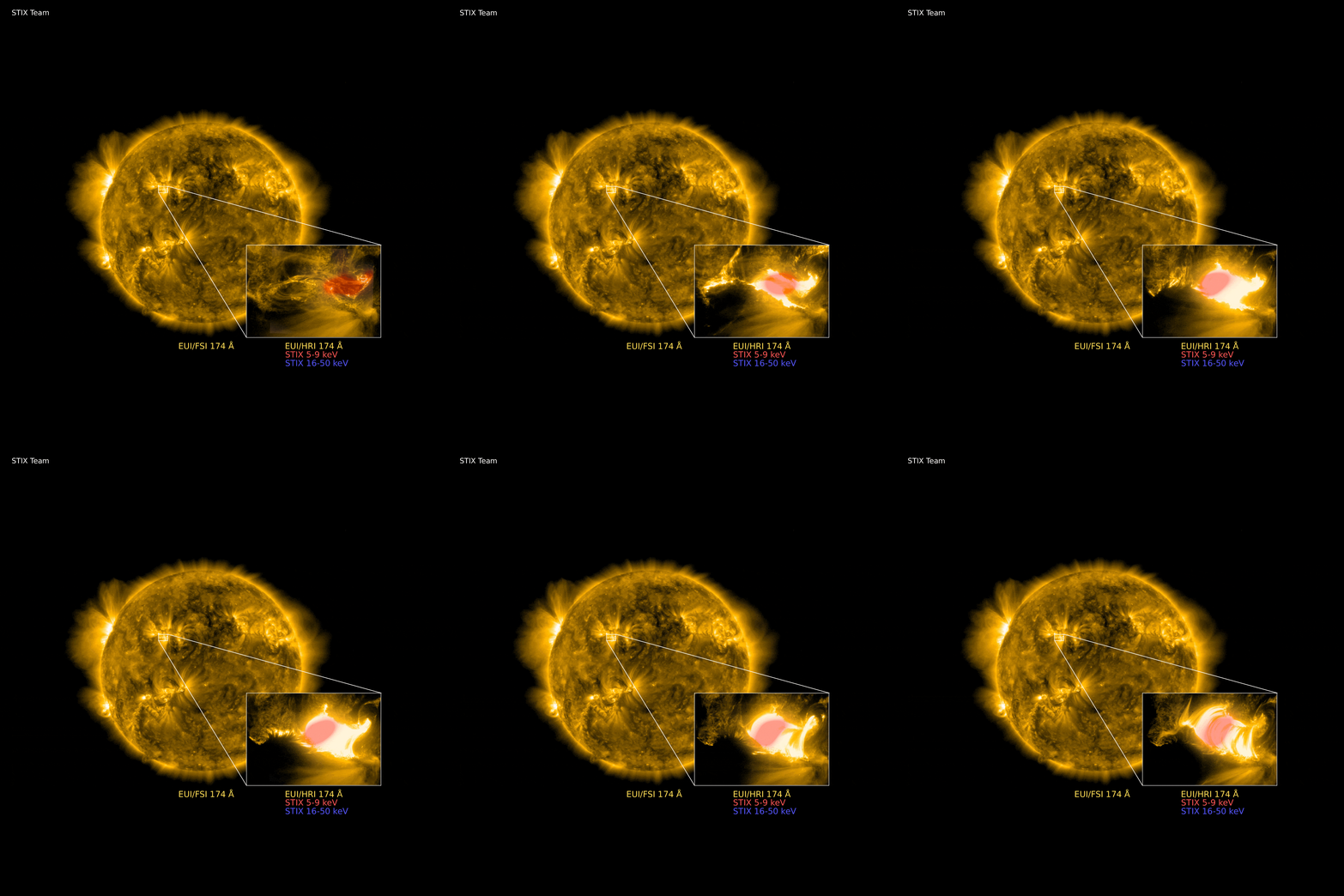
Solar flare seen by EUI and STIX
Solar Orbiter observed this solar flare on 11 November 2022 with its Extreme Ultraviolet Imager (EUI) and Spectrometer/Telescope for Imaging X-rays (STIX) instruments.
The EUI footage (yellow) shows million-degree gas in the Sun’s atmosphere. A narrow ejection of gas from the flare called a solar jet, can be clearly seen heading towards the bottom right of the inset.
Solar flares release electrons both outwards into space and inwards towards the Sun’s surface. When they hit the Sun’s surface, they generate X-rays. This X-ray emission, recorded by STIX, is overlaid in blue.
Some of the electrons the flare sent outwards into space were picked up by Solar Orbiter. Read more about how Solar Orbiter traced these superfast electrons back to solar flares on the Sun.
The new research is published today in Astronomy & Astrophysics, as part of a public catalogue of Solar Energetic Electron events observed by Solar Orbiter.
[Image description: A bright, detailed view of the Sun in yellow tones, with swirling patterns and active regions visible on its surface. A rectangular box highlights a specific area on the Sun, which is magnified in an inset to the right. The inset reveals a solar flare seen by Solar Orbiter's SXI and EUI instruments on 11 November 2022. The main image is based on data from the Extreme Ultraviolet Imager/Full Sun Imager (EUI/FSI) at a wavelength of 174 Ångström, and the highlighted region is relevant to the study of solar energetic electron events.]