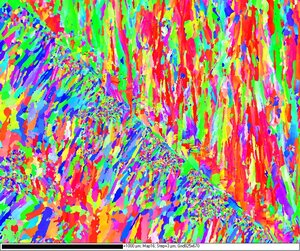
3D-printed space metal under microscope
This February, the first-ever metal part 3D-printed in space landed on Earth. Produced in the European Space Agency’s Metal 3D Printer Technology Demonstrator on the International Space Station (ISS), it is now in the hands of ESA’s engineers at ESTEC, the agency’s technical centre in the Netherlands, who poke and prod it to understand how microgravity affected its printing process.
“We are comparing this metal part with an identically shaped one created here on Earth, using the same printer before it was shipped to the ISS,” explains Caterina Iantaffi, ESA’s materials engineer. “What we are looking for are differences attributable to different gravity levels.”
Caterina’s inspection of the first metal made in space began at a microscope – this first look through a magnifying lens allowed her to see any ridges and imperfections on the surface of the metal more clearly.
[Image description: This is a photo of a laboratory workspace. On the right hand side, there is a person wearing blue gloves and a blue lab coat with the logo of the European Space Agency on the back. On the left hand side, there is a microscope positioned above a metallic sample about the size of a human hand consisting of a circular base and six protruding cylindrical shapes. The microscope is connected to a computer monitor in the background, displaying an image of parallel lines, representing a magnified view of the sample’s surface structure. The person on the right side is facing the monitor, and their left hand is on the microscope.]

3D-printed space metal under microscope

3D-printed space metal ready for tensile testing

3D-printed space metal ready for tensile testing

3D-printed space metal in CT scan