What is spectroscopy?
We see distant space objects by collecting the light that they send in our direction – either with our eyes or with a telescope. Using dedicated instruments attached to telescopes, we can split this light into a spectrum to find out more about the object.
The technique to split light into its component wavelengths is called spectroscopy. Anything that absorbs or emits light can be studied with spectroscopy. Because light interacts with different materials in predictable ways, spectroscopy allows scientists to understand faraway objects without sampling them directly.
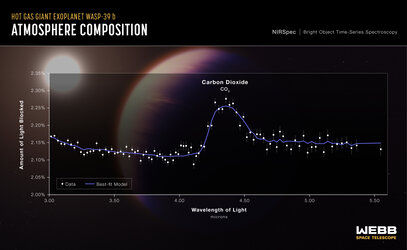
A light source (such as a star) emits light nearly continuously across the electromagnetic spectrum – from gamma rays to radio waves. As that light interacts with something between us and the light source, such as gas clouds or the atmosphere of an exoplanet, it gets altered.
In absorption spectroscopy, we look at the wavelengths of light absorbed by atoms or molecules in the intervening object. This leaves dark lines on a mostly bright spectrum. Absorption spectroscopy is useful for studying interstellar dust clouds and exoplanet atmospheres. It even helps us figure out the composition of stars – because elements within a star absorb some of its own light.
In emission spectroscopy, we look at the wavelengths of light emitted by atoms and molecules. This leaves bright lines on a mostly dark spectrum. Emission spectroscopy is useful for studying clouds of hot gas, which absorb starlight and emit it at specific wavelengths.
Spectroscopy is useful for more than just visible light. Even though the human eye cannot see other wavelengths, scientists use instruments to study spectra across the electromagnetic spectrum. The data they collect reveals details on the composition, motion, temperature, density, distance, size and shape of distant objects.