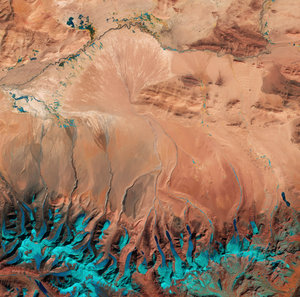
Tibetan Plateau horizontal displacement
A study on tectonic plates that converge on the Tibetan Plateau has shown that tectonic lines are far weaker and the continents are less rigid than scientists previously thought. The study, published in Science, includes several high-resolution maps based on data from Copernicus Sentinel-1 satellites.
The Tibetan Plateau, often called the ‘roof of the world’, was formed by the ongoing collision of the Indian and Eurasian tectonic plates. This region, north of the Himalayas and south of the Kunlun mountains in China, covers about 2.5 million sq km and has an average elevation above 4500 m. The plateau spans numerous countries including the Tibet Autonomous Region, several Chinese provinces, as well as parts of India, Pakistan, Nepal, Bhutan, Tajikistan and Kyrgyzstan.
The ground displacement map shows how the eastern part of the Tibetan Plateau is moving eastwards by as much as 25 mm per year (shown on the map in dark brown). This area contrasts, however, with zones of the plateau that are moving at a slower rate of up to 10 mm per year (light brown). Areas in green are moving in an opposing direction, showing the ‘stretch’ of the tectonic plates, in this case as they move away from each other. Vectors are shown in the map on the right.
Read full story: New satellite view of Tibet’s tectonic clash