Zooming in on magnetic reconnection
Solar Orbiter’s high-resolution images reveal the fine-grained detail of the ‘magnetic avalanche’ process that led up to the major solar flare of 30 September 2024.
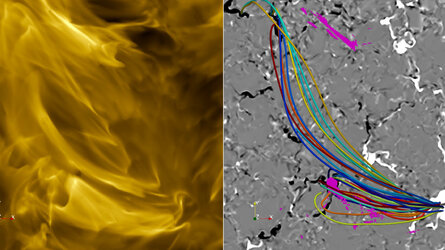
This video zooms in on a tangled X-shaped-configuration of magnetic field lines connected to a dark solar filament (not seen in this close-up view, but visible in the main flare video) that eventually unleashes the solar flare. The scale bar shows a distance of 2 Mm (2000 km, about a sixth of the diameter of Earth).
The left-hand frame shows the high-resolution imagery. The right-hand frame shows the ‘running difference’ sequence, which better highlights changes in brightness. It is made by subtracting one image in the sequence from the next such that only what has changed between the two frames stands out as either brighter (a new structure or region that became brighter) or darker (material that moved away or faded) pixels.
Impressively, the imagery reveals that new magnetic field strands are appearing in every image frame – equivalent to every two seconds or less.
Each strand is magnetically contained, and they become twisted, like ropes. Then, just like an avalanche, the region becomes unstable. The twisted strands begin to break and reconnect, rapidly triggering a cascade of further destabilisations in the area. This creates progressively stronger reconnection events and outflows of energy, seen as increasing brightness in the imagery.
Solar Orbiter is a space mission of international collaboration between ESA and NASA. The EUI instrument is led by the Royal Observatory of Belgium (ROB).
[Image description: A GIF with two frames side by side. On the left is a darker background with a yellow cross extending from the centre of the frame. On the right is a yellow background with a dark cross extending from the centre of the frame. The crosses are otherwise the same in both images. A scale bar indicates 2 Mm, and a time stamp indicates that the event happened at around 23:20 Universal Time.]