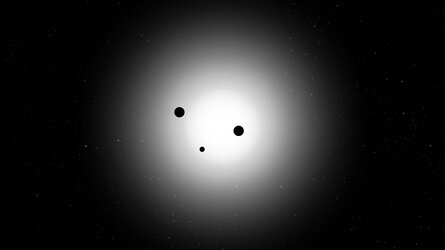
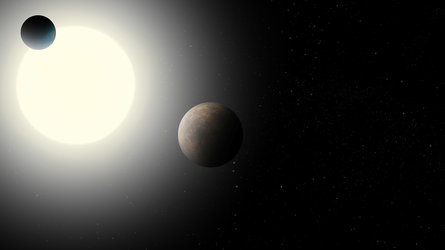
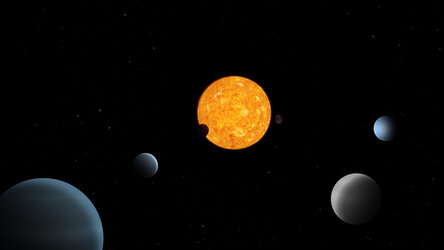
Artist impression of the planetary system around the star LHS 1903
LHS 1903 is a small red M-dwarf star that is cooler and shines less brightly than our Sun. Scientists used telescopes in space and on Earth to discover four planets orbiting LHS 1903. With those telescopes, they classified the three closest planets to the star as the innermost being rocky, and the two that follow it gas giants.
In a recent study, scientists used ESA’s Cheops satellite to investigate the fourth planet in this system. They noted that it is much smaller and further away from its star than the other planets and discovered that it might be rocky, like Venus. This is surprising because a planet order of rocky-gaseous-gaseous-rocky in a planetary system is unusual and rarely observed in the Universe.
Note that the distances and sizes of the planets are not to scale – the outer fourth planet is much smaller than the other three planets in the system.
Read more about this unusual planetary system here.
[Image description: This image shows a planetary system with four planets circling around a star. In the foreground, a large reddish-brown rocky planet with craters is visible. Behind it, there are three smaller planets: one with blue and white colours, another with blue and brown bands, and the third with a rocky surface. In the top right corner of the image, a small but bright red star illuminates the scene, with space dust and distant stars visible in the background.]