


Smile deploys its magnetometer boom (artist impression, GIF)
This is a GIF from a cinematic animation. Click here to view the animation in full.
The joint European-Chinese Smile mission will launch this spring from Europe’s Spaceport in French Guiana, on a Vega-C rocket.
The rocket will place Smile into an almost-circular orbit around Earth’s poles. Over the following month, Smile will gradually alter its orbit, firing its engines as it flies over Antarctica.
After Smile has reached this final ‘science orbit’, it will deploy a three-metre-long boom that carries two magnetometer sensors at the end. This artist impression shows the boom mid-deployment. The magnetometer sensors will measure the strength and direction of magnetic fields around the spacecraft.
Known as ‘MAG’, data from this science instrument will be combined with data from Smile’s X-ray camera, ultraviolet camera, and particle detector to give humankind its first complete look at how Earth reacts to streams of particles and bursts of radiation from the Sun.
By improving our understanding of the solar wind, solar storms and space weather, Smile will fill a stark gap in our understanding of the Solar System and help keep our technology and astronauts safe in the future.
Smile (the Solar wind Magnetosphere Ionosphere Link Explorer) is a joint mission between the European Space Agency and the Chinese Academy of Sciences.
[Image description: Artist's impression GIF showing a gold‑covered spacecraft set against deep black space dotted with tiny stars. A black arm-like boom stretches from the right side of the spacecraft. The scene then zooms out to show the boom fully extended.]

Smile deploys its magnetometer boom (artist impression)

Smile orbit transfer and magnetometer boom deploymen…
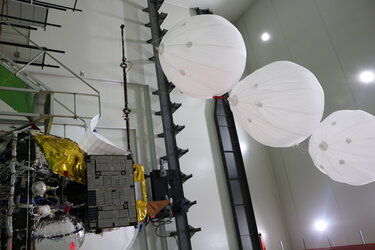
Smile spacecraft during a test of the magnetometer b…

Smile launch and solar panel deployment (artist impression)
