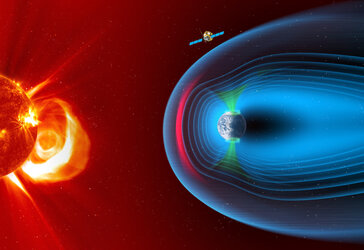
The Sun's threat to Earth
The space between the planets of the Solar System is not actually empty, but filled with a driving rain of particles constantly streaming outwards from the Sun at speeds of up to more than 2 million km an hour. The giant bubble of space filled by this ‘solar wind’ is called the heliosphere and it reaches out to around three times the distance to Pluto.
Luckily, Earth is holding up a massive umbrella against this driving rain. A magnetic field bubble called the magnetosphere deflects most of the charged particles in the solar wind around Earth and keeps us safe from their harmful effects. But just like our feet might get wet under heavy rain even when we carry a good umbrella, when the solar wind is strong enough some particles make it through our magnetosphere. The visible result is the beautiful northern and southern lights. But the invisible harmful impact on our technological systems could be huge.
Smile (the Solar wind Magnetosphere Ionosphere Link Explorer) is a joint mission between the European Space Agency and the Chinese Academy of Sciences. It will give humankind its first complete look at how Earth reacts to streams of particles and bursts of radiation from the Sun.
Find out more about the solar wind and space weather.
[Image description: A comic strip-style infographic that tells the story of a solar wind particle as it leaves the Sun, travels through space, crashes into Earth's magnetosphere and is funnelled towards the north pole, where it hits oxygen and nitrogen molecules, causing them to release green and purple light.]