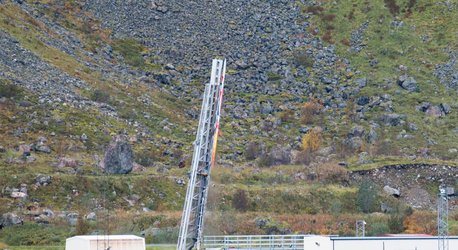
4DSpace-Daedalus (ICI-5b) sounding rocket
The 4DSpace-Daedalus (ICI-5b) mission for space weather research was coordinated by the University of Oslo, Norway and funded partly by ESA's Prodex programme.
This Norwegian sounding rocket with several instruments onboard, was launched on 11 March 2026 from Norway’s Andøya Space Centre right into the onset of an auroral substorm. While the rocket flew through the northern lights, it collected a wealth of data related to turbulence in highly-charged, ionised air (ionospheric plasma) and in the neutral part of the upper atmosphere.
With its independent 4DSpace daughter subpayloads released during the mission, the scientists were able to collect three-dimensional data on turbulence along the rocket flight. The data will be analysed and used in space weather research and to understand the fundamental processes in energy transfer and couplings within the upper polar atmosphere.
The University of Oslo coordinated the rocket, was responsible for the whole experiment, and provided the multi-needle Langmuir probe (mNLP) instrument, electric field instrument, and instrumentation for daughter payloads.The Institute of Atmospheric Physics, Germany, provided the CONE instrument for neutral density and temperature measurements. The University of Iowa, USA provided the magnetometer and low-energy spectrometer for auroral particles. NASA contributed with the motor and trajectory design and participated in the launch and operations.