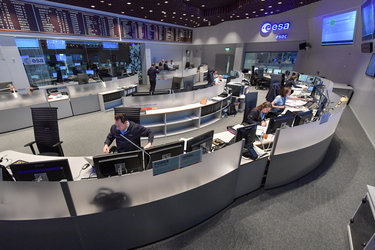
Sentinel-1 control room
After 12 years of exceptional service, the pioneering Copernicus Sentinel-1A radar satellite has reached the end of its mission. Originally designed for a seven-year life in orbit, the satellite has exceeded expectations, not only by its longevity, but through the extraordinary impact of its data, which have deepened our understanding of our changing planet and supported a wide range of operational services and laid the foundation for scientific discoveries.
In the weeks leading up to retirement, mission controllers ESA’s European Space Operations Centre (ESOC) in Germany carried out some complex orbital manoeuvres, carefully coaxing Sentinel-1A and its younger siblings, Sentinel-1C and Sentinel-1D, into a three-satellite configuration. This has ensured a seamless transition so that the younger siblings are in the right positions to take on their important roles of primary suppliers of radar data from space.
The photograph shows the Sentinel-1 control room at ESOC.
Read full story: Time to say goodbye to Sentinel-1A