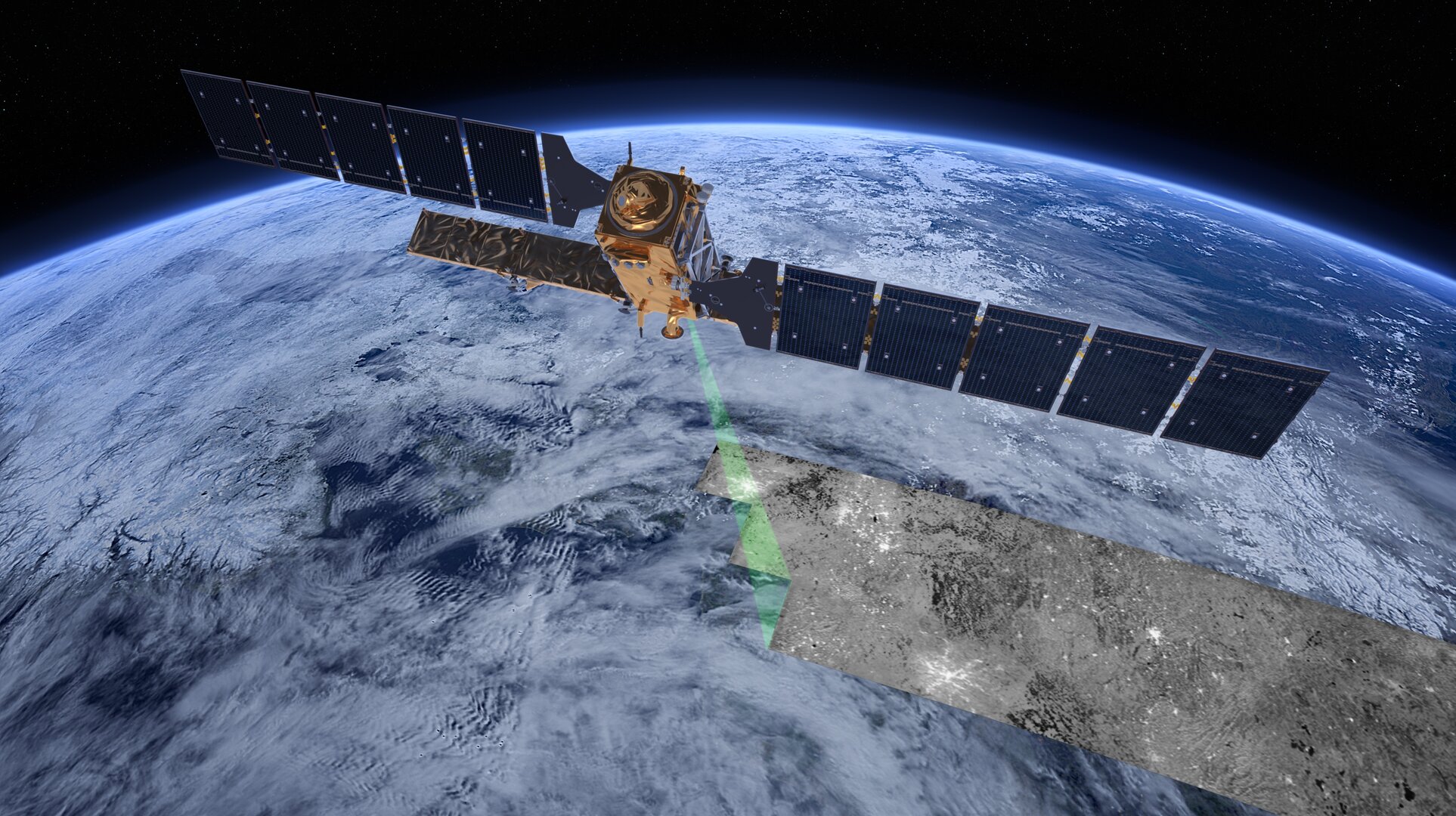
Time to say goodbye to Sentinel-1A
After 12 years of exceptional service, the pioneering Copernicus Sentinel-1A radar satellite has reached the end of its mission. Originally designed for a seven-year life in orbit, the satellite has exceeded expectations, not only by its longevity, but through the extraordinary impact of its data, which have deepened our understanding of our changing planet and supported a wide range of operational services and laid the foundation for scientific discoveries.
While Sentinel-1A's remarkable journey has come to an end, the mission lives on with gusto with Sentinel-1C and Sentinel-1D – ensuring that Europe maintains an unblinking radar eye on Earth for years to come.

Launched on 3 April 2014, Sentinel-1A marked more than the start of a single mission; it heralded the beginning of Copernicus, the Earth observation component of the European Union’s space programme.
For more than a decade, Sentinel-1A served as an unwavering eye in the sky.
Equipped with an advanced C-band synthetic aperture radar, it delivered high-resolution images of Earth day and night and no matter the weather. Its ability to see through adverse weather conditions made it an indispensable tool for monitoring our dynamic planet.
From tracking Arctic sea ice and monitoring glacier movement to detecting oil spills, mapping floods and supporting disaster response efforts worldwide, the satellite became an indispensable asset for environmental monitoring and public safety, while advancing our scientific understanding of the planet at the same time.
Its achievements are all the more remarkable considering that it significantly outlived its original design lifetime. Sentinel-1A remained operational well beyond its planned mission duration, and became especially critical after its sister satellite, Sentinel-1B, suffered a power-system failure in 2021. During those challenging years, Sentinel-1A shouldered much of the responsibility for maintaining Europe's radar Earth observation capability.
The satellite's legacy extends far beyond Europe. Like all Copernicus Sentinel missions, Sentinel-1A's data were made freely and openly available to users worldwide, supporting scientific research, climate studies, agricultural monitoring, maritime security operations and humanitarian relief efforts. Millions of radar images acquired over its lifetime have contributed to a growing archive that will continue to inform research and decision-making for decades to come.
ESA’s Operations Centre in Germany confirmed that Sentinel-1A's operational duties ended on 29 June 2026.
Two of the last radar images that Sentinel-1A returned before it was officially retired captured western Iceland and Melbourne in Australia, both featured below.

In the weeks leading up to retirement, mission controllers carried out some complex orbital manoeuvres, carefully coaxing Sentinel-1A and its younger siblings, Sentinel-1C and Sentinel-1D, into a three-satellite configuration. This has ensured a seamless transition so that the younger siblings are in the right positions to take on their important roles of primary suppliers of radar data from space.
ESA’s Sentinel-1 Mission Manager, Nuno Miranda, said, “Sentinel-1A holds a special place for all of us. As the first satellite of the Copernicus programme, it paved the way for new approaches in both operations and science. Over the years, it has weathered several disruptions and challenges. Yet, despite being the oldest member of the fleet, it is far from obsolete in the new-space era.
“Sentinel-1A remains at the forefront of Earth observation and continues to play a key role in enabling the application of artificial intelligence in data and services. After years of outstanding service, Sentinel-1A has earned a well-deserved retirement.

“Over the past few years, the teams have worked tirelessly to dispose of one satellite and commissioning two new ones. Today, Sentinel-1C and Sentinel-1D are performing very well and offer improved capabilities with respect Sentinel-1A. This gives us great confidence as we look to the future of the mission.
“While Sentinel-1A's operational life has come to an end, its story is not yet over. The team is now preparing for the disposal phase, which is expected to begin during the summer.”
The Sentinel-1D and Sentinel-1C satellites are now working in tandem, orbiting on opposite sides of the globe, 180° apart, to optimise global coverage and data delivery. Both satellites carry a C-band synthetic aperture radar along with an Automatic Identification System (AIS) instrument – so while capturing high-resolution imagery of Earth’s surface, these two satellites also improve the detection and tracking of ships over maritime zones.

ESA’s Director of Earth Observation Programmes, said, “Sentinel-1A was far more than a satellite – it opened the Copernicus era. For over a decade, it delivered vital data every day, helping us better understand our planet and respond to some of society's most pressing challenges.
“As we bid farewell to this remarkable satellite, we celebrate an extraordinary legacy and look forward with confidence as Sentinel-1C and Sentinel-1D carry that legacy into the years ahead."