Beta Pictoris system (NIRSpec IFU image and spectrum)
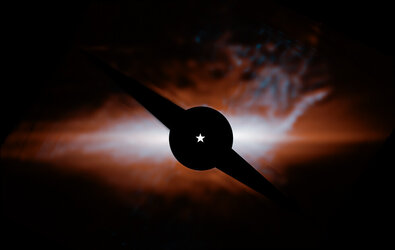
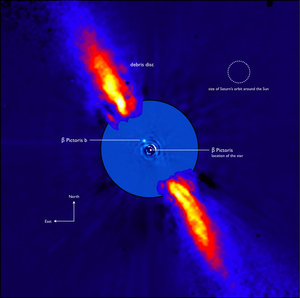
Researchers used the NIRSpec (Near-Infrared Spectrograph) Integral Field Unit on the NASA/ESA/CSA James Webb Space Telescope to map chemical contents of the Beta Pictoris system. As a result, they discovered a third planet, Beta Pictoris d, orbiting the young star.
Instead of identifying the planet as a bright point of light, as seen in the reconstructed image, researchers searched the spectroscopic data for the molecular signatures expected from a giant planet atmosphere, allowing the object to stand out from the surrounding debris disc.
The extracted NIRSpec and MIRI (Mid-Infrared Instrument) spectra of Beta Pictoris d display a distinctive series of carbon monoxide (CO) absorption lines. This molecular “fingerprint” identified the object as a giant planet, while measurements of the Doppler shift of the spectral lines provided the planet’s radial velocity, confirming it is gravitationally bound to the Beta Pictoris system.
[Image description: The image at the left shows two exoplanets of the Beta Pictoris system. At the centre, there is a white star symbol, which represents light blocked from the host star. Immediately to the left of the star symbol, there is a bright orange-whitesh smudge, labeled b. To the right of the star symbol is a blurry orange smudge labeled d. There is a white circle around this smudge with lines drawn to the spectrum at the right. The x-axis is labeled “Wavelength of Light” and extends from 4.2 to 5.2 microns. The y-axis is labeled “Brightness.” An up arrow is labeled “brighter,” a down arrow “dimmer.” There are two jagged horizontal lines across the graph. One is white, the other is maroon (the former labeled “Webb data”, the latter labeled “Best fit model” in the bottom left corner). A blue vertical column spanning from about 4.3 microns to 5 microns is labeled Carbon Monoxide, CO.]