


Exoplanet WD 1856 b NIRSpec transmission spectrum
The NASA/ESA/CSA James Webb Space Telescope measured the constituents of exoplanet WD 1856 b as it passed in front of its star, finding signs of methane. WD 1856 b orbits a white dwarf star the size of Earth. As a result, the planet blocks more than half of the star’s light. The red bands indicate where bumps in the spectrum show that this planet’s atmosphere contains methane.
[Image description: This image shows a graph of the amount of light blocked by percent on the y-axis and wavelength of light in microns on the x-axis. The y-axis ranges from 55.2% to 56.5% with tick marks every 0.1% and labels at 55.5 and 56.0. The x-axis ranges from 0.5 to 4.0 microns with tick marks every 0.5 microns. A thick purple line outlined with two semi-translucent bands has an inner line that is darker and an outer line that is lighter. The purple line is wavy and runs higher, in the top third, until about 3.5 microns, where it drops to 55.2 on the y-axis and 4.0 on the x-axis. Five humps are highlighted by vertical red bars, indicating the presence of methane. White circles representing data points are scattered above and below the purple line. A key shows that the purple line is the best fit model, red highlights methane, and white circles represent data.]

Beta Pictoris system (NIRSpec IFU image and spectrum)
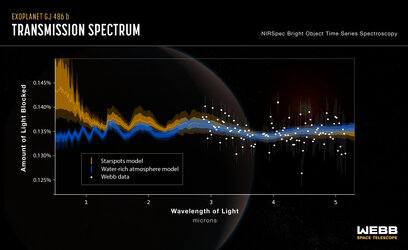
Webb finds water vapour, but from a rocky planet or…
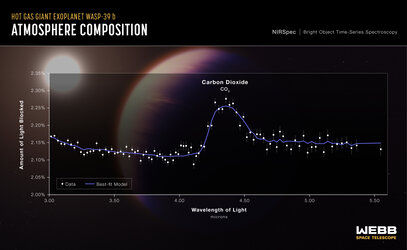
Exoplanet WASP-39 b – NIRSpec transmission spectrum
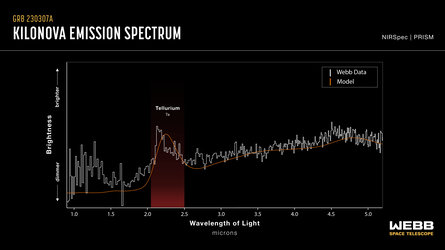
Kilonova emission spectrum
