


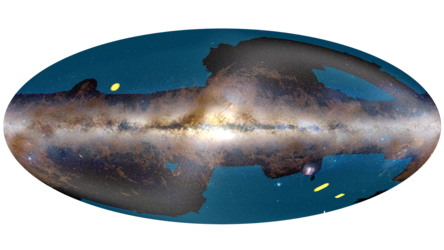
Locations of the 31 new Euclid quasars
This graphic shows the location of the 31 newly discovered quasars (yellow dots) by the European Space Agency’s Euclid telescope, and the mission’s survey footprint in August 2025 (blue area). The locations of the farthest found quasars are shown as red dots. The farthest quasar is the one on the right and is named EUCL J172902.75+641018.1 (redshift of 7.77), and the second-farthest (the red dot on the left) is named EUCL J125308.55+705432.3 (redshift of 7.69).
This all-sky view is overlaid on ESA Planck’s map from 2014, with the bright horizontal band corresponding to the plane of our Milky Way galaxy, where most of its stars reside.
[Image description: An oval image showing a projection of the night sky with the bright plane of our Milky Way galaxy running horizontally through the centre. Cloud-like features representing stars and interstellar gas and dust extend above and below the plane. Some regions are marked in blue, indicating Euclid’s survey footprint in August 2025. In these regions, yellow an red dots show the locations of the quasars.]

Quasars discovered by Euclid
Euclid’s wide and deep surveys

Euclid’s wide and deep surveys over the next 6 years

Artist’s concept of an ancient quasar
