


Side view of the Sun's surface magnetism
This magnetic map (magnetogram) shows the direction of the magnetic field on the Sun's surface. White and black regions indicate areas of strong magnetic field, where magnetic field lines point either outward or inward.
This map was measured by Solar Orbiter's Polarimetric and Helioseismic Imager (PHI) instrument on 8 August 2026. At the time, Solar Orbiter was facing the side of the Sun, rotated around 90 degrees away from Earth's view. This is in contrast to other solar observatories, which view the Sun from near Earth.
This unique vantage point makes this data invaluable for getting a complete, three-dimensional picture of the Sun's magnetic field. As such, this PHI data is invaluable to predicting what we'll see during the total solar eclipse of 12 August 2026.
Solar Orbiter is a space mission of international collaboration between ESA and NASA. PHI was developed and built under the leadership of the Max Planck Institute for Solar System Research (MPS), Germany, and is operated by MPS.
[Image description: This magnetic map, captured by Solar Orbiter’s PHI instrument, displays the Sun’s surface as a grey sphere overlaid with a white grid of latitude and longitude lines. Patches of white and black are scattered across the surface, representing regions of opposite magnetic polarity. These areas vary in size and intensity, forming a mottled pattern that highlights the Sun’s complex magnetic landscape. The image includes a timestamp and notes the spacecraft’s distance from the Sun (0.371 astronomical units). In the top right, a small image visually indicates Solar Orbiter's location as a small green circle with respect to the Sun (yellow, centre) and Earth (blue, right side).]
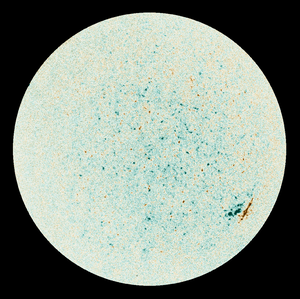
Magnetogram of the Sun

Magnetic regions on the Sun viewed by Solar Orbiter
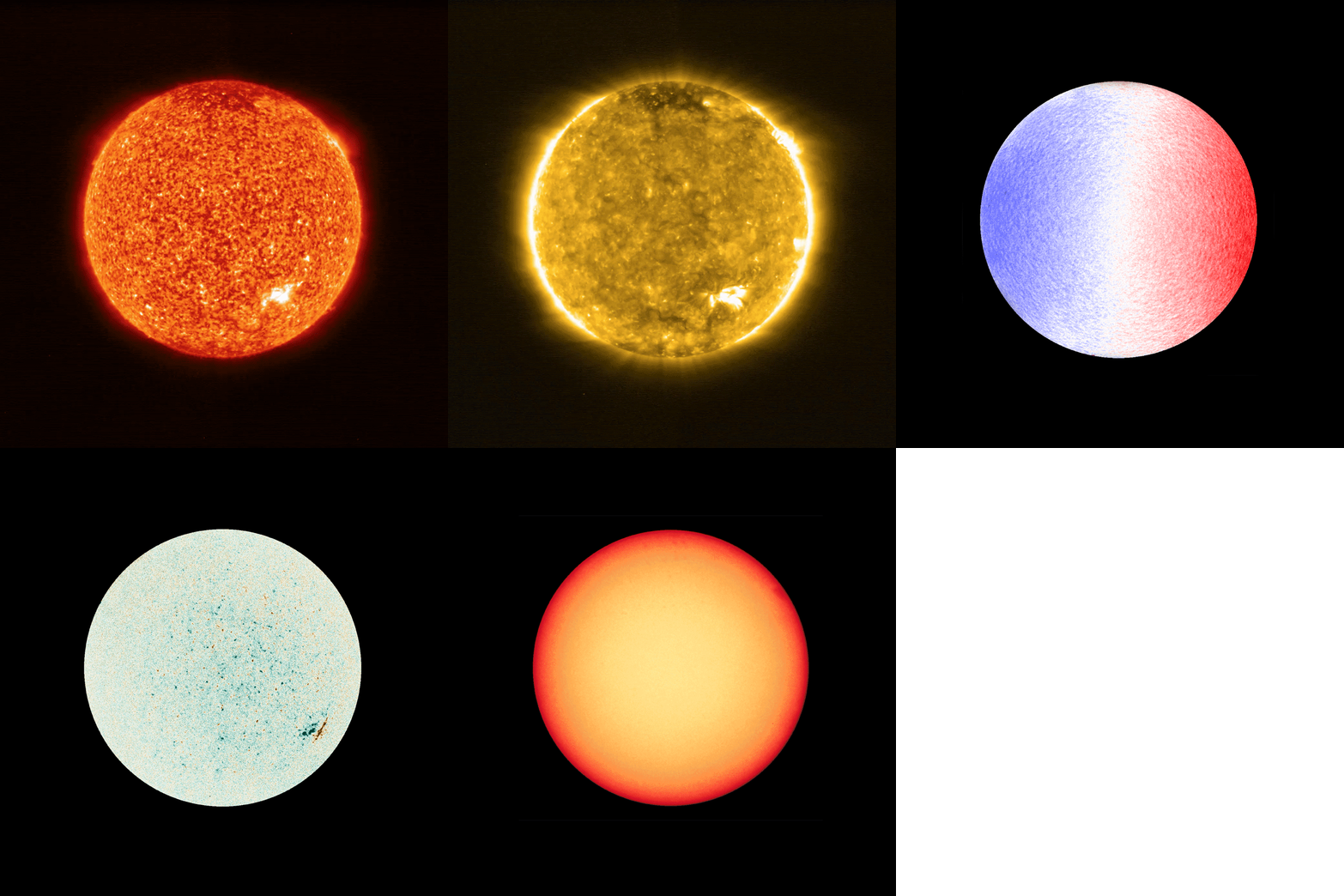
Solar Orbiter’s first views of the Sun

Closer than ever: Solar Orbiter’s first views of the Sun
