Rover's view from landing platform
An image from early in the mission, when the rover was still on the lander platform. This image is a composite of three pictures taken by the PanCam wide angle camera.
While the rover sent self-location parameters, measurements and images from the field, planners and scientists at the control centre in Italy worked around the clock to prepare for the next day, just as they will during the real mission.
The data came from prototypes of Rosalind Franklin’s suite of scientific instruments: cameras for far and wide angles (PanCam) as well as close-ups (CLUPI), a spectrometer (Enfys) and a ground-penetrating radar (WISDOM). These instruments are designed to detect clues to ancient microbial activity.
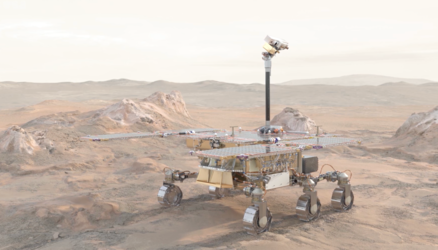
The exercise was an important rehearsal for what the ExoMars Rosalind Franklin rover might encounter when it lands on the Red Planet in 2030. It brought together a rover prototype called Charlie and around 100 scientists and engineers from across Europe in September. Together, they choreographed how the robotic explorer could move safely, exercise exploration strategies and maximise the scientific results.