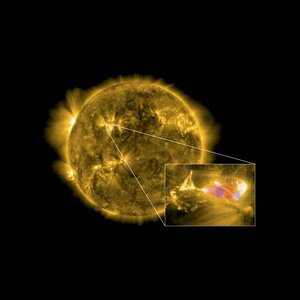
Zooming in on raining plasma blobs

For the first time, thanks to the ESA-led Solar Orbiter mission, scientists have been able to explore in extremely high resolution how energy is deposited in the solar corona (the outermost part of the Sun’s atmosphere), in the build up to, during, and after an intense solar flare. The scale bar shows a distance of 2 Mm (2000 km, about a sixth of the diameter of Earth).
This video is a ‘running difference’ sequence, which highlights changes in brightness. It is made by subtracting one image in the sequence from the next such that only what has changed between the two frames stands out as either brighter (a new structure or region that became brighter) or darker (material that moved away or faded) pixels. The video covers a period of about 20 minutes, with the main phase of the flare indicated by the timestamp changing to red.
Rapid changes are seen at an extremely high cadence – each frame corresponds to just two seconds. The changes represent the deposition of energy associated with progressively stronger reconnection events leading to the flare. That is, twisted magnetic fields break and reconnect, creating an outflow of energy that subsequently rains down through the Sun’s atmosphere in ribbon-like streams. Even after the flare subsides, the raining plasma blobs continue for some time.
This video corresponds to the location indicated by the central ‘raining plasma blobs’ label marked in the main video.
Solar Orbiter is a space mission of international collaboration between ESA and NASA. The EUI instrument is led by the Royal Observatory of Belgium (ROB).