

Fly around Schiaparelli Crater with Mars Express

ESA’s Mars Express takes us on another mesmerising flight, this time around one of the biggest craters on Mars.
Despite measuring a huge 460 km across, Schiaparelli Crater seems to be relatively shallow. Perhaps it has been filled in over the last few billion years by sediment blown by the wind or deposited by water, by lava – or by a combination of all three.
Schiaparelli Crater is named after Italian astronomer Giovanni Schiaparelli (1835–1910). Although he studied Mercury and Venus, he is best known for his observations of the Red Planet.
During the ‘Great Opposition’ of 1877, when Mars passed close to Earth, Schiaparelli mapped the planet, perceiving several straight dark lines across the red surface. He assumed that these were natural water-filled channels and used the equivalent Italian word, ‘canali’.
However, other astronomers thought he meant canals, meaning artificial irrigation and transportation routes, which led to a few astronomers, and a large number of the general public, believing that they had been created by intelligent martians.
Now we know that Schiaparelli’s ‘canali’ were illusions created by the comparatively poor telescopes of the time and there are no water-filled channels on Mars today. Nevertheless, we do believe that water was once present in this region of the planet, perhaps in the form of a lake.
Schiaparelli Crater is also important in popular culture, being the final destination of astronaut Mark Watney in Andy Weir’s novel ‘The Martian’.
Enjoy the flight, and be sure to turn up the volume for the full audio guide experience.
Processing notes:
This film was created using the Mars Express High Resolution Stereo Camera Mars Chart (HMC-30) data, image mosaics made from multiple observations by the mission’s High Resolution Stereo Camera (HRSC). The mosaic image, centred at 8°S/17°E, is combined with topography information from the digital terrain model to generate a three-dimensional landscape.
For every second of the movie, 50 separate frames are rendered following a predefined camera path in the scene. The vertical exaggeration used for the animation is three-fold. Atmospheric effects, like clouds and haze, have been added to conceal the limits of the terrain model. The haze starts building up at a distance of 250 km.
The HRSC camera on Mars Express is operated by the German Aerospace Center (DLR). The systematic processing of the camera data took place at the DLR Institute for Space Research in Berlin-Adlershof. The working group of Planetary Science and Remote Sensing at Freie Universität Berlin used the data to create the film.

Mars Express image of Schiaparelli’s landing site –…
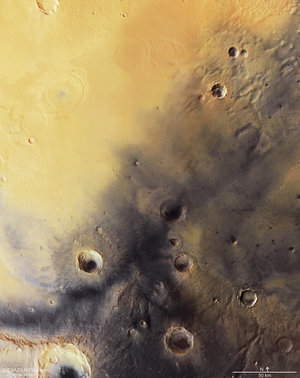
Mars Express image of Schiaparelli’s landing site
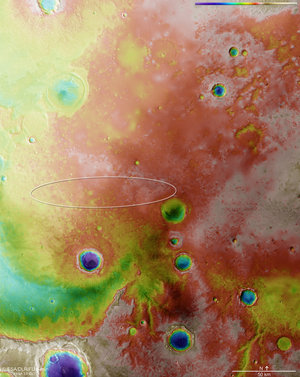
Meridiani Planum topography with Schiaparelli landin…

Overhead perspective of Flaugergues Crater
