X-Ray Imaging Goes Neuromorphic
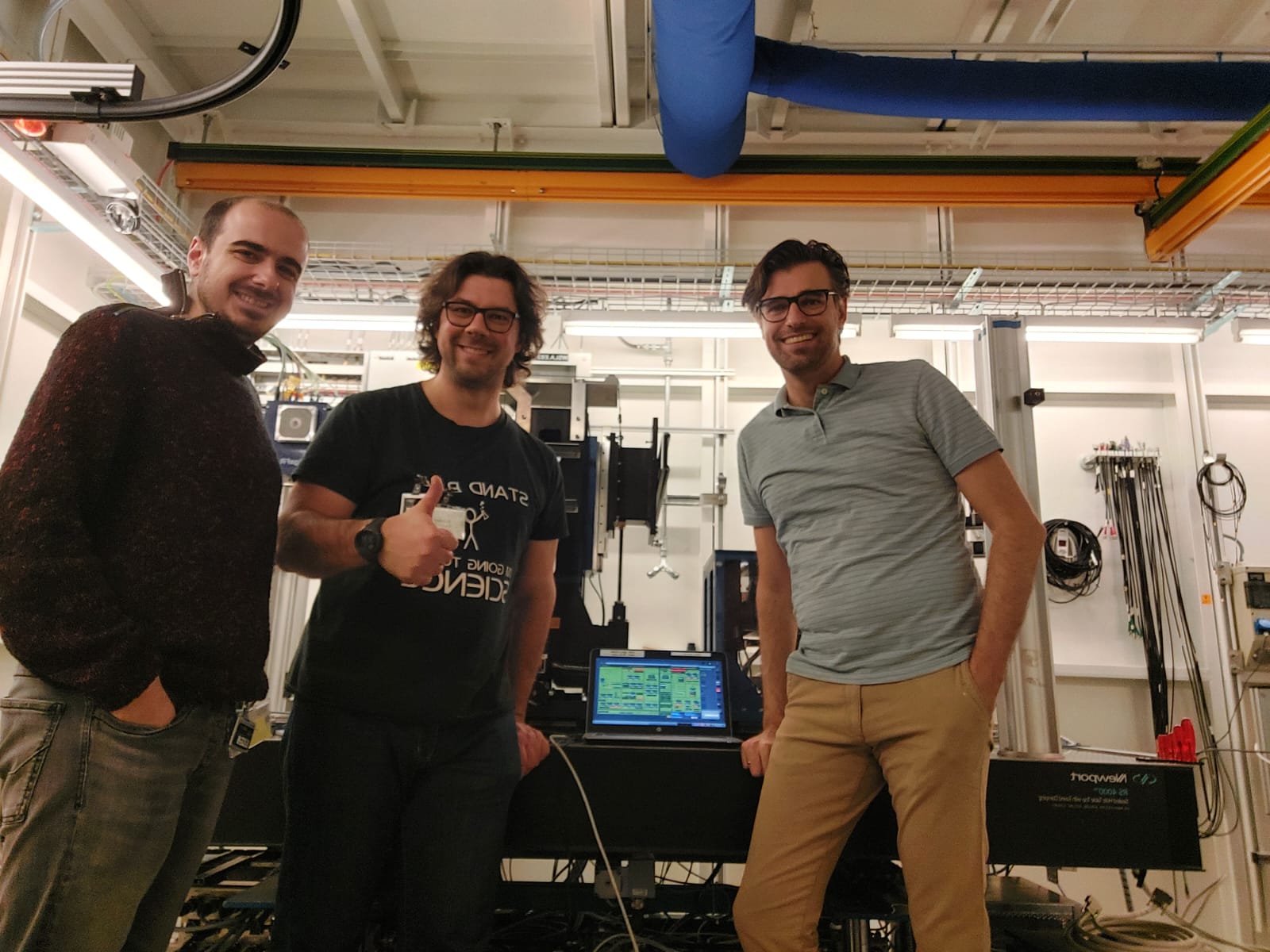
The Advanced Concepts Team recently conducted their first experiments on X-ray based neuromorphic imaging in collaboration with the Paul Scherrer Institute and the TOMCAT (TOmographic Microscopy and Coherent rAdiology experimentTs) beamline team in Switzerland. This research aims to pave the way for neuromorphic tomography by demonstrating the capability of high temporal super-resolution and reduced data production rates in dynamic experiments. Our researchers are developing an event-assisted temporal super-resolution pipeline for 3D object imaging, using a PROPHESEE EVK-4 event-based sensor and an in-house developed Gigafrost image detector. This allows for artificial de-blurring of images and a significant reduction in streaming data rates. The team will apply this procedure to study the in situ properties of additive manufacturing materials, which typically require quasi-static experiments for observation.
During this first round of experiments, ACT research fellows and the TOMCAT team successfully synchronized the acquisition of cameras, tested the beam-splitting setup, and calibrated the event-based sensor to be compatible with the input beam signal. The team filmed sand falling through an hourglass, producing imaging samples to calibrate their temporal super-sampling pipeline.


This approach has the potential of significantly increasing the temporal resolution of a scan without capturing and storing excessive amounts of data. For high-speed tomographic imaging, this method could revolutionize the field by achieving improved temporal resolution and a significant reduction in data amounts in dynamic imaging experiments. For space applications, these findings could serve as proof-of-principle and feasibility evaluation of event-assisted temporal super-sampling for fast dynamic tracking, with potential applications in in-orbit servicing, satellite health monitoring operations, X-ray astronomy, and navigation during critical operations in complex dynamical environments such as comet interception, planetary landing, and fly-bys.