Biosensors
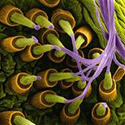
Optical sensors are powerful tools that have applications in various fields such as environmental hazard detection, structural health monitoring, and biological research. Current optical sensors have been developed following recent advances in fibre optics communications and silicon wafer manufacturing. One of the limitations of current sensors is typically that there are very few intrinsic interactions between the waveguide structure and the surrounding environment, which makes current optical sensors not optimal for practical sensing. The current approach to overcome these limitations is to increase the light-matter interactions, with the aim of increasing the sensitivity of sensors.
By using materials that change mechanical and optical properties according to its environment, multi-component sensitive sensors could be obtained with lower energy requirements. Nature uses this approach in many biological receptors, like smell, taste, etc. These are based on transmembrane receptor-peptides that change structural conformation upon binding to a certain ligand in the extracellular space. This conformational change triggers an action potential in the receptor neuron via a second messenger pathway sending a signal to the nervous system that then identifies the smell, taste, etc. These bio-receptors work at the nanoscale level with minimal energy occupying very small spaces, high sensor density, accuracy and robustness.
Biomimetic approaches of these biological sensors are been made at this very moment with the integration of specific transmembrane proteins in synthetic membranes. However this research and a working first principle will take a few more decades to develop. Moreover this entire system is extremely complex which is a serious disadvantage for space applicability. Here we propose to uncouple the conformational change of the receptor-peptide from the second messenger pathway responsible for the cascading final signal, seriously reducing the complexity of the entire sensing system. Instead we look at the change in material properties of structural “receptor”-proteins upon interacting with molecules. Such changes can be measured much more easily. In these receptor-proteins different molecules will induce characteristic conformational changes resulting in distinct material property changes. These can be associated with specific compounds. The advantages of this approach are firstly to reduce the complexity of the system and secondly to increase the sensitivity of the “sensor”. Additionally more chemicals can be identified in this way as every interaction will result in a change in material properties, whereas this is not the case in the original receptor-proteins as these tend to be ligand specific and not every molecule results in an action potential.
The ACT investigated biosensors and the potential biomimetic transfer of the mechanism in the framework of the Ariadna Project: “The Silky Way: Biomimetic sensing through changes in structural proteins” - Study Reference Number: 14-6401. The project is done in collaboration with the Group of Fibre Optics at EPFL (CH) and the Oxford Silk Group at Oxford University (UK).