Deflective Sunshades
Background
Currently, climate risk mitigation is largely pursued through emissions reduction pathways, supported by climate model projections that estimate future temperature outcomes, rather than through direct modification of Earth’s radiative balance. Within the broader discussion on geoengineering, sunshading has been proposed as a potential approach to reduce incoming solar flux and offset greenhouse-gas-induced warming. Climate modelling studies suggest that a reduction in total solar insolation of approximately ~1–2% could counteract the radiative forcing associated with a doubling of atmospheric CO₂ [1]. In space-based implementations, sunshading could be achieved by deploying large-scale structures or swarm systems near the Sun–Earth L1 point, enabling partial attenuation of solar flux before it reaches Earth.
Project goal
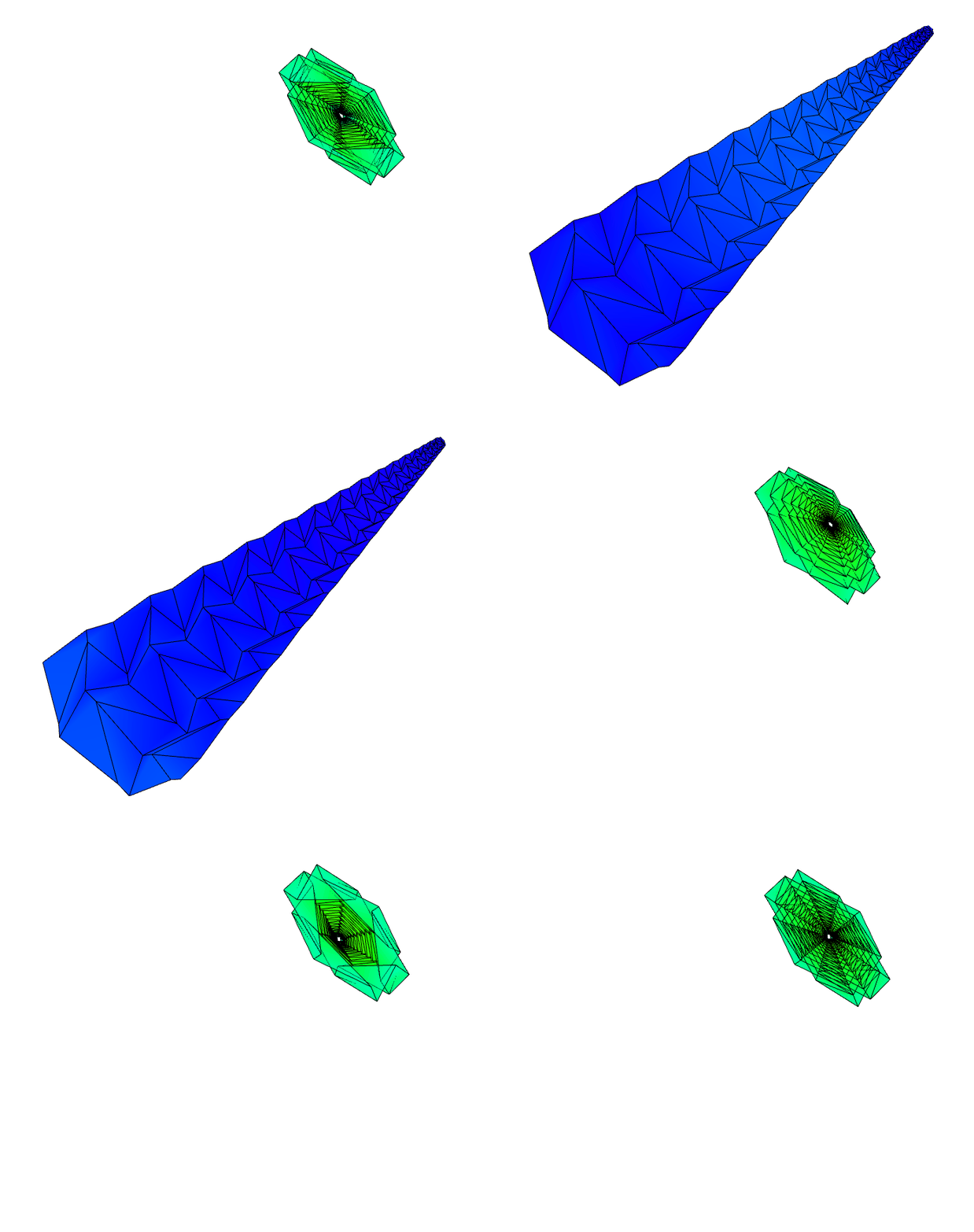
The goal of this project is to investigate the feasibility and performance of alternative sunshade geometries, beyond the conventional disc-shaped design proposed in the literature. Since the overall mass of the structure must remain above a minimum threshold [1], optimizing both geometry and optical properties is a key strategy for reducing overall system requirements. We introduce a class of sunshades, termed deflective, designed to shape the effective solar radiation pressure through macroscopic surface geometry. By employing inclined reflective elements, these systems redirect incident radiation to simultaneously control flux attenuation and the resulting momentum exchange, enabling the use of conventional high-reflectivity materials (e.g., aluminium films). The concept admits multiple geometrical realizations, including conical, pyramidal, and louvered (venetian-blind) configurations. A conical configuration is then studied in more detail as a representative implementation of this broader design principle.
Moreover, to improve its packaging efficiency and scalability, we consider a distributed constellation of units and propose a flat-folding strategy based on a Miura–Ori pattern [2] adapted to the conical geometry finding its optimal configuration parameters resulting in a favourable geometry.
References
- C. McInnes, Space-based geoengineering: Challenges and requirements, Journal of Mechanical Engineering Science Journal of Mechanical Engineering Science 224 (2010) 571–580.
- H. Sharma, S. H. Upadhyay, Folding pattern design and deformation behavior of origami based conical structures, Advances in Space Research 67 (7) (2021) 2058–2076