Stochastic control of out-of-equilibrium thermodynamic error-correction
Background
Correcting an error is costly: Landauer's principle states that to erase one bit of information a minimum amount of energy is required. Artificial and biological systems rely on copying mechanisms that can incur in errors, DNA replication being one of the most relevant examples in this context. To help prevent the irreversible copying of the wrong information, a system can rely on multiple check points thanks to the drive of external energy [2,4]. One of the most studied examples is kinetic proofreading, the underlying chain of steps before the irreversible binding of a molecule to a receptor or enzyme. In this context of bio-chemical reactions, a key result is that increasing the number of proofreading steps improves the trade-offs between accuracy of the binding and dissipation of energy, while leaving speed–dissipation relations largely unchanged [1-3], and the structure of the topology of the network seems to play a central role in this [2]. Error correcting paradigms fundamentally consist in the biased exploration of a network. Hence, the external intake of energy drives the system out of equilibrium, while the topology of the network effectively allows the system to find itself in a trade-off between speed, error and energy dissipation [1-3].
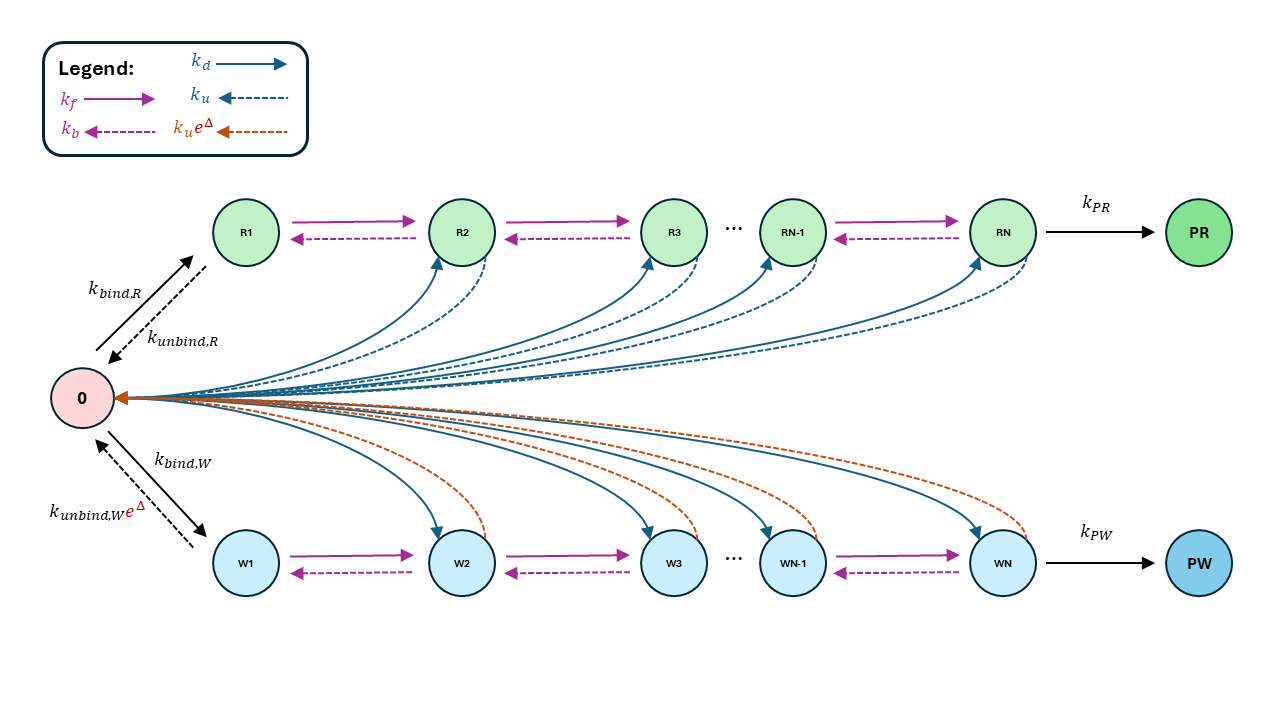
In steady state the trade-off can be optimized following a Pareto front search [2], but such behaviour is emerging from considering an ensemble of reactions. This means that these studies implicitly assume that performance is evaluated on average, identifying optimal parameter regimes under thermodynamic constraints.
![Pareto fronts for error-speed-dissipation realtions for a topology of N=4 steps [2]](/gsp/ACT/images/projects/pareto_fronts_errcorr.png)
Ensemble-average descriptions conceal potentially important information captured by individual realizations/trajectories. These trajectories can differ widely in their thermodynamic cost, even when average behaviour is identical. Two networks may exhibit identical average dissipation, speed, and/or error rate, yet differ drastically in how thermodynamic cost is distributed across individual trajectories [4]. Hence, one network may produce uniformly moderate-cost trajectories; another may generate many cheap realisations alongside rare, highly expensive ones. These distributional differences are invisible to averages-based descriptions, yet they may be consequential for both biological function and the design of synthetic circuits operating under resource constraints.
Project Goals
In this project we ask: what information about network performance is only accessible at the trajectory level, and can systems exploit it? The main hypothesis would be that efficiency in biochemical networks is not solely determined by average behaviour, but by how systems manage and select individual stochastic trajectories. This reframes the problem along two complementary mechanisms: topological biasing, so network topology passively shapes the trajectory-cost distribution without any active intervention, and active abort strategies, which relates to a system that could actively monitor its running trajectory cost and abort inefficient realisations early. Both mechanisms share the same underlying motivation: that controlling individual realisations, not merely optimising averages, is potentially important for performance in (biological) error-correcting protocols.
References
[1] Banerjee K, Kolomeisky AB, Igoshin OA. Elucidating interplay of speed and accuracy in biological error correction. Proc Natl Acad Sci U S A. 2017 May 16;114(20):5183-5188. doi: 10.1073/pnas.1614838114.
[2] Chiuchiu D, Mondal S, Pigolotti S. Pareto optimal fronts of kinetic proofreading. New J Phys. 2023 Apr;25:043007. doi: 10.1088/1367-2630/acc757.
[3] Murugan A, Huse DA, Leibler S. Speed, dissipation, and error in kinetic proofreading. Proc Natl Acad Sci U S A. 2012 Jul 24;109(30):12034-9. doi: 10.1073/pnas.1119911109
[4] Sartori P, Pigolotti S. Thermodynamics of error correction. Phys Rev X. 2015 Dec 10;5:041039. doi: 10.1103/PhysRevX.5.041039.