Fuel Optimality in Lyapunov Control
Project overview
Control Lyapounov Functions (CLFs) [5] provide a framework for designing closed-loop, feedback-driven control laws for spacecraft trajectory design, guidance, and control applications. By enforcing the monotonic decrease of a suitably chosen Lyapunov function, CLF-based controllers guarantee closed-loop stability and robustness to disturbances.
In their basic form, most CLF-based controllers are typically formulated for continuous spacecraft thrusting. As such, they are often good at time-optimal many-revolution transfers. In this work, instead of considering the design, shape or optimisation of the CLFs themselves, we study the comparatively under-explored mechanisms for switching between thrusting and coasting arcs, which has a notable impact on fuel-optimality.
Linking CLFs with Optimal Control Theory
This project, in particular, explores the link between CLFs and Optimal Control Theory. Existing works on the link between OCT and CLFs [1, 2] focus on the structure of the CLF and instead in this project we extend the link to the fuel-optimal switching strategy. We are motivated by the fact that CLFs are an approximation of the time-optimal value function, which is tricky to solve for directly as its the solution to the Hamiltonian-Jacobi-Bellman equations.
By creating a pseudo-Hamiltonian where the state costates are replaced by the spatial derivative of the CLF, and using the same switching function that exhibits bang-bang solutions in OCT, we can introduce a fuel-optimal switching strategy for the CLF without requiring the solution of a two-point boundary value problem.
Test Cases
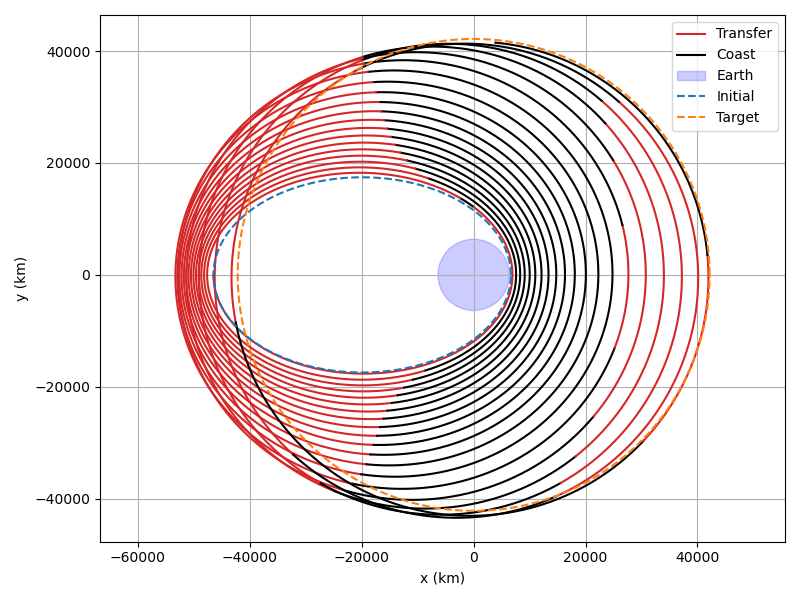
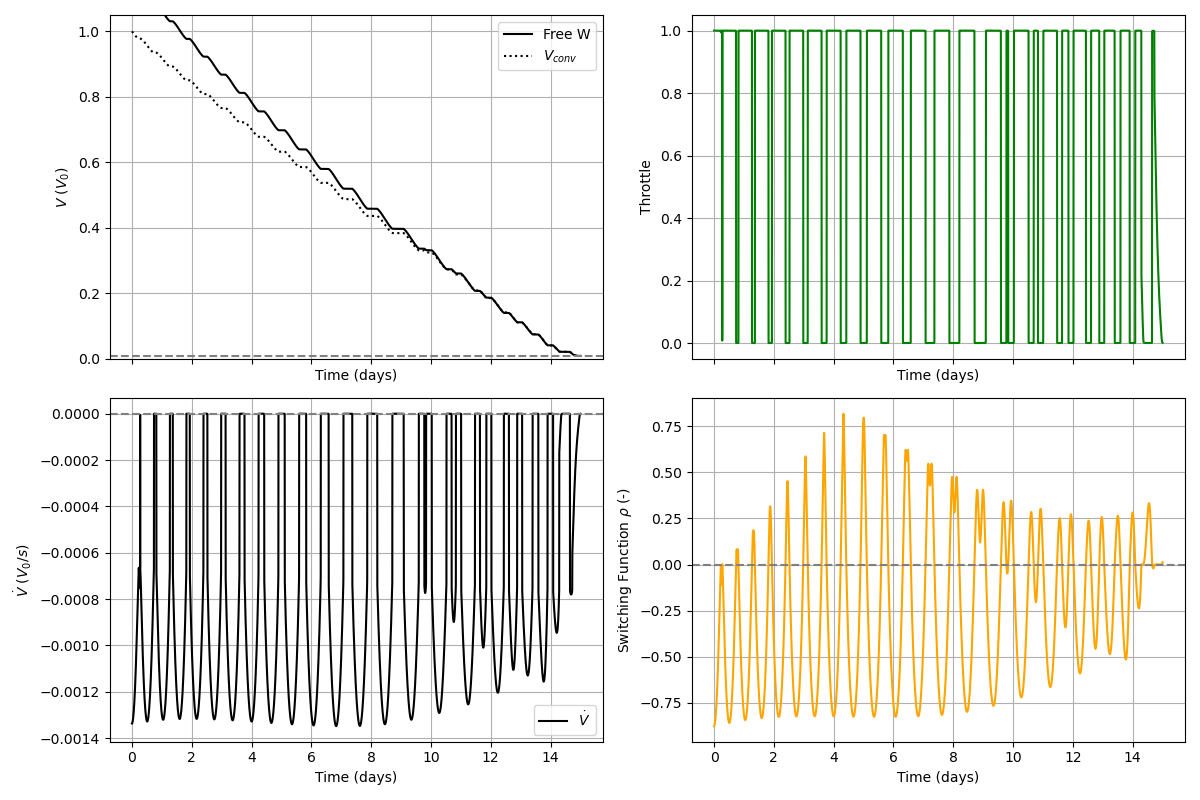
This is applied to many-revolution low-thrust trajectories (GTO-GEO, LEO-GEO, GTO-Molniya, etc. The newly proposed switching functions exhibit an advantage as the thrust-to-mass ratio decreases. Since the CLF provides an approximation of the time-optimal value function, it may consequently become a better approximation of the fuel-optimal value function in the low-thrust regime, as the two converge (see LEO-GEO case).
We compare this switching function approach with two main ones in the literature:
Lyapunov decay thresholds: The user imposes a decay condition on the CLF, within which a quadratic program (QP) is solved to minimise the instantaneous thrust magnitude while preserving formal Lyapunov stability guarantees. (e.g. in [3])
Effectivity thresholds: The more widely adopted approach in astrodynamics and compares the instantaneous rate of CLF decrease to its maximum and minimum values along the current osculating orbit. [4], [5]


References
[1] Yang, G., 2009. Direct optimization of low-thrust many-revolution earth-orbit transfers. Chinese Journal of Aeronautics, 22(4), pp.426-433.
[2] Gao, Y. and Li, X., 2010. Optimization of low-thrust many-revolution transfers and Lyapunov-based guidance. Acta Astronautica, 66(1-2), pp.117-129.
[3] Petropoulos, A., 2004, August. Low-thrust orbit transfers using candidate Lyapunov functions with a mechanism for coasting. In AIAA/AAS Astrodynamics Specialist Conference and Exhibit (p. 5089).
[4] Schaub, H., and Junkins, J. L., 2018. Analytical Mechanics of Space Systems,Fourth Edition. American Institute of Aeronautics and Astronautics, Inc.
[5] R.Tedrake, 2023. Underactuated Robotics. https://underactuated.csail.mit.edu/lyapunov.html