Maximum Initial Mass for Low-Thrust Trajectory Design
Background
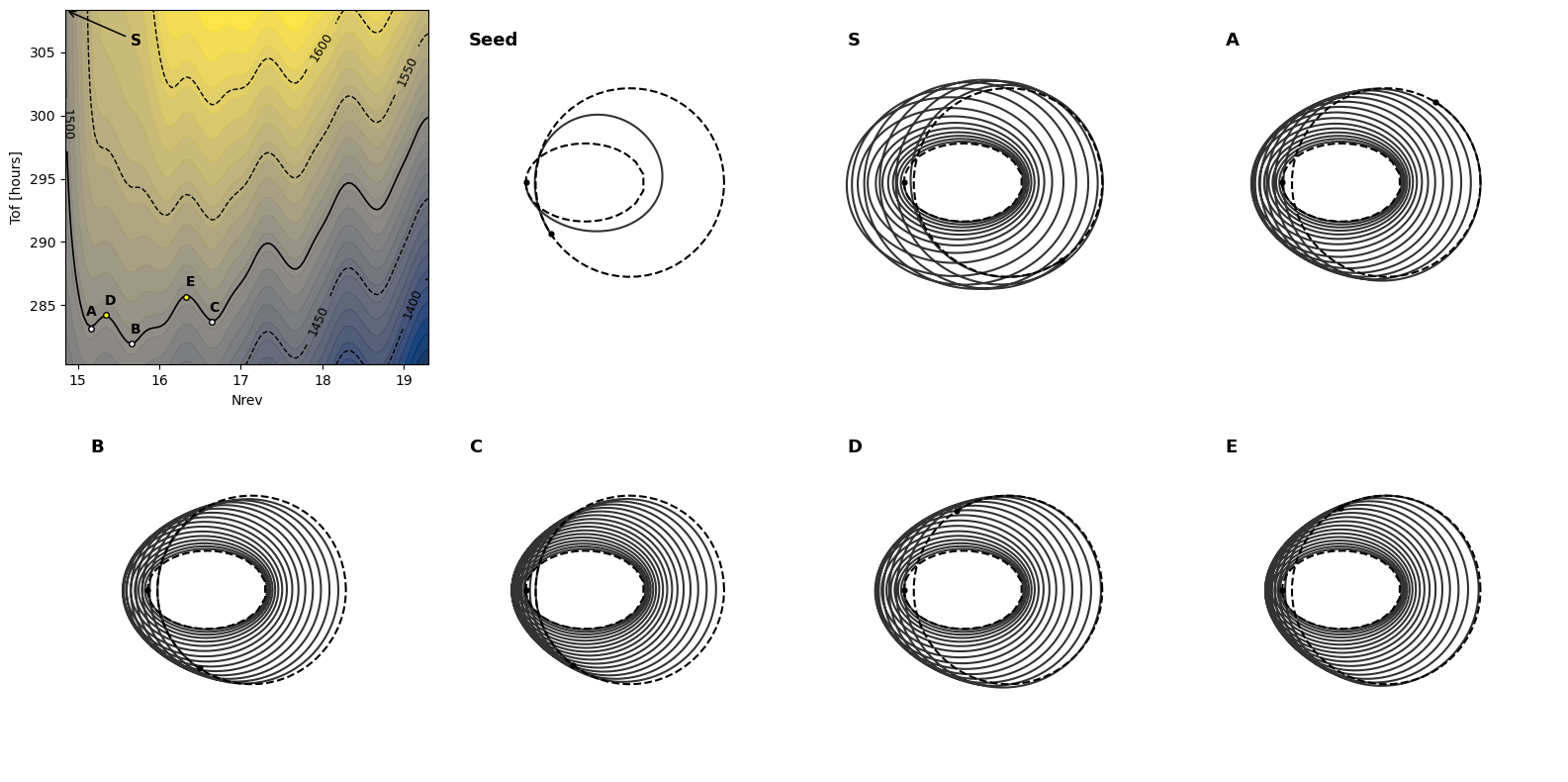
Designing optimal low-thrust trajectories remains a central challenge in space mission analysis. Classical formulations typically focus on either propellant minimisation or transfer time optimisation, both of which lead to highly nonlinear optimal control problems. These problems are often difficult to initialise and solve reliably, particularly in multi-revolution regimes.
This project introduces the Maximum Initial Mass (MIM) formulation as an alternative optimal control perspective. Instead of optimising for minimum time or fuel consumption, the MIM problem seeks the largest initial spacecraft mass that can reach a prescribed terminal state within a fixed transfer time.
This viewpoint has gradually emerged within global trajectory optimisation research. In particular, during the Global Trajectory Optimization Competitions (GTOC), the team at JPL introduced and exploited an approximation to the maximum initial mass solution for short transfer arcs. This approach later became known and systematically studied under the acronym MIMA [1], [2]. More recently, the MIM formulation has been used for characterising reachability in low-thrust dynamics. In this context, machine learning surrogate models have been trained to approximate the MIM function, enabling efficient representation of reachable sets without repeatedly solving full optimal control problems [3].
This reformulation reveals deep connections with classical minimum-time optimal control problems and introduces a smooth continuation parameter that significantly improves numerical convergence in indirect methods.
Project Goals
This project develops the theoretical foundations of the Maximum Initial Mass formulation using Pontryagin’s Maximum Principle. In particular, it establishes the relationship between MIM and minimum-time extremals, clarifies the role of the terminal Hamiltonian condition, and shows how the formulation naturally supports continuation strategies across families of multi-revolution trajectories.
The MIM is also being used to develop fast reachability estimation methods and to support scalable optimisation tools for future autonomous mission design.
References
[1] Hennes, Daniel, Dario Izzo, and Damon Landau. "Fast approximators for optimal low-thrust hops between main belt asteroids." 2016 IEEE Symposium Series on Computational Intelligence (SSCI). IEEE, 2016.
[2] Izzo, Dario, Marcus Märtens, Laurent Beauregard, Max Bannach, Giacomo Acciarini, Emmanuel Blazquez, Alexander Hadjiivanov, Jai Grover, Gernot Heißel, Yuri Shimane, and Chit Hong Yam. "Asteroid mining: ACT&Friends’ results for the GTOC12 problem." Astrodynamics 9 (2025): 19-40.
[3] Acciarini, Giacomo, Dario Izzo, and Zhong Zhang. "Reachability for low-thrust trajectories via maximum initial mass." 30th International Symposium on Space Flight Dynamics. 2026.