Mathematical modelling for strategic decision-making in the future space economy
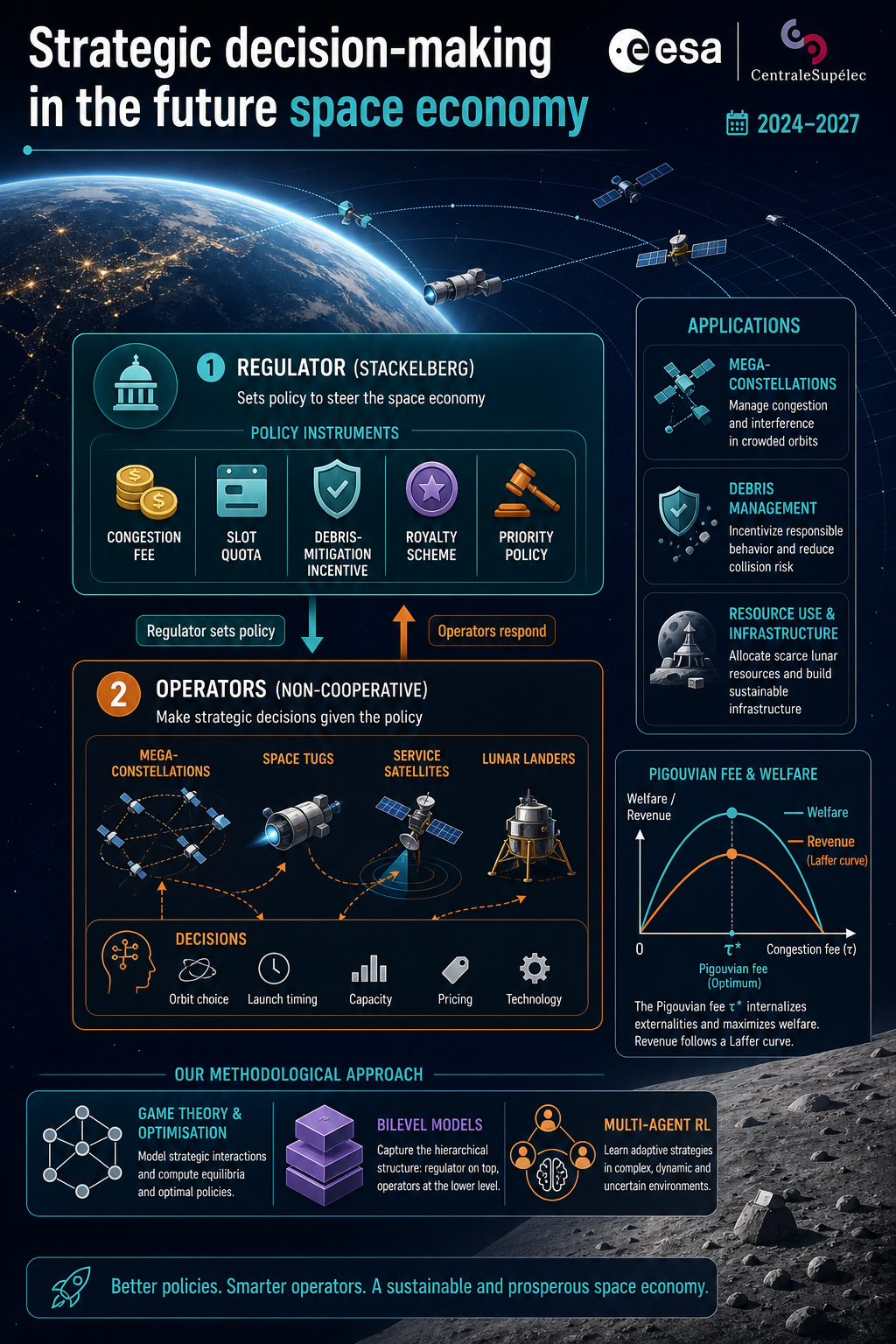
As space becomes more commercially active, the main challenge is not only technical. It is also strategic: how do we encourage many independent actors to make choices that keep the orbital environment safe, usable, and economically valuable over the long term?
This project studies strategic decision-making across the future space economy. Operators, infrastructure providers, resource users, and public authorities do not act in isolation. Decisions about where to operate, which orbital slot to occupy, which target to pursue, how much to invest in mitigation, or how access should be regulated can shift risks, costs, and opportunities across the wider system. For strategy makers, the core question is therefore how to design incentives and rules that support collective outcomes without blocking innovation.
This ongoing work builds on an earlier closed ACT study from 2015, Game theoretic analysis of the space debris removal dilemma, which first examined active debris removal as a strategic coordination problem. The present project explores a related class of applications, including debris management, mega-constellation deployment, in-situ resource utilisation, and future orbital infrastructure.
We use game theory and optimisation methods [1-5] to compare different governance options in a structured way. In practice, this means examining what happens when each actor follows its own interest, identifying where that leads to congestion, avoidable risk, or inefficient use of shared resources, and testing which policy measures can improve the outcome. The work is intended to help decision-makers assess tools such as congestion fees, slot quotas, debris-mitigation incentives, access rules, royalty schemes, and priority policies.
An important feature of the project is that the model used to compute optimal choices is validated against a real operational environment. For this, the project draws on ACT's open-source software tool cascade, a C++/Python library for propagating large populations of orbiting objects while reliably and efficiently detecting conjunction. Cascade is used to connect the strategic analysis with realistic orbital dynamics and conjunction computations. The analysis is thus not limited to economic behaviour in the abstract: it also takes account of the physical and engineering realities that shape space missions.
From a technical point of view, the work combines two modelling layers. The first represents competition among operators when each actor pursues its own objective under mission and engineering constraints, and identifies the resulting equilibrium. The second adds a regulator that chooses a policy in advance, then evaluates how operators are likely to respond. In optimisation terms, this corresponds to non-cooperative equilibrium models on one side and Stackelberg or bilevel policy design on the other [1-5]. This allows the project to connect strategic behaviour, regulatory design, and the physical realities of orbital operations in one framework.
The framework can be applied across several parts of the future space economy. In mega-constellations, it can support decisions on how to reduce congestion and collision risk in low Earth orbit [6]. In lunar and asteroid resource activities, it can help explore how competition over scarce locations or time-critical opportunities should be managed. For future orbital infrastructure, such as servicing platforms or data centres, it can clarify how choices about location, access, spectrum, and jurisdiction may influence both market outcomes and the resilience of the wider space ecosystem.
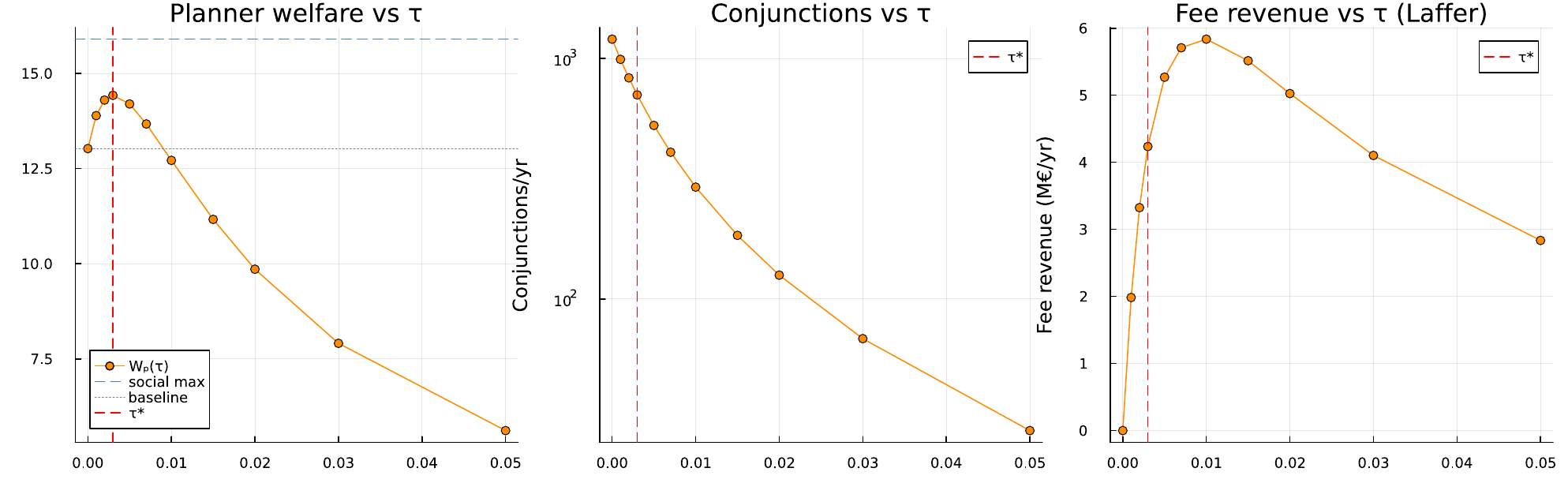
The project also explores multi-agent reinforcement learning [7] as a way to examine how actors may adapt over time when conditions are uncertain and behaviour is not perfectly predictable. This is useful for decision-makers because real-world actors do not always follow idealised assumptions: they learn, react, and change course as markets, costs, and regulations evolve.
This research project is a collaboration between the ESA Advanced Concepts Team and CentraleSupélec, Université Paris-Saclay, under French National Research Agency project ANR-23-CE10-0006 (ANR-JCJC, 2024–2027), Resilient and Sustainable Planning and Management of Future Space Industry Infrastructure, principal investigator Dr. Adam Abdin (CentraleSupélec, Université Paris-Saclay).
References
[1] F. Facchinei and J.-S. Pang. Finite-Dimensional Variational Inequalities and Complementarity Problems. Springer, 2003.
[2] T. Kleinert, M. Labbé, I. Ljubić and M. Schmidt. A survey on mixed-integer programming techniques in bilevel optimization. EURO Journal on Computational Optimization, 9:100007, 2021.
[3] S. Dempe and P. Mehlitz. Duality-based single-level reformulations of bilevel optimization problems. Journal of Optimization Theory and Applications, 205(2):26, 2025.
[4] Z. Feinstein and B. Rudloff. Characterizing and computing the set of Nash equilibria via vector optimization. Operations Research, 72(5):2082–2096, 2024.
[5] Y. Beck, I. Ljubić and M. Schmidt. A survey on bilevel optimization under uncertainty. European Journal of Operational Research, 311(2):401–426, 2023.
[6] N. Adilov, P. J. Alexander and B. M. Cunningham. An economic analysis of Earth orbit pollution. Environmental and Resource Economics, 60(1):81–98, 2015.
[7] K. Zhang, Z. Yang and T. Başar. Multi-agent reinforcement learning: a selective overview of theories and algorithms. In Handbook of Reinforcement Learning and Control, pages 321–384, Springer, 2021.