Continuous learning of irregular gravity fields via Neural Hamiltonian ODEs
The gravity field of a small body is both a primary science product and the core of the force model used by guidance, navigation and control during proximity operations. Its estimation is fundamentally an inverse problem: measurements of spacecraft motion and forces, including tracking data and, where available, direct gravitational-acceleration measurements from a gravimeter, must be used to infer a spatially varying gravitational field from noisy observations collected along the orbits a navigation team is actually willing to fly.
The established representation for this task, the spherical harmonics expansion, converges only outside the Brillouin sphere: the smallest sphere centred at the expansion origin and containing the body. For irregular bodies the region below the Brillouin sphere is not marginal, and descent, sampling and close-proximity operations take place inside it.
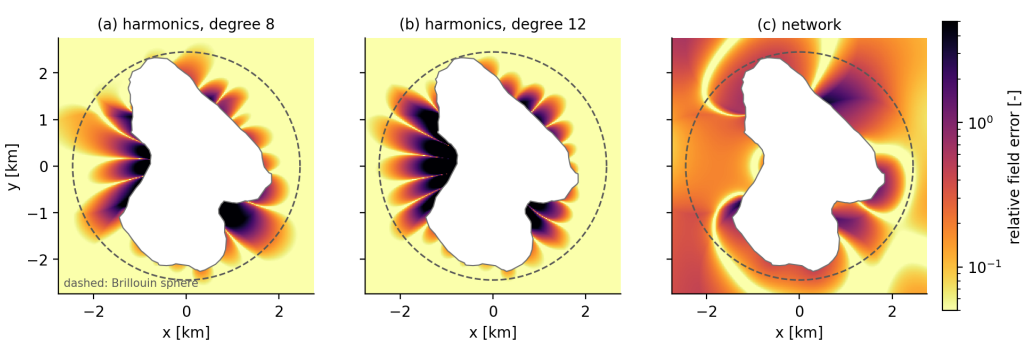
In this project we formulate gravity estimation as learning the unknown part of the system Hamiltonian. A small feed-forward network, multiplied by a physics-informed radial envelope enforcing the correct quadrupole falloff, is compiled symbolically into the equations of motion and integrated with a Taylor scheme (heyoka)~[5]. The resulting Neural Hamiltonian ODE~[4] is trained by batch least squares on the observed arcs, with exact gradients provided by the variational equations of the flow, the same machinery navigators use for orbit determination, and the same we use with the spherical harmonics baseline it is compared against.
Project overview
The estimation is continual by construction: as tracking accumulates over the mission, each refit is warm-started from the previous solution, and the Gauss--Newton information matrix, built from predicted sensitivities alone, scores candidate orbits before they are flown (D-optimal experiment design), turning data acquisition itself into an onboard decision.
Assessed on scenarios built from the shapes of Itokawa, 67P, Bennu and Eros, with ground truths the estimators never see, the approach shows what it can add with respect to the classical pipeline. At flight altitude (above the Brillouin sphere), over the smooth exterior field, the harmonics expansion remains the more accurate estimator. But in the regimes that place the highest demands on the gravity model the picture reverses: from tracking alone and with no shape model, the network plans ballistic descents to Itokawa with 4.6 m median touchdown error against 5.1--48.9 m for harmonics of degree 4--12. It is also the only representation able to effectively assimilate descent data, and it degrades mildly, rather than catastrophically, when a force acting on the spacecraft is left unmodelled (e.g. solar radiation pressure). Once imaging delivers the shape, the correct architecture is a residual one: with the constant-density shape model moved into the known part of the Hamiltonian, the network in these cases reaches 0.9 m median descent planning error and detects buried density anomalies that no harmonics degree or Kaula regularisation can represent from the same data.
The two representations fail in disjoint regimes, and are best flown together across the phases of a small-body mission. Beyond geodesy, the learned model is a smooth, structure-preserving Hamiltonian: high-order expansions of its flow can be used to propagate uncertainties (onboard), connecting this work to the team's research on high-order flow expansions of neural ODEs~[2,3].
References:
Acciarini G, Izzo D. Continuous Learning of Gravity Field Irregularities Around Small Bodies via Neural Hamiltonian ODEs. arXiv preprint arXiv:2609.12022. 2026.
Acciarini G, Baresi N, Lloyd D J, Izzo D (2025). Nonlinear propagation of non-gaussian uncertainties. Journal of Guidance, Control, and Dynamics, 48(4), 903-913.
Izzo D, Origer S, Acciarini G, Biscani F. High-order expansion of neural ordinary differential equation flows. Science Advances. 2025;11(51):eady1348.
Greydanus S, Dzamba M, Yosinski J. Hamiltonian neural networks. Advances in Neural Information Processing Systems. 2019;32.
Biscani F, Izzo D. Revisiting high-order Taylor methods for astrodynamics and celestial mechanics. Monthly Notices of the Royal Astronomical Society. 2021;504(2):2614-2628.