Quantum causality
Background
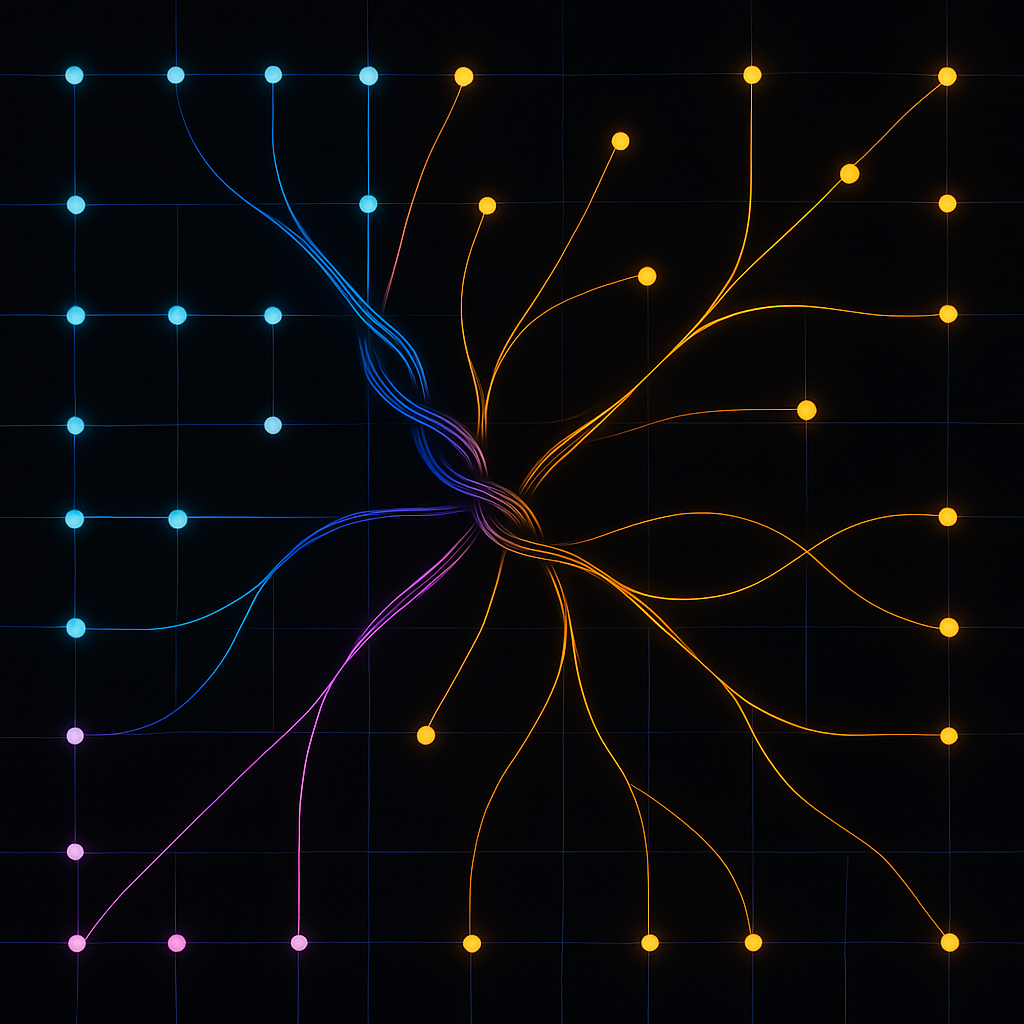
Causality provides the framework to reason about what would happen under change, enabling counterfactuals, policy evaluation, scientific explanation, and control. In the classical domain, structural causal models and Bayesian networks link observational data to the effects of interventions [1]. Their measure-theoretic extension, causal spaces [2], replaces discrete variables with measurable spaces and probability kernels, which accommodates cycles and even indefinite causal order while still defining coherent interventional probabilities. In the quantum domain, measurements disturb systems, so interventions are modeled as sets of completely positive maps, called instruments. The process-matrix formalism [3] assigns classical probability distributions to instrument outcomes, even without a fixed causal order. These lines run in parallel and suggest a common underlying concept.
Project goals
This project aims to unravel and lay out the common theoretical foundations of both frameworks, and work towards a more general model of causality in quantum physics. We will formalize the correspondence between interventions and instruments, align classical events with quantum operations, and identify assumptions under which each framework recovers the other. The work will develop a shared vocabulary, prove representation theorems that bridge probability kernels and process matrices, and test the theory on instructive case studies. Clarifying this parallel structure can provide a first step toward a unified science of causal reasoning across classical and quantum settings.
References
[1] Pearl, Judea. Causality. Cambridge university press, 2009.
[2] Park, Junhyung, et al. "A measure-theoretic axiomatisation of causality." Advances in Neural Information Processing Systems 36 (2023): 28510-28540.
[3] Oreshkov, Ognyan, Fabio Costa, and Časlav Brukner. "Quantum correlations with no causal order." Nature communications 3.1 (2012): 1092.