• → European Space Agency

      • Space for Europe
      • Space News
      • Space in Images
      • Space in Videos
    • About Us

      • Welcome to ESA
      • DG's News and Views
      • For Member State Delegations
      • Business with ESA
      • ESA Exhibitions
      • ESA Publications
      • Careers at ESA
    • Our Activities

      • Space News
      • Observing the Earth
      • Human Spaceflight
      • Launchers
      • Navigation
      • Space Science
      • Space Engineering
      • Operations
      • Technology
      • Telecommunications & Integrated Applications
    • For Public

    • For Media

    • For Educators

    • For Kids

    • ESA

    • Education

    • Teachers' Corner

    • ESA Kids

    • About ESA Education
    • Education programme
    • International collaboration
    • Projects for Teachers
    • European Space Education Resource Office
    • CanSats
    • Hands-on Projects
    • CubeSats
    • Drop Your Thesis!
    • European Student Earth Orbiter
    • European Student Moon Orbiter
    • Fly Your Thesis!
    • Global Educational Network for Satellite Operations
    • Spin Your Thesis!
    • Previous projects
    • Hands-on Collaboration
    • REXUS/BEXUS rocket & balloon experiments
    • GENSO Experimental Orbital Initial Demonstration
    • Previous projects
    • Opportunities
    • Conferences
    • Courses
    • Gaining experience
    • Affiliation programme
    • Subscribe for news

    ESA > Education

    REXUS and BEXUS teams selected

    20 December 2012

    More than 50 students took part in the REXUS/BEXUS Selection workshop held at the European Space Research and Technology Centre (ESTEC) in Noordwijk, the Netherlands, from 11 to 13 December. Eight student teams from ESA's Member and Cooperating States were selected to fly their experiments on sounding rockets and balloons campaigns in 2013 and 2014.

    REXUS/BEXUS are the acronyms for Rocket and Balloon Experiments for University Students, respectively.

    Besides presenting their experiments to a panel of experts from ESA, the Swedish National Space Board (SNSB), SSC, and the German Aerospace Center (DLR), the students participating in the workshop were given training on how to plan, design and document a space project, and could also enjoy a guided tour of the facilities at ESTEC.
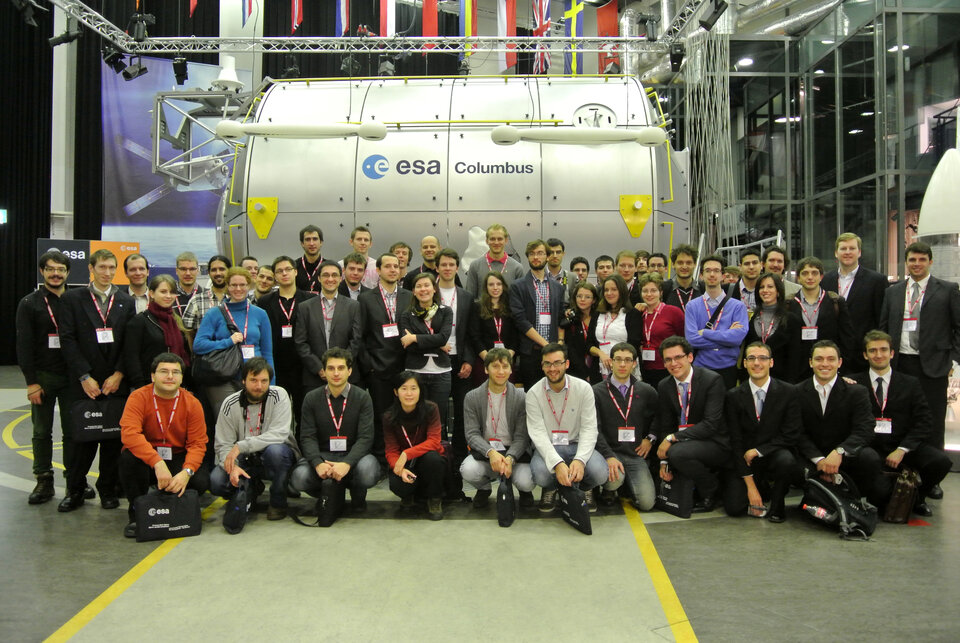
    REXUS-BEXUS selection workshop group picture

    The selected teams for the REXUS 15 and 16 flights are the following:

    • CWIS (Belgium and Italy): Chemical Waves In Soret effect.
    • ISAAC (Sweden): Infrared Spectroscopy to Analyse the upper Atmosphere’s Composition.
    • LOW-GRAVITY (Romania and United Kingdom): Laser Output Welding in microGRAVITY.

    The selected teams for BEXUS 16 and 17 flights are:

    • ARCADE-R2 (Italy): Autonomous Rendezvous Control And Docking Experiment – REFLIGHT 2.
    • Daemon (Hungary): Continuous monitoring of the DNA damage due to solar radiation.
    • FREDE (Poland): FREon Decay Experiment.
    • iSEDE (United Kingdom): Inflatable Satellite Encompassing Disaggregated Electronics.
    • TORMES (Spain): TOpography from Reflectometric Measurements: an Experiment from Stratosphere.
    REXUS / BEXUS team selection workshop in ESTEC

    In addition to these SNSB/ESA teams, DLR also selected six German student experiments to be flown in the same launch vehicles.

    The REXUS/BEXUS programme is realised under a bilateral Agency Agreement between DLR and the SNSB. The Swedish share of the payload has been made available to students from other European countries through a collaboration with ESA. EuroLaunch, a cooperation between the Esrange Space Center of SSC and the Mobile Rocket Base (MORABA) of DLR, is responsible for campaign management and the operation of the launch vehicles. Experts from DLR, SSC and ESA provide technical support to the student teams throughout the project.

    K. Dannenberg (SNSB) presenting organisers of the REXUS & BEXUS programme

    Since the current programme began 6 years ago, more than four hundred students have been given the opportunity to develop their experiments for flights on REXUS and BEXUS, enabling them to receive training from experts in the field, and to gain significant hands-on experience in the design, development and operation of space-related projects.

    The BEXUS 16 and 17 balloons will be launched in autumn 2013, while the REXUS 15 and 16 sounding rockets are scheduled to launch in spring 2014. All flights will take place at the SSC Esrange Space Center in northern Sweden.

    A call for new experiment proposals is issued jointly by ESA and SNSB in September each year, with a deadline in late October.

    Rate this

    Views

    Share

    • Currently 4.5 out of 5 Stars.
    • 1
    • 2
    • 3
    • 4
    • 5
    Rating: 4.42/5 (7 votes cast)

    Thank you for rating!

    You have already rated this page, you can only rate it once!

    Your rating has been changed, thanks for rating!

    607
    facebook
    twitter
    reddit
    google plus
    digg
    tumbler
    digg
    blogger
    myspace
    • More information
    • REXUS/BEXUS rocket & balloon experiments
    • How to apply
    • Sponsorship details
    • Related news
    • BEXUS 14 & 15
    • Opportunity for REXUS 15/16, BEXUS 16/17
    • Rexus 11 launch
    • REXUS 12 launch
    • REXUS 11/12 campaign
    • REXUS 13/14 & BEXUS 14/15 team selection
    • REXUS 9/10 & BEXUS 10/11 team selection
    • Reiter invites students
    • REXUS 7/8 & BEXUS 8/9 team selection
    • REXUS 5/6 launch
    • REXUS 5/6 campaign
    • BEXUS 6/7 flight
    • BEXUS 6/7 campaign
    • REXUS 5/6 & BEXUS 6/7 team selection
    • Related links
    • REXUS/BEXUS website
    • Esrange Space Centre
    • Swedish National Space Board, SNSB
    • German Aerospace Center, REXUS BEXUS

    Connect with us

    • RSS
    • Youtube
    • Twitter
    • Flickr
    • Google Buzz
    • Subscribe
    • App Store
    • LATEST ARTICLES
    • · CryoSat hits land
    • · Ariane 5 completes seven launches …
    • · Measuring skull pressure without t…
    • · Malargüe station inauguration
    • · The solar wind is swirly
    • FAQ

    • Jobs at ESA

    • Site Map

    • Contacts

    • Terms and conditions