• → European Space Agency

      • Space for Europe
      • Space News
      • Space in Images
      • Space in Videos
    • About Us

      • Welcome to ESA
      • DG's News and Views
      • For Member State Delegations
      • Business with ESA
      • ESA Exhibitions
      • ESA Publications
      • Careers at ESA
    • Our Activities

      • Space News
      • Observing the Earth
      • Human Spaceflight
      • Launchers
      • Navigation
      • Space Science
      • Space Engineering
      • Operations
      • Technology
      • Telecommunications & Integrated Applications
    • For Public

    • For Media

      • Media
      • ESA TV
      • Videos for professionals
      • Photos
    • For Educators

    • For Kids

    • ESA

    • Education

    • Teachers' Corner

    • ESA Kids

    • About ESA Education
    • Education programme
    • International collaboration
    • Projects for Teachers
    • European Space Education Resource Office
    • CanSats
    • Hands-on Projects
    • CubeSats
    • Drop Your Thesis!
    • European Student Earth Orbiter
    • European Student Moon Orbiter
    • Fly Your Thesis!
    • Global Educational Network for Satellite Operations
    • Spin Your Thesis!
    • Previous projects
    • Hands-on Collaboration
    • REXUS/BEXUS rocket & balloon experiments
    • GENSO Experimental Orbital Initial Demonstration
    • Previous projects
    • Opportunities
    • Conferences
    • Courses
    • Gaining experience
    • Affiliation programme
    • Subscribe for news

    ESA > Education

    What experiments can be undertaken?

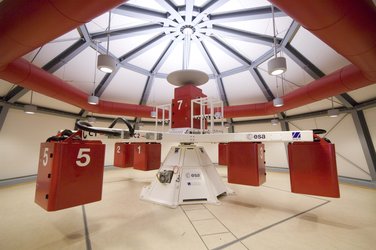
    In the area of hypergravity research there are numerous reasons to perform ground-based research. The most likely uses for the LDC are expected to be:

    • to perform scientific studies on the effects of hypergravity on the system under investigation;
    • to investigate, more specifically, the parameters which might be affected by hypergravity conditions;
    • to test hardware performance under simulated hypergravity conditions.

    Technical constraints

    While defining their projects, applicants should keep in mind the following constraints that apply to the experiments:

    • Experiments requiring high temperatures open flames or similar conditions cannot be performed within the LDC gondolas. Exceptions may be discussed, but the experiment set-up must be well contained, autonomous and present no hazard to either personnel or the LDC and its gondolas.
    • LDC gondolas do not provide active cooling.
    • Power availability in each gondola is limited to 1.3 kW.
    • The experiments should not take up an area of more than 500 mm x 500 mm x 750 mm.
    • The maximum payload per gondola is 80 kg.
    Preparing the experiment in the LDC.

    The gondolas can be supplied with water and gases from bottles stored in the centre of the LDC, broadening the range of possible tests and increasing experiment duration while avoiding intermediate stops. Forced ventilation of the gondolas is also possible.

    The LDC is operated by ESA engineers from the control room via the operator work station. The experiments can also be controlled and monitored by the users via the science work stations at their own centres, through the LabView programme. The users have access to the LDC sensor data and the gondolas’ scientific equipment.

    For examples of experiments in hypergravity you can visit our page on professional centrifuge experiments and the pages of the previous student experiments from Spin Your Thesis!

    Rate this

    Views

    Share

    • Currently 0 out of 5 Stars.
    • 1
    • 2
    • 3
    • 4
    • 5
    Rating: 0/5 (0 votes cast)

    Thank you for rating!

    You have already rated this page, you can only rate it once!

    Your rating has been changed, thanks for rating!

    90
    Tweet

    Related articles

    The new Large Diameter Centrifuge at ESA-ESTEC

    Spin Your Thesis! 2013 teams selected22 March 2013

    The new Large Diameter Centrifuge at ESA-ESTEC

    Spin Your Thesis! 2013 teams selected22 March 2013 Four teams of university students have been chosen to develop and conduct hypergravity experiments during ESA's fourth ‘Spin Your Thesis!’ campaign.

    Spin your thesis in 201305 September 2012

    Spin your thesis in 201305 September 2012 European students are invited to submit their proposals on hypergravity experiments for the 2013 ‘Spin Your Thesis!’ campaign. Proposals can be submitted until 5 February 2013.

    Student teams selected for 'Spin Your Thesis!'26 April 2012

    Student teams selected for 'Spin Your Thesis!'26 April 2012 Three teams of university students will develop and perform experiments in hypergravity during ESA's third ‘Spin Your Thesis!’ campaign.

    Student teams working on 'Spin Your Thesis!'16 March 2011

    Student teams working on 'Spin Your Thesis!'16 March 2011 Four teams of university students will develop and perform experiments in hypergravity during ESA's second ‘Spin Your Thesis!’ campaign.

    Spin Your Thesis! 2010 campaign completed24 September 2010

    Spin Your Thesis! 2010 campaign completed24 September 2010 ESA’s first ‘Spin Your Thesis!’ campaign came to a successful conclusion during the week of 13-17 September, when the third and fourth teams of university students completed their hypergravity experiments.

    Spin Your Thesis! 2010 campaign begins23 June 2010

    Spin Your Thesis! 2010 campaign begins23 June 2010 The first session of the ‘Spin Your Thesis!’ campaign organised by ESA’s Education Office has been completed successfully at the European Space Technology Centre (ESTEC) in the Netherlands.

    Student teams selected for 'Spin Your Thesis!'26 February 2010

    Student teams selected for 'Spin Your Thesis!'26 February 2010 Four teams of university students have been selected to develop and perform their hypergravity experiments during ESA’s first ‘Spin your Thesis!’ campaign.

    • More information
    • Spin Your Thesis!
    • Hypergravity & the LDC
    • Research opportunities
    • 2013 experiments
    • 2012 experiments
    • 2011 experiments
    • 2010 experiments
      • How to apply
        • Eligibility criteria
          • List of documents
          • 2013 schedule
          • Related Links
          • Life and Physical Sciences and Life Support Laboratory
          • ELGRA
          • Register for ESA Education projects

    Connect with us

    • RSS
    • Youtube
    • Twitter
    • Flickr
    • G+
    • Facebook
    • Livestream
    • Subscribe
    • App Store
    • LATEST ARTICLES
    • · Rare merger reveals secrets of gal…
    • · Watching for hazards: ESA opens as…
    • · ESA astronaut Timothy Peake set fo…
    • · Space drives e-mobility
    • · Proba-V opens its eyes
    • FAQ

    • Jobs at ESA

    • Site Map

    • Contacts

    • Terms and conditions