• → European Space Agency

      • Space for Europe
      • Space News
      • Space in Images
      • Space in Videos
    • About Us

      • Welcome to ESA
      • DG's News and Views
      • For Member State Delegations
      • Business with ESA
      • ESA Exhibitions
      • ESA Publications
      • Careers at ESA
    • Our Activities

      • Space News
      • Observing the Earth
      • Human Spaceflight
      • Launchers
      • Navigation
      • Space Science
      • Space Engineering
      • Operations
      • Technology
      • Telecommunications & Integrated Applications
    • For Public

    • For Media

      • Media
      • ESA TV
      • Videos for professionals
      • Photos
    • For Educators

    • For Kids

    • ESA

    • ATV

    • International Space Station

    • Human Spaceflight

    • Flight plan
    • ATV mission concept
    • ATV flight phases
    • ATV cargo capacity
    • Spacecraft
    • ATV configuration
    • ATV Integrated Cargo Carrier
    • ATV Service Module
    • ATV evolution
    • ATV Missions
    • ATV-1: Jules Verne
    • ATV-2: Johannes Kepler
    • ATV-3: Edoardo Amaldi
    • ATV-4: Albert Einstein
    • ATV-5: George Lemaître
    • Operations
    • Flight operations
    • ATV Control Centre
    • Crew role
    • Industry
    • ESA's role
    • European industry
    • ATV-4 downloads

      • ATV-4 mission brochure English
      • ATV-4 mission brochure German
      • ATV-4 mission brochure French
      • ATV-4 mission brochure Italian
      • ATV-4 mission brochure Russian
    • Multimedia gallery
    • ATV image gallery
    • ATV video gallery
    • ATV on Flickr

    ESA > Our Activities > Human Spaceflight > ATV

    Inside the ATV

    ATV configuration

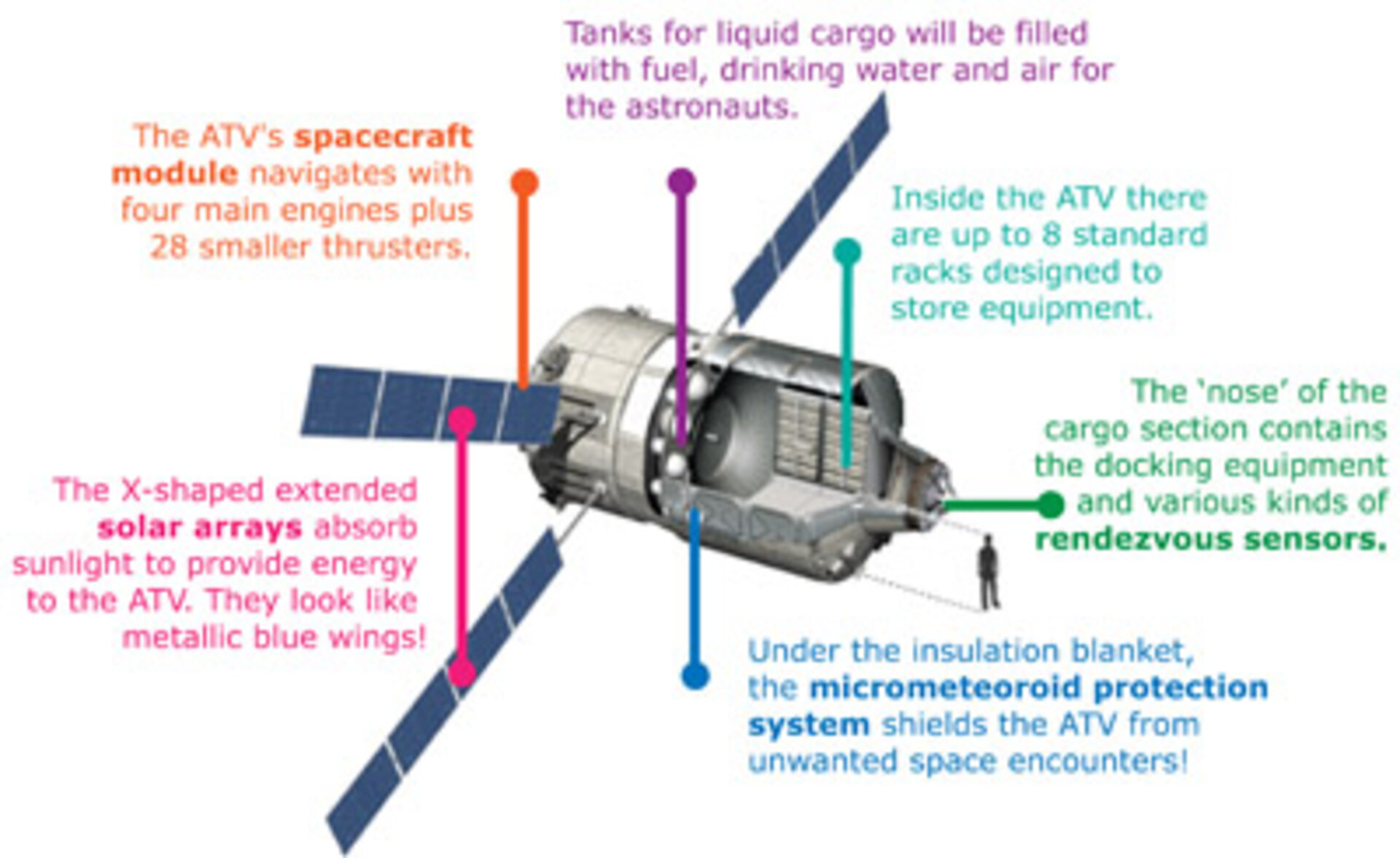
    The exterior of this new generation spacecraft is a cylinder, 10.3 metres long and up to 4.5 metres in diameter. The details of the ATV's external structure are covered with a foil layer and meteorite protection panels.

    Characteristic X-shaped solar arrays extend from the spacecraft. Deployed 100 minutes after lift-off, the solar arrays reach a span of 22.3 m. The four arrays are totally independent and can rotate to get the best orientation to the Sun. They are able to produce an average of 4 800 watts - providing power to rechargeable batteries which are vital for powering ATV systems when the spacecraft is in the shadow of Earth.

    The ATV consists of two main modules:

    • The Integrated Cargo Carrier
    • The ATV Service Module

    Last update: 9 March 2010

    Rate this

    Views

    Share

    • Currently 3.5 out of 5 Stars.
    • 1
    • 2
    • 3
    • 4
    • 5
    Rating: 3.25/5 (4 votes cast)

    Thank you for rating!

    You have already rated this page, you can only rate it once!

    Your rating has been changed, thanks for rating!

    1181
    Tweet
    • Learn more about ATV on Space-in-bytes

    Connect with us

    • RSS
    • Youtube
    • Twitter
    • Flickr
    • G+
    • Facebook
    • Livestream
    • Subscribe
    • App Store
    • LATEST ARTICLES
    • · Rare merger reveals secrets of gal…
    • · Watching for hazards: ESA opens as…
    • · ESA astronaut Timothy Peake set fo…
    • · Space drives e-mobility
    • · Proba-V opens its eyes
    • FAQ

    • Jobs at ESA

    • Site Map

    • Contacts

    • Terms and conditions
