Flight operations
Flight Operations, also known as 'Flight Ops', are a very complex set of written rules and procedures. They are essential for a complex mission such as ATV, to bring together its logistics, its ground segment - including control centres, launch, tests and training facilities, and different scenarios.
For ATV, Flight Ops were quite elaborate since they involved:
- Kourou, ESA's launch site in French Guiana where the ATV took off on top of an Ariane 5. The early mission software sequences were loaded onto ATV at the launch site.
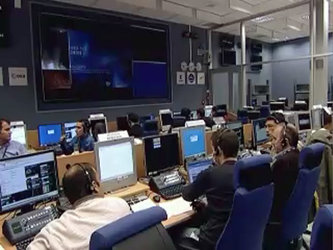
- ATV Control Centre (ATV-CC) in Toulouse, France, from where a ground team controls an ATV mission.
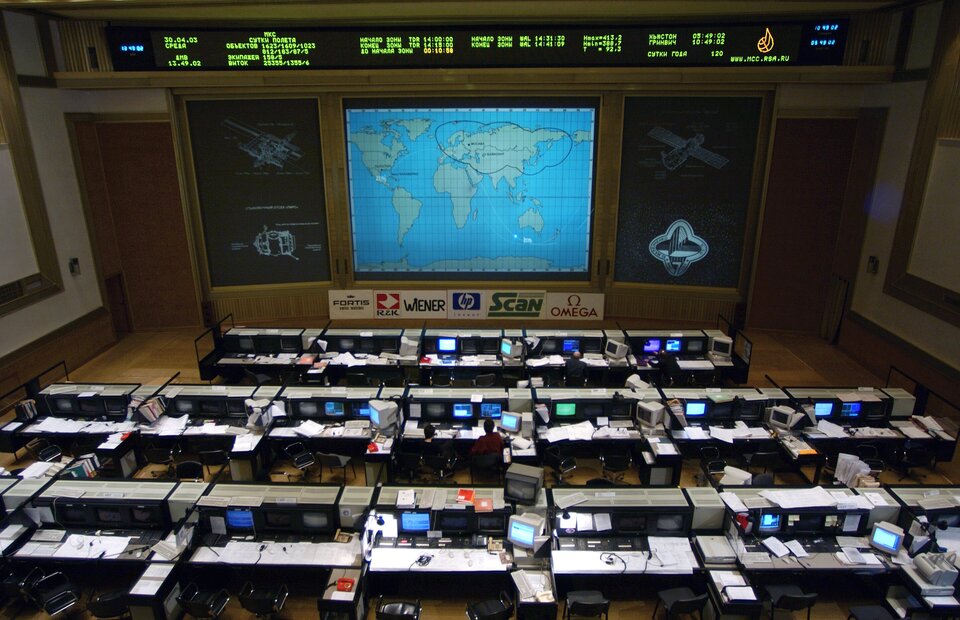
- Mission Control Centre in Moscow (MCC-M) because ATV docked with the Russian segment of the International Space Station. MCC-M took control most of the time during the six-month docked phase of ATV.
- Mission Control Center in Houston (MCC-H) is responsible for the entire Space Station and coordinated overall ATV and Station operations.
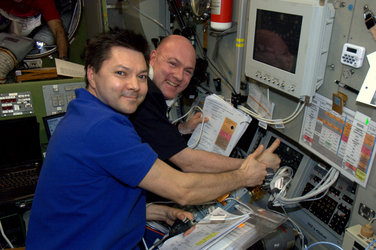
- Astronauts who monitor tasks during the rendezvous and cargo transfer during the docked phase.
ATV-CC communicated with ATV to control and monitor its behaviour and performance, and when needed, to send commands. The communications between the ATV Control Centre and ATV itself were routed either via NASA relay satellites, or by the European relay satellite Artemis. Both paths were available at all times.

Pre-programmed sequences
Since ATVs are highly automated spaceships, ground controllers essentially monitored its flight and, at predefined steps, sent 'Go' commands to the spaceship to execute the next programmed sequence.
ATVs were loaded with Onboard Mission Plans, which automatically ran software sequences, controlling the spacecraft's configuration. Some Onboard Mission Plans, which correspond to the flight to be flown, were sent to ATV sequentially as the mission went on, with the proper data corresponding in particular to the manoeuvres that the spacecraft should perform.
This remote surveillance required complex ground infrastructure. In case of irregular situations ATV-CC needed to understand what went wrong and implement proper solutions to recover a mission.
Constant and in real-time
ATV Flight Operations prime objective was to maintain a constant interface with ATV in real-time. This crucial task was indispensable to the mission and required the instantaneous treatment of all telemetry, parameters and data of the spaceship.
Each team handling an ATV mission had its own flight operations tools:
- Flight Rules dictated the decisions taken by the Flight Director.
- The Flight Operations Plan was used by ATV-CC flight controllers to execute two kinds of procedures on Earth: procedures related to ATV only and a set of procedures for ground control logistics.
- Multi Elements Procedures and the Operations Interface Procedures were the tasks assigned to each Control Centre and their interfaces.
- Onboard Data Files were used in orbit by the astronauts that worked with an ATV.