• → European Space Agency

      • Space for Europe
      • Space News
      • Space in Images
      • Space in Videos
    • About Us

      • Welcome to ESA
      • DG's news and views
      • For Member State Delegations
      • Business with ESA
      • Law at ESA
      • ESA Exhibitions
      • ESA Publications
      • Careers at ESA
    • Our Activities

      • Space News
      • Observing the Earth
      • Human Spaceflight
      • Space Transportation
      • Navigation
      • Space Science
      • Space Engineering & Technology
      • Operations
      • Telecommunications & Integrated Applications
      • Preparing for the Future
    • Careers at ESA

    • For Media

      • Media
      • ESA TV
      • Videos for professionals
      • Photos
    • For Educators

    • For Kids

    • ESA

    • Human Spaceflight

    • Astronauts

    • International Space Station

    • Research

    • Education

    • About research in space
    • Research areas
    • Human health
    • Aging
    • Plants
    • Life support
    • Exobiology
    • Physics and materials
    • Radiation
    • Technology
    • Platforms and facilities
    • International Space Station
    • Sounding rockets
    • Parabolic flights
    • Drop towers
    • Bedrest and ground studies
    • Hypergravity
    • Research activities
    • Research Announcements
    • Experiment archive
    • Multimedia
    • Images
    • Videos
    • Web Streaming Network
    • Printed products
    • Brochures
    • European user guide to low gravity platforms
    • Space for life newsletter

    ESA > Our Activities > Human Spaceflight > Research

    Earth's protective shield

    Radiation

    Away from Earth’s atmosphere, the International Space Station is exposed to the hostile environment of space. This orbital location has advantages: it makes the outpost a precious platform for observing the Sun and cosmic radiation over a long period of time.

    Outside Earth’s protective atmosphere, radiation is everywhere: high-energy particles from the Sun, protons, electrons and ions are attracted by Earth’s magnetic field while cosmic rays bombard us from beyond the Solar System.

    Radiation levels in space are up to 15 times higher than on Earth and radiation can have severe health consequences for astronauts as well as damage materials, electronic components and solar cells. The International Space Station's shell does offer some protection.

    Understanding radiation, its interaction with the Station and its impact on humans is important for long-duration flights beyond Earth. Several experiments have been monitoring radiation across the entire Station to help scientists understand it and develop efficient shielding.

    Here comes the sun

    The Sun is our star, our main source of light and energy. Only by analysing solar activity in more detail can we hope to understand the physical mechanisms at work in this gigantic fusion reactor.

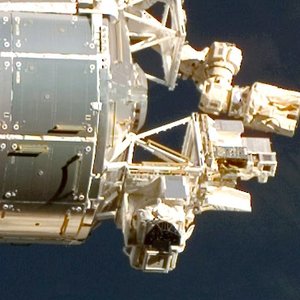
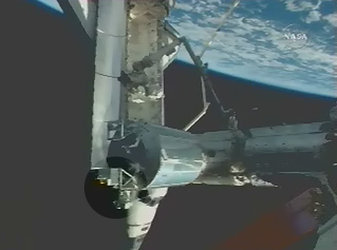
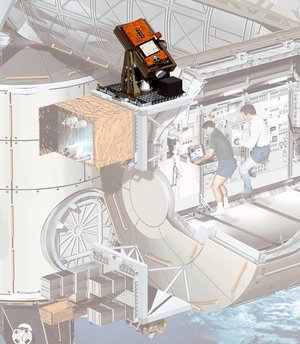
    Instruments that make up ESA’s Solar facility on the Columbus module have been studying the Sun’s irradiation with extreme accuracy across most of its spectral range since 2008.

    Solar facility on Space Station

    Scientific data from Solar are helping scientists improve climate models and sharpen future climate forecasts. Its instruments will help build an even more detailed picture of sunspots, flares and our star’s magnetic field. Scientists also hope to better distinguish between the Sun’s impact and human influence on Earth’s climate.

    The data from this experiment can aid satellite design to prolong their life. The readings will contribute to more accurate navigation data, as well as more precise satellite and space-debris orbit predictions.

    Last update: 24 April 2015

    Rate this

    Views

    Share

    • Currently 5 out of 5 Stars.
    • 1
    • 2
    • 3
    • 4
    • 5
    Rating: 5/5 (3 votes cast)

    Thank you for rating!

    You have already rated this page, you can only rate it once!

    Your rating has been changed, thanks for rating!

    1416
    Tweet

    Related articles

    International Space Station salutes the Sun28 November 2012

    International Space Station salutes the Sun28 November 2012 This weekend, the International Space Station will turn itself to position ESA’s SOLAR instrument for a better view of the Sun. It will be the first time the Station has changed attitude for scientific reasons alone.

    Capturing the Sun in a computer05 October 2012

    Capturing the Sun in a computer05 October 2012 ESA’s SOLAR instrument suite on the International Space Station has been granted a longer lease of life to continue recording almost the full spectrum of the Sun’s radiation. SOLAR is vital for understanding the Sun and its effects on Earth.

    SOLAR and EuTEF

    SOLAR: three years observing and ready for solar maximum11 March 2011

    SOLAR and EuTEF

    SOLAR: three years observing and ready for solar maximum11 March 2011 Europe’s Columbus research module has been part of the International Space Station for three years now. During that time, its external SOLAR package has been faithfully monitoring the energy flowing from the Sun.

    SOLAR and EuTEF are circled

    Columbus external experiments installed during spacewalk15 February 2008

    SOLAR and EuTEF are circled

    Columbus external experiments installed during spacewalk15 February 2008 Astronauts have successfully completed a spacewalk to install the Columbus external experiment facilities, SOLAR and the European Technology Exposure Facility. The facilities will now be activated and checked out before starting to collect the first d...

    Solar location on Columbus

    Sun observatory for Columbus arrives in Florida15 August 2007

    Solar location on Columbus

    Sun observatory for Columbus arrives in Florida15 August 2007 Solar, a suite of payload instruments for the Columbus laboratory, arrived yesterday at NASA's Kennedy Space Center, Florida, completing a seven day journey from Turin, Italy.

    ESA’s Sun-watching Proba-2 minisatellite shows the aftermath of 18 February 2014’s ‘coronal mass ejection’

    SOLAR24 January 2008

    ESA’s Sun-watching Proba-2 minisatellite shows the aftermath of 18 February 2014’s ‘coronal mass ejection’

    SOLAR24 January 2008 SOLAR studies the Sun with unprecedented accuracy across most of its spectral range. Apart from contributing to solar and stellar physics and increasing our knowledge of how the Sun interacts with Earth's atmosphere, the facility is of great importanc...

    • Experiment archive
    • International Space Station Benefits for Humanity
    • European space laboratory Columbus
    • App Store
    • Subscribe
    • mobile version
    • LATEST ARTICLES
    • · Counting calories in space
    • · How to rescue a Moonwalker in need
    • · See our seasons change from space
    • · Preparing for Mercury: BepiColombo…
    • · Giant iceberg in the making
    • FAQ

    • Site Map

    • Contacts

    • Terms and conditions