• → European Space Agency

      • Space for Europe
      • Space News
      • Space in Images
      • Space in Videos
    • About Us

      • Welcome to ESA
      • DG's News and Views
      • For Member State Delegations
      • Business with ESA
      • ESA Exhibitions
      • ESA Publications
      • Careers at ESA
    • Our Activities

      • Space News
      • Observing the Earth
      • Human Spaceflight
      • Launchers
      • Navigation
      • Space Science
      • Space Engineering
      • Operations
      • Technology
      • Telecommunications & Integrated Applications
    • For Public

    • For Media

    • For Educators

    • For Kids

    • ESA

    • Navigation

    • EGNOS

    • Galileo

    • Evolution

    • About satellite navigation
    • Europe's satellite navigation services
    • Resources
    • Development Facilities
    • Navipedia
    • Multimedia
    • Galileo's In-Orbit Validation phase - 2012 video
    • Galileo - Europe leads the way 3D video
    • Image gallery
    • Video gallery
    • Documents
    • Galileo factsheet (PDF)
    • Galileo IOV factsheet (PDF)
    • Galileo FOC factsheet (PDF)
    • GNSS Evolution factsheet (PDF)
    • Galileo IOV brochure (PDF)
    • Galileo IOV brochures in French and German (PDF)
    • Archives
    • News archive
    • Navigation projects
    • Services
    • Subscribe

    ESA > Our Activities > Navigation

    First Galileo satellites six months from launch

    GIOVE A satellite (artist impression)
    GSTB-V2/A satellite (artist's impression)
    9 June 2005

    Two experimental satellites are being developed for the Galileo System Test Bed – Version 2, which will make up the first phase of in the 'in-orbit validation' of the Galileo system. Both spacecraft are now approximately six months away from launch.

    The main mission of these first Galileo satellites is intended to secure the Galileo frequency filings, validate new technologies for operational use, characterise the radiation environment of medium earth orbit that the operational satellites will occupy and enable experimentation with live Galileo signals. To ensure the success of this phase, two satellites have been ordered from industry, currently known as GSTB-V2/A and GSTB-V2/B, and they are being built in parallel. They are the first step towards the 'in-orbit validation' phase, which will require a constellation of four satellites.

    Satellite assembly and test

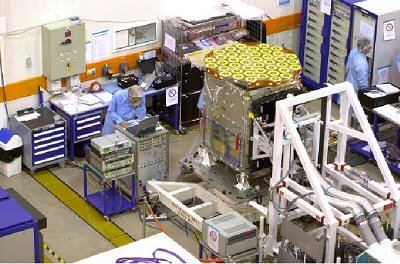
    GSTB-V2/A payload bay under construction
    GSTB-V2/A payload bay under construction

    GSTB-V2/A is being developed by Surrey Satellite Technology Ltd (UK). Galileo Industries (GaIn) is developing the GSTB-V2/B satellite. GaIn is a European consortium including Alcatel Space Industries (F), Alenia Spazio (I), Astrium GmbH (D), Astrium Ltd (UK) and Galileo Sistemas y Servicios (E).

    Much of the testing of the units and subsystems that will make up the two spacecraft has been completed. Both satellites are now being assembled and prepared for their environmental tests, which ensure that the satellite is able to withstand the stress of launch and that it will operate correctly in space. GSTB-V2/A will be transported to the European Space Research and Technology Centre (ESTEC) to undergo testing early in the summer. GSTB-V2/B, currently being assembled at Astrium in the UK, will begin its test campaign at Alenia in Rome before moving to ESTEC for final testing in the autumn.


    ESA payload procurement

    GTTB-V2/B payload module under test
    GTTB-V2/B payload module under test

    In GSTB-V2, the European Space Agency (ESA) has direct responsibility for the procurement of all of the GTSBV2/B payload units and some of the GSTB-V2/A payload units. The other part of the GSTB-V2/A payload is a parallel signal generation chain developed by SSTL, the satellite prime contractor.

    The units procured by ESA include:

    • rubidium frequency standards (both satellites)
    • a passive hydrogen maser (GSTB-V2/B)
    • clock monitoring and control units (both satellites)
    • navigation signal generation units (both satellites)
    • frequency generation and upconversion units (both satellites)
    • solid state power amplifiers (GSTB-V2/B)
    • output filters and diplexer (GSTB-V2/B)
    • navigation antennas (both satellites)

    The flight versions of all units have been successfully delivered to the satellite prime contractors and production of the spare units is in progress.

    Ground facilities

    In parallel with the construction of the two spacecraft, the ground facilities required for controlling the satellites and performing the validation experiments are being developed and tested.

    The primary ground systems for GSTB-V2/A are located at the Chilbolton Observatory and Rutherford-Appleton Laboratory in the UK. The control centre for GSTB-V2/B is at Fucino in Italy.

    Launch

    Preparations for the launch of both satellites have been initiated. Soyuz vehicles will launch both spacecraft from the Baikonur cosmodrome in Kazakhstan. An inspection of the launch facilities was completed in April. The launch of the first Galileo test satellite is currently scheduled for December this year.

    Additional information about the Galileo programme is now available on the European Space Agency web portal. A new navigation menu on the right hand side of the Galileo pages gives access to the following subject areas:

    • First stages of Galileo
    • In-orbit validation
    • Full deployment
    • Galileo specifications

    Rate this

    Views

    Share

    • Currently 0 out of 5 Stars.
    • 1
    • 2
    • 3
    • 4
    • 5
    Rating: 0/5 (0 votes cast)

    Thank you for rating!

    You have already rated this page, you can only rate it once!

    Your rating has been changed, thanks for rating!

    26
    Tweet
    • Related news
      • Galileo: contracts for the first satellites
        • Contract signed for launch of two experimental Galileo satellites
        • Galileo In-Orbit Validation contract is signed
        • Related links
        • Galileo (ESA)
        • Galileo Joint Undertaking (GJU)
        • Galileo website (EC)
        • SSTL - GSTB-V2A
        • European Satellite Navigation Industries
        • ESTEC Test Centre

    Connect with us

    • RSS
    • Youtube
    • Twitter
    • Flickr
    • G+
    • Facebook
    • Livestream
    • Subscribe
    • App Store
    • LATEST ARTICLES
    • · ESA astronaut Timothy Peake set fo…
    • · Space drives e-mobility
    • · Proba-V opens its eyes
    • · First new Galileo satellite arrive…
    • · Next destination: space
    • FAQ

    • Jobs at ESA

    • Site Map

    • Contacts

    • Terms and conditions