HIRS/4 scanning method
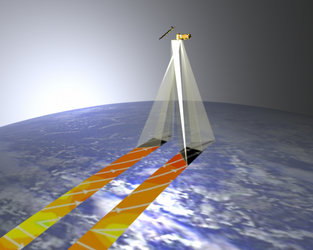
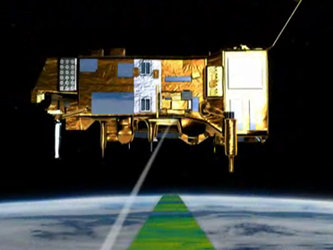
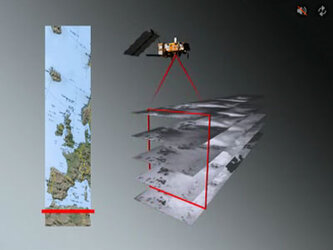
Multi-spectral data from 20 channels are obtained from a single scanning telescope. A rotating filter wheel located in the optical train containing 20 individual filters seperates the individual channels. An elliptical scan mirror provides cross-track scanning of 56 steps in increments of 1.8°. The filter wheel makes one revolution for each step of the scan mirror. The mirror rapidly steps (@ 32 msec.), then holds at each position while the 20 filter segments are sampled during the wheel revolution. This action ('stop & stare') takes place each 0.1 sec. As a result, an Earth scan line lasts 6.4 sec. (stops & stares + retrace back).
The HIRS/4 optics are designed to operate within its specifications under any Sun angle condition between 0° and 80°. The radiant cooler is designed to operate from 0° to 68° Sun angle and, with spacecraft supplied shading, can operate from 0° to 80° Sun angle. The Sun angle is defined as the angle between the satellite to Sun line and the normal to the orbital plane.
HIRS/4 scans the Earth surface in 20 spectral bands in the range of 0.69 - 14.95 microns: one visible channel at 0.69 micron, seven short-wave IR channels (3.7 to 4.6 microns) and 12 long-wave IR channels (6.5 to 15 microns). This provides data for:
- temperature
- altitude profiles
- moisture content
- cloud height
- surface albedo
The instrument sensitivity (noise equivalent spectral radiance, NEDN) are illustrated in the table below.
| Channel number | Centre wavenumbCener (cm-1) | tre wavelength (mm) |
Specified sensitivity (NEΔN) (mW/ m2 sr cm-1) | FWHM bandwidth (cm-1) | |
|---|---|---|---|---|---|
| 1 | 669 | 14.95 | 3.00 | 3 | LW |
| 2 | 680 | 14.71 | 0.67 | 10 | LW |
| 3 | 690 | 14.49 | 0.50 | 12 | LW |
| 4 | 703 | 14.22 | 0.31 | 16 | LW |
| 5 | 716 | 13.97 | 0.21 | 16 | LW |
| 6 | 733 | 13.64 | 0.24 | 16 | LW |
| 7 | 749 | 13.35 | 0.20 | 16 | LW |
| 8 | 900 | 11.11 | 0.10 | 35 | LW |
| 9 | 1030 | 9.71 | 0.15 | 25 | LW |
| 10 | 802 | 12.47 | 0.15 | 16 | LW |
| 11 | 1365 | 7.33 | 0.20 | 40 | LW |
| 12 | 1533 | 6.52 | 0.20 | 55 | LW |
| 13 | 2188 | 4.57 | 0.006 | 23 | SW |
|---|---|---|---|---|---|
| 14 | 2210 | 4.52 | 0.003 | 23 | SW |
| 15 | 2235 | 4.47 | 0.004 | 23 | SW |
| 16 | 2245 | 4.45 | 0.004 | 23 | SW |
| 17 | 2420 | 4.13 | 0.002 | 28 | SW |
| 18 | 2515 | 4.00 | 0.002 | 35 | SW |
| 19 | 2660 | 3.76 | 0.001 | 100 | SW |
| 20 | 14500 | 0.69 | 0.10% albedo | 1000 | VIS |
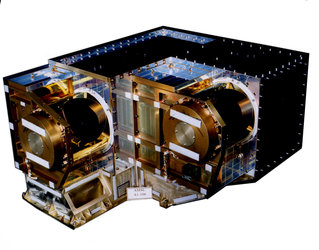
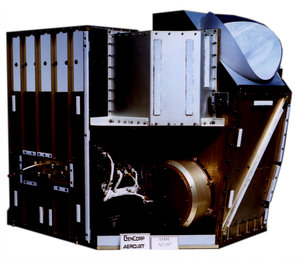
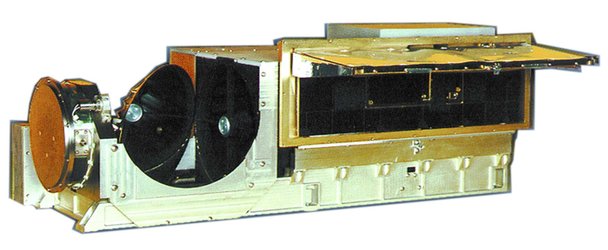
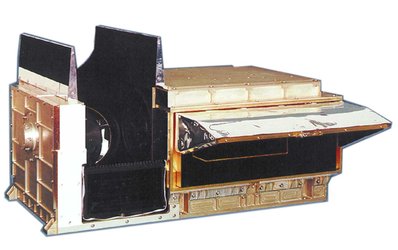
The HIRS/4 instrument is a single package that mounts directly onto the satellite. The major sub-assemblies are:
- Scan subsystem
- Filter Wheel Sub-Assembly
- Detectors
- Radiant Cooler Assembly
- Optical Assembly
- Baseplate