• → European Space Agency

      • Space for Europe
      • Space News
      • Space in Images
      • Space in Videos
    • About Us

      • Welcome to ESA
      • DG's News and Views
      • For Member State Delegations
      • Business with ESA
      • ESA Exhibitions
      • ESA Publications
      • Careers at ESA
    • Our Activities

      • Space News
      • Observing the Earth
      • Human Spaceflight
      • Launchers
      • Navigation
      • Space Science
      • Space Engineering
      • Operations
      • Technology
      • Telecommunications & Integrated Applications
    • For Public

    • For Media

    • For Educators

    • For Kids

    • ESA

    • Operations

    • Ground Systems Engineering

    • Space Debris

    • SSA

    • Operations
    • Operations home
    • Background
    • About Operations
    • The Right Stuff
    • Multimedia

      • Images
      • Videos
    • SSA programme
    • Space Situational Awareness
    • Teams on ground
    • Ground Systems Engineering
    • EGOS - Ground operation system
    • Missions in space
    • Solar and planetary
    • Astronomy & fundamental physics
    • Earth observation
    • Human spaceflight
    • Technology demonstration
    • Estrack operations
    • Past missions
    • ESA mission history
    • - Find a mission: A...Z
    • Mission control centres
    • ATV Control Centre (ATV-CC)
    • Columbus Control Centre (Col-CC)
    • Ground stations
    • Estrack tracking stations
    • ESTRACK Control Centre
    • - Find a station: A...Z
    • OPS Community
    • Advanced Operations Concepts Office
    • HSO Exchange
    • Knowledge Management at ESA's Operations team

    ESA > Our Activities > Operations

    Mars Express mission controllers ready for NASA Phoenix landing

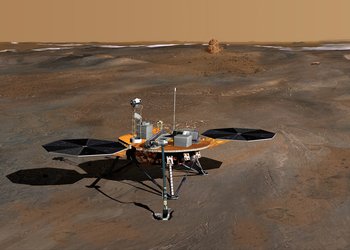
    Artist's impression of parachute deployment during Phoenix's descent to Mars
    20 May 2008

    ESA's Mars Express mission control team are ready to monitor Phoenix's critical entry, descent and landing onto the Martian surface on 26 May 2008.

    The Mars Express mission control team have completed major preparations for supporting the entry, descent and landing (EDL) phase of NASA's Phoenix mission to the Red Planet. On 25 May, Mars Express will point towards Phoenix's planned entry trajectory and record signals broadcast from the lander as it plunges through the Martian atmosphere.

    The recorded data will serve as a useful and potentially crucial back-up to compare Phoenix's planned and actual descent profiles. Landing is planned for 23:38 UTC, 25 May, which is 01:38 CEST, 26 May.

    Mars Express Spacecraft Operations Manager Michel Denis

    "We have tested a specially designed slew for our spacecraft, and scheduled a series of data downloads immediately after Phoenix's landing; NASA will receive our recorded data about one hour later," says Michel Denis, Spacecraft Operations Manager at ESOC, ESA's Space Operations Centre, Darmstadt, Germany.

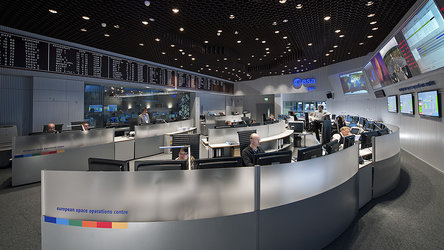
    The Mars Express team will monitor the event from the Dedicated Control Room at ESOC.


    Effective reuse of on-board lander communications system

    Mission controllers will use the MELACOM (Mars Express Lander Communications) system to point towards Phoenix during EDL; the radio instrument was originally intended for communications with the Beagle 2 lander.

    Mars Express in orbit around Mars

    Mars Express will perform a high-speed slew as MELACOM tracks Phoenix, rotating about one axis at a speed some two to three times faster than normal; this action has already been tested and confirmed. The orbit phasing of Mars Express was already adjusted at the end of 2007 to provide visibility to Phoenix.

    Data recording is scheduled to begin at 23:21 UTC, and run for 26 minutes, until 23:47 UTC.

    "Our MELACOM data will enable NASA to confirm the Phoenix lander's descent characteristics, including speed and acceleration through the Mars atmosphere," says Peter Schmitz, Deputy Spacecraft Operations Manager and project lead for Mars Express Phoenix support activities.

    Mars Express Deputy Spacecraft Operations Manager Peter Schmitz

    MELACOM data will be downloaded to Earth via NASA's Deep Space terminals DSS-15 and DSS-25. After a 15-minute, 20-second light-speed travel time, ESOC will receive the data transmitted from Mars Express, i.e. at 00:40 UTC ( 02:40 CEST). Recorded data will subsequently be downloaded two more times to ensure no loss of packets.

    The ESA spacecraft will also fly over Phoenix's intended landing zone, beginning at 06:12 UTC (08:12 CEST) on 26 May and will again monitor signals transmitted up from the surface.

    In the following week, Mars Express will monitor Phoenix using MELACOM 14 more times; at least one of these will be used to demonstrate and confirm that the ESA spacecraft can be used as a data relay station for NASA, receiving data from the surface and transmitting test commands to the lander.

    Mars Express Flight Director Paolo Ferri

    This capability has already been trialed between Mars Express and NASA's Mars Exploration Rovers (MER), now operating on the surface.

    In the days leading up to the Phoenix landing, NASA and ESA ground stations also cooperated to perform highly sophisticated 'delta-DOR' (delta - Differential One-way Range) interferometry measurements. This enabled a precise determination of whether Phoenix was on track to meet the planned entry point.

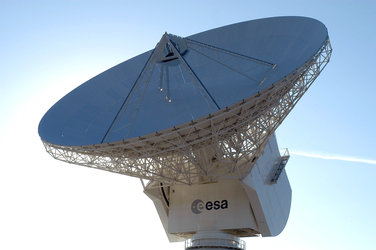
    This is the first time that ESA has been requested to operationally support NASA with the delta-DOR equipment installed at the Agency's two deep-space tracking stations, in Cebreros, Spain, and New Norcia, Australia.
    Rate this

    Views

    Share

    • Currently 0 out of 5 Stars.
    • 1
    • 2
    • 3
    • 4
    • 5
    Rating: 0/5 (0 votes cast)

    Thank you for rating!

    You have already rated this page, you can only rate it once!

    Your rating has been changed, thanks for rating!

    50
    Tweet
    • Operations
    • Looking at Mars
    • More information
    • Mars Express operations
    • Mars Express Science Operations Centre
      • Delta DOR
      • Related articles
        • Mars Express one of three orbiters preparing for Phoenix landing
          • ESA support to NASA Phoenix highlights beneficial Mars cooperation
            • Interplanetary networking: ESA’s Mars Express will keep an eye on NASA’s Phoenix
              • ESA and NASA extend ties with major new cross-support agreement
                • Relays from Mars demonstrate international interplanetary networking
                • Related
                • NASA's Phoenix mission
                • NASA Jet Propulsion Laboratory
                • Click to watch
                  Click to watch
                  ESOC videos

    Connect with us

    • RSS
    • Youtube
    • Twitter
    • Flickr
    • G+
    • Facebook
    • Livestream
    • Subscribe
    • App Store
    • ESA Operations Twitter

    Follow ESA operations

    • LATEST ARTICLES
    • · Rare merger reveals secrets of gal…
    • · Watching for hazards: ESA opens as…
    • · ESA astronaut Timothy Peake set fo…
    • · Space drives e-mobility
    • · Proba-V opens its eyes
    • FAQ

    • Jobs at ESA

    • Site Map

    • Contacts

    • Terms and conditions